


The Wild Card Companies Can't Control
 12-03-2009 | 09:18 AM
#1

Thread Starter
Gets Weekends Off
Joined: Jul 2007
Posts: 3,203
Likes: 0
From: Gear Monkey
 The Wild Card Companies Can't Control
Fuel is the wildcard companies can't control ---- even Fred!
Hopefully this prediction is correct.
Oil supplies rise, leaving a super spike in prices unlikely - Dec. 3, 2009
Why cheap oil is here to stay
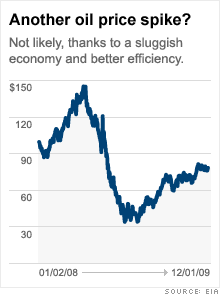
With oil supplies rising and the economy becoming ever more efficient, a super-spike in prices is looking increasingly unlikely.
By Steve Hargreaves, CNNMoney.com staff writer
December 3, 2009: 4:32 AM ET
NEW YORK (CNNMoney.com) -- Because oil prices have always been directly related to the strength of the economy, a recovery might have seen headlines like these:
• The recession ends: Get ready for $100 oil
• The economy roars: $140 oil, is there an end in sight?
• Everyone in China buys a Cadillac: World tapped out
But a growing number of experts are saying that you can forget all that. For the next couple of years, they say, oil prices will remain well below $100 a barrel as the economy remains fragile and efficiency measures kick in.
"The world will never run out of oil," Deutsche Bank analysts wrote in a recent research note, echoing the old logic that the Stone Age didn't end because the world ran out of stone.
"If the oil age does end, it likely will be because we become more efficient and simply use less petroleum."
It's this "becoming more efficient" idea that the Deutsche Bank analysts use to predict even lower oil prices in 2010 than now - an average of $65 a barrel next year compared to nearly $80 currently.
To get there, they employ a metric known as energy intensity, which basically measures the amount of oil used in relation to the size of the economy.
(Keep an eye on this term in the next couple of weeks - countries at the upcoming Copenhagen summit on climate change will use it to try to wiggle out of making any hard commitments on cutting greenhouse gases.)
The energy intensity of the U.S. economy has actually dropped by about 2% a year every year since the early 1980s.
In the next couple of years Deutsche Bank expects it to decline by around 3% as people buy more fuel efficient cars and respond in other ways to the high prices of 2004-2008 and as government conservation measures kick in.
With economic growth expected to remain at a sluggish 2.5% or so over the next couple of years, that translates into an actual drop in U.S. oil consumption.
"US oil demand may have already peaked," the note said.
The bank's numbers aren't far off from what the government is saying either.
U.S. oil consumption, which peaked at almost 21 million barrels a day in 2005, is now under 19 million barrels a day, according to the Energy Information Administration.
"The last time we had a decline in consumption of this magnitude was 1979-82," said Tancred Lidderdale, an oil analyst at EIA.
U.S. oil demand isn't expected to near 21 million barrels a day again until 2029.
But what about Chinese demand?
Speculators?
Geopolitical tensions?
Or any one of the myriad reasons cited for rising oil prices?
Chinese economic growth at this quick rate is not sustainable, said Addison Armstrong, director of market research at Tradition Energy, an energy brokerage in Stamford, Conn.
Besides, he says, the Chinese will likely reduce the energy intensity of their economy even faster than America.
And by the time hundreds of million of Chinese are buying cars, the fleet could very well be all-electric.
As for speculators, Armstrong said credit tightening is making it harder for them to make the big bets on energy that were seen before the crisis.
And geopolitical flare-ups in oil-rich nations are much less apt to affect prices now that the world has the ability to produce much more oil than it is using.
Indeed, this lack of spare capacity was an underlying reason oil prices got so high in 2008.
That year, spare capacity hit a low of 1 million barrels a day, a mere tanker load away from demand exceeding supply.
Now that number is almost 4 million barrels a day, and expected to grow to 4.5 million barrels a day by the middle of next year.
"There's so much spare capacity right now," said Armstrong, noting that oil prices in the $70 range are still high enough to insure new supplies are being brought online.
"It's very difficult to see prices much higher."
Hopefully this prediction is correct.
Oil supplies rise, leaving a super spike in prices unlikely - Dec. 3, 2009
Why cheap oil is here to stay
With oil supplies rising and the economy becoming ever more efficient, a super-spike in prices is looking increasingly unlikely.
By Steve Hargreaves, CNNMoney.com staff writer
December 3, 2009: 4:32 AM ET
NEW YORK (CNNMoney.com) -- Because oil prices have always been directly related to the strength of the economy, a recovery might have seen headlines like these:
• The recession ends: Get ready for $100 oil
• The economy roars: $140 oil, is there an end in sight?
• Everyone in China buys a Cadillac: World tapped out
But a growing number of experts are saying that you can forget all that. For the next couple of years, they say, oil prices will remain well below $100 a barrel as the economy remains fragile and efficiency measures kick in.
"The world will never run out of oil," Deutsche Bank analysts wrote in a recent research note, echoing the old logic that the Stone Age didn't end because the world ran out of stone.
"If the oil age does end, it likely will be because we become more efficient and simply use less petroleum."
It's this "becoming more efficient" idea that the Deutsche Bank analysts use to predict even lower oil prices in 2010 than now - an average of $65 a barrel next year compared to nearly $80 currently.
To get there, they employ a metric known as energy intensity, which basically measures the amount of oil used in relation to the size of the economy.
(Keep an eye on this term in the next couple of weeks - countries at the upcoming Copenhagen summit on climate change will use it to try to wiggle out of making any hard commitments on cutting greenhouse gases.)
The energy intensity of the U.S. economy has actually dropped by about 2% a year every year since the early 1980s.
In the next couple of years Deutsche Bank expects it to decline by around 3% as people buy more fuel efficient cars and respond in other ways to the high prices of 2004-2008 and as government conservation measures kick in.
With economic growth expected to remain at a sluggish 2.5% or so over the next couple of years, that translates into an actual drop in U.S. oil consumption.
"US oil demand may have already peaked," the note said.
The bank's numbers aren't far off from what the government is saying either.
U.S. oil consumption, which peaked at almost 21 million barrels a day in 2005, is now under 19 million barrels a day, according to the Energy Information Administration.
"The last time we had a decline in consumption of this magnitude was 1979-82," said Tancred Lidderdale, an oil analyst at EIA.
U.S. oil demand isn't expected to near 21 million barrels a day again until 2029.
But what about Chinese demand?
Speculators?
Geopolitical tensions?
Or any one of the myriad reasons cited for rising oil prices?
Chinese economic growth at this quick rate is not sustainable, said Addison Armstrong, director of market research at Tradition Energy, an energy brokerage in Stamford, Conn.
Besides, he says, the Chinese will likely reduce the energy intensity of their economy even faster than America.
And by the time hundreds of million of Chinese are buying cars, the fleet could very well be all-electric.
As for speculators, Armstrong said credit tightening is making it harder for them to make the big bets on energy that were seen before the crisis.
And geopolitical flare-ups in oil-rich nations are much less apt to affect prices now that the world has the ability to produce much more oil than it is using.
Indeed, this lack of spare capacity was an underlying reason oil prices got so high in 2008.
That year, spare capacity hit a low of 1 million barrels a day, a mere tanker load away from demand exceeding supply.
Now that number is almost 4 million barrels a day, and expected to grow to 4.5 million barrels a day by the middle of next year.
"There's so much spare capacity right now," said Armstrong, noting that oil prices in the $70 range are still high enough to insure new supplies are being brought online.
"It's very difficult to see prices much higher."
12-03-2009 | 12:34 PM
#2
Are we there yet??!!
Joined: Apr 2006
Posts: 2,010
Likes: 0
Not once in that article did it mention the price controls and supply controls put in by OPEC. OPEC has a direct effect on the price of oil because they control the available supply and over the past couple of yrs they have reduced the amount of oil flowing to increase the price. We saw the same thing in the 70s.
(and yes, the buying power of the dollar does have an effect on the current price)
(and yes, the buying power of the dollar does have an effect on the current price)
12-03-2009 | 12:37 PM
#3

Gets Weekends Off
Joined: Mar 2007
Posts: 3,215
Likes: 0
From: Capt
Hi!
Hopefully this scenario works out, and we wean ourselves off of oil with no major distruptions. That is what I am hoping for.
I am worried most about increasing demand. The article kept mentioning China, but left India out completely, India is rapidly catching up on China, in every way, and, in the future, will be bigger (economy and population-wise) than China.
The bad thing will be if people, worldwide, see this low price of oil as a sign to go back to using oil as they have in the past, and abandoning the permanent solution of renewable energy.
cliff
NBO
Hopefully this scenario works out, and we wean ourselves off of oil with no major distruptions. That is what I am hoping for.
I am worried most about increasing demand. The article kept mentioning China, but left India out completely, India is rapidly catching up on China, in every way, and, in the future, will be bigger (economy and population-wise) than China.
The bad thing will be if people, worldwide, see this low price of oil as a sign to go back to using oil as they have in the past, and abandoning the permanent solution of renewable energy.
cliff
NBO
12-03-2009 | 10:59 PM
#5
Gets Weekends Off
Joined: Sep 2006
Posts: 142
Likes: 0
From: 727 F/O
This is how the oil cartel members can make prices go up:
I have been flying over UAE several times a week now. There are literally hundreds of ships sitting at anchor. Not one ship is at the dock. It has been this way for a couple of months now. It would appear from the untrained eye that they are trying to reduce the supply to possibly result in an increased price.
Now Dubai World cannot pay its bills.....
Again, just an observation. Discuss.
I have been flying over UAE several times a week now. There are literally hundreds of ships sitting at anchor. Not one ship is at the dock. It has been this way for a couple of months now. It would appear from the untrained eye that they are trying to reduce the supply to possibly result in an increased price.
Now Dubai World cannot pay its bills.....
Again, just an observation. Discuss.
12-03-2009 | 11:11 PM
#6

"blue collar thug"!
Joined: Nov 2006
Posts: 1,614
Likes: 0
From: A proponent of...
The article doesnt take into account the change in the value of the $ on a worldwide basis, or the fact that some want/are using Euros to buy oil and want that currency to become the new standard.
12-04-2009 | 12:05 AM
#7
Line Holder
Joined: Sep 2006
Posts: 1,209
Likes: 12
From: MD11 FO
This is how the oil cartel members can make prices go up:
I have been flying over UAE several times a week now. There are literally hundreds of ships sitting at anchor. Not one ship is at the dock. It has been this way for a couple of months now. It would appear from the untrained eye that they are trying to reduce the supply to possibly result in an increased price.
Now Dubai World cannot pay its bills.....
Again, just an observation. Discuss.
I have been flying over UAE several times a week now. There are literally hundreds of ships sitting at anchor. Not one ship is at the dock. It has been this way for a couple of months now. It would appear from the untrained eye that they are trying to reduce the supply to possibly result in an increased price.
Now Dubai World cannot pay its bills.....
Again, just an observation. Discuss.
2. Controlling oil is much harder than just OPEC saying it - Saudi Arabia has been trying this for years but if you've got other non-OPEC countries unwilling then it's not very effective - everyone is greedy.
I generally would trust an analyst's opinion on oil over that of a pilot - including my own.
12-04-2009 | 01:25 AM
#8
Gets Weekends Off
Joined: Sep 2006
Posts: 142
Likes: 0
From: 727 F/O
1. Dubai has no oil - Abu Dhabi does.
2. Controlling oil is much harder than just OPEC saying it - Saudi Arabia has been trying this for years but if you've got other non-OPEC countries unwilling then it's not very effective - everyone is greedy.
I generally would trust an analyst's opinion on oil over that of a pilot - including my own.
2. Controlling oil is much harder than just OPEC saying it - Saudi Arabia has been trying this for years but if you've got other non-OPEC countries unwilling then it's not very effective - everyone is greedy.
I generally would trust an analyst's opinion on oil over that of a pilot - including my own.
"The United Arab Emirates has the world's sixth largest oil reserves[9] and possesses one of the most developed economies in the Middle East."
12-04-2009 | 05:15 AM
#9

Line Holder
Joined: Apr 2007
Posts: 52
Likes: 0
From: 75/76 FO
This is how the oil cartel members can make prices go up:
I have been flying over UAE several times a week now. There are literally hundreds of ships sitting at anchor. Not one ship is at the dock. It has been this way for a couple of months now. It would appear from the untrained eye that they are trying to reduce the supply to possibly result in an increased price.
Now Dubai World cannot pay its bills.....
Again, just an observation. Discuss.
I have been flying over UAE several times a week now. There are literally hundreds of ships sitting at anchor. Not one ship is at the dock. It has been this way for a couple of months now. It would appear from the untrained eye that they are trying to reduce the supply to possibly result in an increased price.
Now Dubai World cannot pay its bills.....
Again, just an observation. Discuss.

Thread
Thread Starter
Forum
Replies
Last Post


