Early-Out Program to Mitigate Displacements - #1
On February 14, a record Profit Sharing payout made possible by record-setting corporate revenue was celebrated with fanfare by Delta management. Costs were not a problem for Delta on that day. At the same time, a virus, a thousandth of the width of a human hair, was silently spreading across America, ultimately becoming a pandemic and triggering an economic downturn. Presently, Delta's challenge is the instant evaporation of revenue, which is forecasted to be down 90% for this quarter and has spurred management to store over half of its jets. In early March, your MEC engaged with the Company and provided cost-saving solutions contained in LOA 20-01 via the April bid package re-do and SILs. Shortly after agreeing to LOA 20-01, your Negotiating Committee approached Delta to discuss an additional cost-savings measure – a voluntary pilot early-out program. The Company declined even to meet and hear the proposal. This program would have provided limited pay and benefits to pilots if they took a voluntary buyout package and retired early. By offering pilot early-outs in categories that the Company intends to reduce the size of, downline displacements are curtailed, providing substantial savings – savings impactful enough that United and American offered similar programs to their pilots months ago.
Early-Outs: They Save Real Money
Before discussing potential voluntary pilot early-outs, displacements and furloughs need to be addressed. These options hinge upon the fleet plan Delta is formulating for summer 2021, and the network plan that will reflect the needs of the fleet plan. All pandemics have a lifecycle. This one, and the recession that has come in its wake, will end. Notwithstanding, both are currently making planning a difficult task for the Company.
At its core, Delta has publicly indicated that it will be a smaller airline than it was earlier this year and that it will seek flexibility to scale up in the eventual recovery. With a fleet plan in hand, Crew Resources can derive the manning requirements needed to staff the trimmed down airline in the short and medium time frame. Through ALPA's analysis, we have concluded that there are three primary methods to most efficiently reduce the staffing required for the smaller airline.
- Voluntary Early-outs
- Displacements
- Furloughs, if necessary
If management decides to negotiate a viable early-out for pilots, these can be surgically used to reduce manning and curtail expensive waterfall training. Typically, displacements before early-outs negate much, if not all, of the cost savings advantage. On the upside, Delta is facing a historical wave of retirements. Below are the upcoming age-65 retirements.
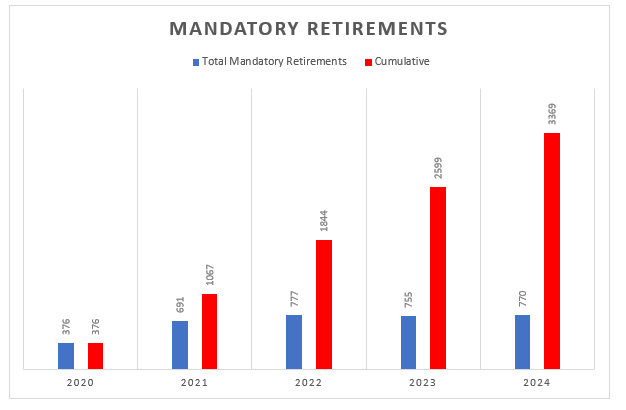 Looking ahead, from May 1 to the end of 2024, 3,369 pilots will reach age 65. That represents nearly 23% of today's seniority list. The retirement numbers will most likely be higher as pilots decide to retire early or leave with a medical issue. When distilling fleet specific retirements just to the end of 2022, over half of the B777 and nearly half of the A350 captains will retire. This is not an insignificant number of pilots that can be incentivized to retire early that would otherwise be subject to displacement and the source of waterfall training events.
Displacements High Price Tag: The Financial and Personnel Costs The cost of initial qualification, not including a pilot's salary, is $40-50,000 per pilot. This number varies by the length of training, whether it is off-site, and who is instructing. Further adding to the costs are:
Looking ahead, from May 1 to the end of 2024, 3,369 pilots will reach age 65. That represents nearly 23% of today's seniority list. The retirement numbers will most likely be higher as pilots decide to retire early or leave with a medical issue. When distilling fleet specific retirements just to the end of 2022, over half of the B777 and nearly half of the A350 captains will retire. This is not an insignificant number of pilots that can be incentivized to retire early that would otherwise be subject to displacement and the source of waterfall training events.
Displacements High Price Tag: The Financial and Personnel Costs The cost of initial qualification, not including a pilot's salary, is $40-50,000 per pilot. This number varies by the length of training, whether it is off-site, and who is instructing. Further adding to the costs are:
- There is no seat lock for displaced pilots; they can bid in the first available AE, thus negating some of the previous displacements.
- Mandatory displacements carry moving expenses to include lease cancellations, packing, motor vehicle transportation and insurance costs if pilots elect to relocate to a Delta base.
- Displacements from senior categories can cause a waterfall of training events.
As an example, we will look at the displacement of a junior A350 Captain:
- The A350 Captain displaces to the A330 A seat.
- An A330 Captain gets displaced to the B7ER A seat.
- A B7ER Captain gets displaced to the B73N A seat.
- A B73N Captain gets displaced to the A220 A seat.
- An A220 Captain gets displaced to the A330 B seat.
- An A330 F/O gets displaced to the B7ER B seat.
- A B7ER F/O gets displaced to the B73N B seat.
- A B73N F/O gets displaced to the A220 B seat.
This one displacement causes seven additional training events, making the cost of displacing the A350 Captain approximately $280-350,000 by conservative estimates – and that is without the potential associated moving expenses. A worst-case scenario, as described by management during an Investor Day presentation, a B777 Captain displacement can potentially trigger 17 training events, representing a staggering sum of up to $850,000 for just that one senior Captain.
Displacements, and the disruption that comes with them, can also bring high personal costs to pilots and their dependents. Budgets are reworked as income is reduced, and families suffer when pilots find themselves forced to commute across the country to new domiciles causing them to spend significant time away from their homes. Even if a pilot and his or her family can move, it still represents an erosion of quality of life to uproot and relocate.
What About Training Capacity?
Logistically, some severe constraints would make mass displacements difficult for Delta. Currently, maximum simulator capacity allows for the training of 288 pilots a month. Once a pilot has been retrained, the question of OE and TOE becomes an issue.
- First, Line Check Pilots (LCPs) are not immune to displacements, which will leave their ranks depleted. Replacing a displaced LCP takes time as it involves simulator training and line experience.
- Second, with reduced flying, the opportunities to get OE and TOE become scarce, which will lead to pilots sitting idle while getting paid. During the 9/11 displacements, it was not uncommon for pilots to sit unqualified for months waiting for training between displacements.
Moreover, If Delta decides to furlough pilots, another layer of complexity is introduced. Pilots cannot be cut without consideration given to the fleet and bases they hold. Letting a disproportionately large number of pilots go at once is likely unrealistic as it can leave whole categories excessively drained and uncovered. When considering that the B717 and A220 B are the two most junior seats and that there are only five simulators in-house to meet those fleets training demand, Delta can only furlough as fast as it can train pilots. As a result, before these First Officers can be furloughed, their replacement needs to be trained to fill the soon-to-be-vacated position. To summarize, Delta is shackled by numerous constraints that are amplified by going from hiring and training at max capacity to reversing course with displacements. Those constraints will limit the Company's throughput for years.
Closing
ALPA has identified an undeniably elegant way management could selectively target top-of-the-category and seniority list reductions that vastly eliminate cascading displacements. Curtailing displacements lessens unneeded disruption to pilots and their families' lives and will help moderate any future furloughs and the high costs they entail.
F
or the early-outs to be fully effective, and to capture the most considerable savings, they should be implemented before displacements. The window for seizing this dynamic logistical and cost saving opportunity is fleeting. Swift action by management will ensure that the Company can avail itself of the savings and the flexibility that our direct competitors - United, JetBlue and American Airlines – have already secured.
The next piece in this series will examine the different early-out programs at JetBlue and American.