Originally Posted by
jerryleber
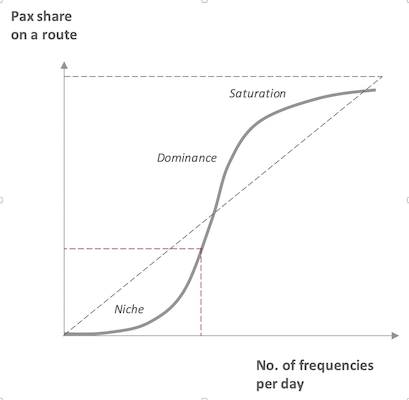
The S-curve effect is a phenomenon in airline competition that describes how a dominant airline can attract more passengers than expected with additional frequency. This is because service-oriented passengers, like business travelers, tend to favor airlines with a more frequent flight schedule.
The S-curve effect can be measured by using frequency share on the x-axis, which is the driver of preference for time-sensitive travelers. The effect can be seen at both the airport and route level.
Airlines can use the S-curve effect to their advantage by building dominant positions at airports and on routes. For example, Delta has a strong S-curve position in Atlanta, Detroit, Minneapolis, New York, and Seattle. In these markets, Delta has a far larger scope and depth of service than its competitors, which means that business travelers tend to choose Delta almost exclusively.
I’ve never seen this, that is extremely interesting. Maybe I should have gotten that degree in aviation management…