WHAT!?!?!? Absolutely 100 percent wrong sir. Cl max is the limiting factor for a wings ability to create lift. Meaning above Cl max the wing is stalled, Cl max has absolutely no bearing on the lift a wing is creating at any given point in time. Cl max only means the limit at which the wing can produce lift before being stalled, in most lift formula it is found by (2 pi AOA) just to keep things simple.
Also, increase in Cl is unquestionably an increase in total lift. Lift = velocity squared * wing area * air density * coefficient of lift. How can Cl go up, a value in the lift formula increase, but lift not increase?
An aircraft does not feel, no more than you are effected by the wind outside the bus on the ride to work. (not saying you take a bus)
If Cl goes up, lift goes up period. period.
This is a rather interesting discussion.. and I'd like to keep it going and perhaps a little deeper...
We should go back to square 1....
Let's do something unorthodox.. throw your lift equation out, here's why:
In order to get more lift, conventional thinking would need:
1. More velocity
2. More wing area
3. More "lift coefficient"
4. Higher air density
*Wing area: This is tricky, it doesn't explain different effects of shape as two equal (area) wings with different aspect ratios will produce different amounts of lift.
*The coefficient of lift is merely a measure of how much the estimated lift the wing will develop vs. the experimentally tested lift as measured. A measure of this doesn't make too much sense when dealing with hard facts, as it is a prediction based on prior performance - dimensionless.
*Angle of attack is not included in this forumla (only figured into CL) but again a bit a circular reasoning.
The velocity and density do have to do with the production of lift. The other figures are almost meaningless. The formula could just as easily be Lift = MC squared as long as the coefficient of lift were to equal 1/C squared x a corrective figure to make the tested performance of the airfoil agree with the formula. Aero Engineering is full of these handy Coefficients.! (Coefficient of drag, etc.)
There are several examples the lift equation fails to provide answers for:
A) Inverted flight.
The answer: Accelerating the air downward will sustain flight whether the airplane wing is upside down or rightside up
B) Propeller thrust. Aero says the camber of the prop blades produces forward thrust a la Bernoulli.
The answer: The rearward component (vector) of the thrust produced by the propeller (a rotating wing air accelerating device) provides increasing thrust as the angle of attack is increased. No lift is produced by camber of any air accelerating device.
C) The helicopter
Conventional wisdom says the camber of the blades produces lift as any wing produces lift.
The answer: The camber built into the helicopter rotor blades provides much drag but no lift! In fact until the angle of attack is increased the rotating blades produce only down loads!
- Also you have to take Bernoulli's principle with a grain of salt because not all fluids act equal under specifc laws:
1) Bernoulli's Principle is not a law for it has never been proven to be so.
2) Fluid Dynamics is the study of directed or conducted fluids; water through pipes, electrical through insulated conduits, air through conducting tubes etc. There are laws that do not act equally on each type of fluid. So it's hard to put a universal label on what will/does work.
3) Considering objects such as airfoils being tested in wind tunnels as the same as testing the airfoils when moving through the undisturbed atmosphere. There is no local force generator in the atmosphere to initiate airflow. There is no airflow; there is no reduction in pressure above or below the airfoil (from airflow) to produce pressure differentials to produce lift. There is no streamline, linear momentum, directed or ordered motion in the undisturbed atmosphere. Since the air molecules are not flowing, there is no velocity to determine so to figure out how much the pressure is lowered due to the velocity of the air.
4) Considering water and air being fluids are both incompressible and inviscid, which is obviously not true! Water is definitely incompressible, while air is almost infinitely compressible at the pressures aeronautics is usually dealing with, and both water and air have viscosity, which increases / decreases with changes in pressures and temperature.
Some physics that don't agree with the conventional approach to how lift is created:
1. It takes the same force to move the air molecules up out of their normal straight line path as it requires to move them back down to their normal straight line path, therefore the motion of the air up and over the upper camber of the airfoil does not produce any lift.
2. In the wind tunnel, when increasing the angle of attack of an airfoil, applying the Bernoulli Principle, we find the greater the angle of attack the higher the pressure developed over the upper surface, and the lower the pressure developed along the lower surface causing negative lift to be produced.
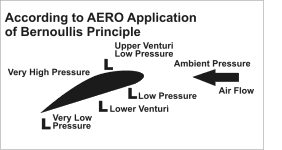
When the airstream and airfoil are considered a venturi, the upper and lower sides both can be considered venturis with the undisturbed air layers above and below the airfoil being the top and bottom of the venturis. As the venturi widens along the top the velocity would lessen and pressure increase: and along the bottom as the venturi constricts, the velocity would increase and the pressure reduce, causing the airplane wing to produce negative lift.
3. Moving the airfoil through undisturbed air, as in flight, is not the same as moving the air past the airfoil  in a wind tunnel. Bernoulli stated that an increase in the velocity of a fluid produces a decrease in pressure (as in a venturi). When the airfoil moves through undisturbed, motionless air, there is no increase in the velocity of the airstream. The air molecules are simply moved out of their place and then return after the passing of the airfoil. This up and down movement produces no lift. Our manometer, however, indicates a reduction of pressure as the velocity of the airfoil causes air molecules to move rapidly across the pressure tap.
I know, you're thinking what does this have to do with the price of tea in China? Well we need to get the right lift equation in:
F=(M*A)