


Vyse?
 08-05-2009 | 07:59 PM
#11
Gets Weekends Off
Joined: Jan 2009
Posts: 350
Likes: 0
From: PA-31/left, LJ31/right

There is likely no published best glide speed, at least there generally isn't for light twin aircraft. Vyse = Best Rate of Climb Single Engine. It would have the same relationship as best glide in that it will get you the furthest distance on one engine, but it is not aerodynamically related to best glide.
Best glide is the aircrafts minimum drag speed, also found where the tangent line meets the power required curve.
Source 1:

You can see the minimum drag, pointed out here as Vbg
or
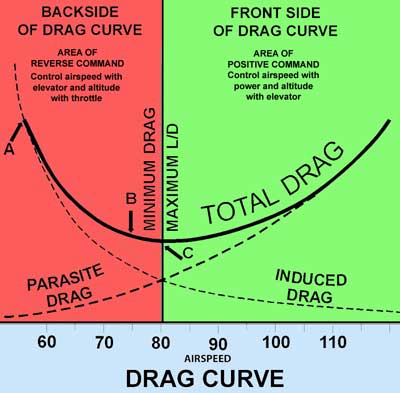
pointed out as min drag or L/D max which all are the same thing, best glide.
Source 2:
 Pink line shows the tangent line.
Vyse is the speed where there is the greatest gap between power available and power required on in an OEI PaPr curve. Basically, the speed where you have the most excess power when one engine is INOP.
I looked for a Pa Pr curve OEI to show you, but was unable to locate one, sorry.
Best glide is the aircrafts minimum drag speed, also found where the tangent line meets the power required curve.
Source 1:
You can see the minimum drag, pointed out here as Vbg
or
pointed out as min drag or L/D max which all are the same thing, best glide.
Source 2:
Pink line shows the tangent line.Vyse is the speed where there is the greatest gap between power available and power required on in an OEI PaPr curve. Basically, the speed where you have the most excess power when one engine is INOP.
I looked for a Pa Pr curve OEI to show you, but was unable to locate one, sorry.
So did you get an MEI recently?
Last edited by HSLD; 08-05-2009 at 08:13 PM.
08-06-2009 | 06:43 AM
#12
Gets Weekends Off
Joined: Jun 2009
Posts: 317
Likes: 0
Didn't realize an MEI was necessary to understand the aerodynamics behind best glide (minimum drag) or best rate of climb (greatest excess power available). If there is something wrong with what I said, feel free to point it out, I am here to learn and teach like anyone else. If there is nothing wrong with the post or if you don't know, then keep your mouth shut or be polite and say thank you.
Chasing someone around and trying to discredit them on various forums because you have a grudge is childish. It is a shame that you would rather spend your time mocking/discrediting me than digging your nose into the books and learning some basic dynamics, like what the lift formula is and how it works.
PS, Mshunger, What ever you do, don't try and claim someone else (Rick Stowell) disagrees with what is said, especially when his book agrees with the topic at hand. Things like that really make you look...
Chasing someone around and trying to discredit them on various forums because you have a grudge is childish. It is a shame that you would rather spend your time mocking/discrediting me than digging your nose into the books and learning some basic dynamics, like what the lift formula is and how it works.
PS, Mshunger, What ever you do, don't try and claim someone else (Rick Stowell) disagrees with what is said, especially when his book agrees with the topic at hand. Things like that really make you look...
08-06-2009 | 07:21 AM
#13

Gets Weekends Off
Joined: Jan 2008
Posts: 383
Likes: 0
From: EMB-170 FO
Check the POH on your specific Baron, but according to BEECH BARON BE55B CHECKLIST - Download Technical, Vyse on the Baron is 101 kts and short field approach speed is 90 knots.
I teach in a Seneca I; Vyse is 105 MPH and short field approach speed on final is 90 MPH with full flaps, max braking and flaps up on touchdown. I instructed in Aztecs a while ago but in all light twins that I've flown, the short field approach speed has been about 10 knots (or 10-15 MPH) slower than Vyse.
Brush up on Chapter 12 on the Airplane Flying Handbook: Transition to Multi-engine Airplanes - http://www.faa.gov/library/manuals/a...83-3a-5of7.pdf (Caution: huge file)
I teach in a Seneca I; Vyse is 105 MPH and short field approach speed on final is 90 MPH with full flaps, max braking and flaps up on touchdown. I instructed in Aztecs a while ago but in all light twins that I've flown, the short field approach speed has been about 10 knots (or 10-15 MPH) slower than Vyse.
Brush up on Chapter 12 on the Airplane Flying Handbook: Transition to Multi-engine Airplanes - http://www.faa.gov/library/manuals/a...83-3a-5of7.pdf (Caution: huge file)
08-06-2009 | 10:42 AM
#14
Gets Weekends Off
Joined: Jan 2009
Posts: 350
Likes: 0
From: PA-31/left, LJ31/right
Didn't realize an MEI was necessary to understand the aerodynamics behind best glide (minimum drag) or best rate of climb (greatest excess power available). If there is something wrong with what I said, feel free to point it out, I am here to learn and teach like anyone else. If there is nothing wrong with the post or if you don't know, then keep your mouth shut or be polite and say thank you.
Chasing someone around and trying to discredit them on various forums because you have a grudge is childish. It is a shame that you would rather spend your time mocking/discrediting me than digging your nose into the books and learning some basic dynamics, like what the lift formula is and how it works.
PS, Mshunger, What ever you do, don't try and claim someone else (Rick Stowell) disagrees with what is said, especially when his book agrees with the topic at hand. Things like that really make you look...
Chasing someone around and trying to discredit them on various forums because you have a grudge is childish. It is a shame that you would rather spend your time mocking/discrediting me than digging your nose into the books and learning some basic dynamics, like what the lift formula is and how it works.
PS, Mshunger, What ever you do, don't try and claim someone else (Rick Stowell) disagrees with what is said, especially when his book agrees with the topic at hand. Things like that really make you look...
woah, woah, woah....... I was simply asking if you had gotten your MEI recently. No need to get all nasty. And the Stowell thing on your hand, is kinda....
I gave you the link, and I work with the guy. But no need to bring up other threads. It ws an innocent question. Last I remember, you were working at some college IIRC, and I thought most places like that help you to get all your instructor certs. It was an honest, legit question.Edit: There is nothing wrong with what you said either. You should know my style by now, I would have pointed it out.
Last edited by mshunter; 08-06-2009 at 10:44 AM. Reason: forgot some stuff.
08-06-2009 | 10:47 AM
#15
Gets Weekends Off
Joined: Jun 2009
Posts: 317
Likes: 0
woah, woah, woah....... I was simply asking if you had gotten your MEI recently. No need to get all nasty. And the Stowell thing on your hand, is kinda.... I gave you the link, and I work with the guy. But no need to bring up other threads. It ws an innocent question. Last I remember, you were working at some college IIRC, and I thought most places like that help you to get all your instructor certs. It was an honest, legit question.
Edit: There is nothing wrong with what you said either. You should know my style by now, I would have pointed it out.
I gave you the link, and I work with the guy. But no need to bring up other threads. It ws an innocent question. Last I remember, you were working at some college IIRC, and I thought most places like that help you to get all your instructor certs. It was an honest, legit question.Edit: There is nothing wrong with what you said either. You should know my style by now, I would have pointed it out.
08-06-2009 | 02:49 PM
#16
Line Holder
Joined: Jul 2008
Posts: 810
Likes: 0
From: 747 Captain (Ret,)
There are a couple of errors on some of the previous posts. L/D max is not the same as minimum drag. Minimum drag (max endurance, holding speed, (or, in glider terms, min sink)) is at the low point on the total drag curve. L/D max (best glide distance) is at the tangent of the line from the origin touching the total drag curve.
Some aircraft with really powerful wing mounted engines and relatively small tails (think P-38) have a very high Vmc, and Vyse has to be raised above what the calculation would normally show to account for that.
Joe
Some aircraft with really powerful wing mounted engines and relatively small tails (think P-38) have a very high Vmc, and Vyse has to be raised above what the calculation would normally show to account for that.
Joe
 08-06-2009 | 04:12 PM
#18

Gets Weekends Off
Joined: Jun 2008
Posts: 1,398
Likes: 0
From: USAF
There are a couple of errors on some of the previous posts. L/D max is not the same as minimum drag. Minimum drag (max endurance, holding speed, (or, in glider terms, min sink)) is at the low point on the total drag curve. L/D max (best glide distance) is at the tangent of the line from the origin touching the total drag curve.
Some aircraft with really powerful wing mounted engines and relatively small tails (think P-38) have a very high Vmc, and Vyse has to be raised above what the calculation would normally show to account for that.
Joe
Some aircraft with really powerful wing mounted engines and relatively small tails (think P-38) have a very high Vmc, and Vyse has to be raised above what the calculation would normally show to account for that.
Joe
08-06-2009 | 07:05 PM
#19
Gets Weekends Off
Joined: Jun 2009
Posts: 317
Likes: 0
There are a couple of errors on some of the previous posts. L/D max is not the same as minimum drag. Minimum drag (max endurance, holding speed, (or, in glider terms, min sink)) is at the low point on the total drag curve. L/D max (best glide distance) is at the tangent of the line from the origin touching the total drag curve.
*Best Glide/Minimum Drag/L/D Max/Maximum Range*
Looking back at Eq. (9.4), we can see that, because drag D = -W sin y, minimum drag Dmin occurs at precisely the condition for best glide.
*Minimum Power Required/Minimum Sink/Maximum Endurance
As we will see shortly, maximum endurance (time aloft) occurs when the minimum power is used to maintain steady level flight. Maximum range (distance traveled) is obtained when the aircraft is flown at the most aerodynamically efficient condition (maximum Cl/Cd).
Source: 13.2 Power Required
It is usually assumed that the trim lift coefficient CLmp gives the minimum sink-speed for any airplane in power-off glide.
Source: http://pdf.aiaa.org/jaPreview/JA/1994/PVJAPRE46639.pdf
*Conclusion*
Best glide speed = minimum drag, maximum L/D, maximum range, and is the tangent line on the power required curve.
Minimum sink speed = minimum power required on the power required curve and maximum endurance.
That is interesting to know, thanks.


