


Wing Dihedral..
 12-06-2009 | 09:01 PM
#11

Gets Weekends Off
Joined: Jul 2008
Posts: 349
Likes: 0
From: BE50C (A), BE95 (A), C172S (B)

Or, if memory serves, the wings of the Tu-154 and most Dassault Falcon corporate jets. Some aircraft have anhedral wings, too. Graceful looking things. Otherwise the aircraft would be *too* stable.
12-07-2009 | 02:42 AM
#12
Gets Weekends Off
Joined: Jun 2009
Posts: 317
Likes: 0
 12-07-2009 | 12:27 PM
#13
Gets Weekends Off
Joined: May 2007
Posts: 848
Likes: 0
From: JS32 FO
I believe the Harrier has anhedral wings.
While some some horizontal stabilizers seemingly have anhedral, remembering that a horizontal stab is an upside down wing makes me think it functions more like dihedral (providing designed stability). Am I crazy?
While some some horizontal stabilizers seemingly have anhedral, remembering that a horizontal stab is an upside down wing makes me think it functions more like dihedral (providing designed stability). Am I crazy?
12-07-2009 | 01:58 PM
#14
Gets Weekends Off
Joined: Jul 2006
Posts: 593
Likes: 0
From: Left Seat, Toyota Tacoma
Some things I saw on the website that I linked to earlier...
- A swept wing has the same effect as a couple degrees of dihedral.
- A high mounted wing has the same effect as a couple degrees of dihedral.
- Thus, high wing airplanes (C-17, C-5, C-141), have a little anhedral to counter the effective dihedral.
- A swept wing has the same effect as a couple degrees of dihedral.
- A high mounted wing has the same effect as a couple degrees of dihedral.
- Thus, high wing airplanes (C-17, C-5, C-141), have a little anhedral to counter the effective dihedral.
12-07-2009 | 02:45 PM
#15
Gets Weekends Off
Joined: Aug 2009
Posts: 398
Likes: 1
As far as I know lateral stability is usually measured in units of effective dihedral. A high wing airplane with a wing at zero degrees (no dihedal) inherently has a few degrees of effective dihedral due to the keel effect. Swept wing airplanes also have a few degrees of effective dihedral.
So on high wing/swept wing planes (think harrier, C141/C17/C5 etc..) there is too much inherent stability, so the wings are swept down (anhedral) to retain some degree of maneuverability.
Hope that helps some
_____________________________
I guess I repeated everything said above^
Disregard!
So on high wing/swept wing planes (think harrier, C141/C17/C5 etc..) there is too much inherent stability, so the wings are swept down (anhedral) to retain some degree of maneuverability.
Hope that helps some
_____________________________
I guess I repeated everything said above^
Disregard!
12-07-2009 | 03:01 PM
#16
Gets Weekends Off
Joined: Jun 2009
Posts: 317
Likes: 0
As far as I know lateral stability is usually measured in units of effective dihedral. A high wing airplane with a wing at zero degrees (no dihedal) inherently has a few degrees of effective dihedral due to the keel effect. Swept wing airplanes also have a few degrees of effective dihedral.
12-08-2009 | 04:01 AM
#17

Line Holder
Joined: Jan 2009
Posts: 65
Likes: 0
From: My name is Roger Murdock, I'm the copilot!
As far as I know lateral stability is usually measured in units of effective dihedral. A high wing airplane with a wing at zero degrees (no dihedal) inherently has a few degrees of effective dihedral due to the keel effect. Swept wing airplanes also have a few degrees of effective dihedral.
So on high wing/swept wing planes (think harrier, C141/C17/C5 etc..) there is too much inherent stability, so the wings are swept down (anhedral) to retain some degree of maneuverability.
So on high wing/swept wing planes (think harrier, C141/C17/C5 etc..) there is too much inherent stability, so the wings are swept down (anhedral) to retain some degree of maneuverability.
Keel effect plays an important, albeit subordinate role to dihedral
12-28-2009 | 06:56 PM
#18
Gets Weekends Off
Joined: Apr 2007
Posts: 456
Likes: 0
To keep the plane level... less maneuverable but more stable... the opposite type is more maneuverable... this is good:
http://en.wikipedia.org/wiki/Dihedral_(aircraft)
http://en.wikipedia.org/wiki/Dihedral_(aircraft)
12-29-2009 | 03:40 AM
#19

Gets Weekends Off
Joined: Dec 2005
Posts: 1,413
Likes: 0
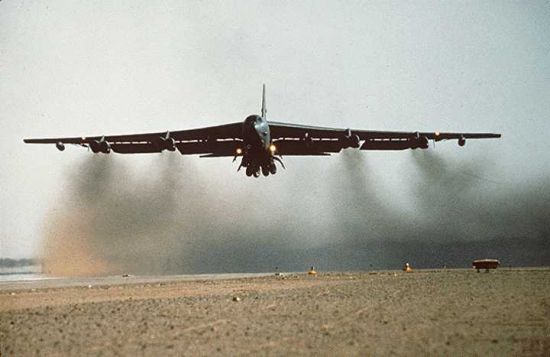
A B-52 inflight doesn't have the droop that it does on the ground. In addition, all planes that have high wing placement have stability by virtue of the verticle CG being below the wing.
12-29-2009 | 12:41 PM
#20
Gets Weekends Off
Joined: Jun 2009
Posts: 317
Likes: 0
And yes, all high wings do, that was previous mentioned. It equates to approximately 5 degrees of dihedral versus a low wing. That is why the low wing piper trainers have about 5 degrees more than their high wing cessna buddies.
See, still a decent amount of anhedral, even in flight:

Thread
Thread Starter
Forum
Replies
Last Post


