


Americans and Their Military
 06-02-2013 | 08:00 AM
#21
Gets Weekends Off
Joined: Jul 2007
Posts: 4,772
Likes: 1
From: 744 CA

people forget that the military... and defense contractors and OTHER companies that provide services to the military support hundreds of thousands ..nay...well north of a million well paying jobs in this country.
06-02-2013 | 08:32 AM
#22

Runs with scissors
Joined: Dec 2009
Posts: 7,847
Likes: 0
From: Going to hell in a bucket, but enjoying the ride .
Anyone (besides me) in the Military back in 1992, when there was a massive BRAC (Base Realignment and Closure) to help balance the budget? I was in the NH Air Guard up at Pease AFB, NH, when they pulled all the active duty KC135's and FB 111's out and closed the base. Within about 6 months, an entire shopping mall,many restraunts and 3 car dealerships just beyond the front gate all went out of business and the local housing prices tanked for then next 10 years.
The last manned fighter has already been built, so how many jobs will Drones provide? More, or less, than building manned fighters. Now multiply that job loss times all the other supply chains used to supply the US Military with men and equipment, and see what you get. Massive unemployment is what you get. So yeah, the transition is going to be painful. Many people lose sight of that.
Many of those jobs that will be lost, are in the high tech industry. Without Government Contracts requiring and paying for tech development, to keep us ahead of China's military, who's going to pay for it? We've already given China and India most of our low tech manufacturing jobs, I guess we can outsource our high tech and military jobs to them too...what could go wrong?
The last manned fighter has already been built, so how many jobs will Drones provide? More, or less, than building manned fighters. Now multiply that job loss times all the other supply chains used to supply the US Military with men and equipment, and see what you get. Massive unemployment is what you get. So yeah, the transition is going to be painful. Many people lose sight of that.
Many of those jobs that will be lost, are in the high tech industry. Without Government Contracts requiring and paying for tech development, to keep us ahead of China's military, who's going to pay for it? We've already given China and India most of our low tech manufacturing jobs, I guess we can outsource our high tech and military jobs to them too...what could go wrong?
06-02-2013 | 09:04 AM
#23

Prime Minister/Moderator

Joined: Jan 2006
Posts: 44,864
Likes: 663
From: Engines Turn or People Swim
Anyone (besides me) in the Military back in 1992, when there was a massive BRAC (Base Realignment and Closure) to help balance the budget? I was in the NH Air Guard up at Pease AFB, NH, when they pulled all the active duty KC135's and FB 111's out and closed the base. Within about 6 months, an entire shopping mall,many restraunts and 3 car dealerships just beyond the front gate all went out of business and the local housing prices tanked for then next 10 years.
The last manned fighter has already been built, so how many jobs will Drones provide? More, or less, than building manned fighters. Now multiply that job loss times all the other supply chains used to supply the US Military with men and equipment, and see what you get. Massive unemployment is what you get. So yeah, the transition is going to be painful. Many people lose sight of that.
Many of those jobs that will be lost, are in the high tech industry. Without Government Contracts requiring and paying for tech development, to keep us ahead of China's military, who's going to pay for it? We've already given China and India most of our low tech manufacturing jobs, I guess we can outsource our high tech and military jobs to them too...what could go wrong?
The last manned fighter has already been built, so how many jobs will Drones provide? More, or less, than building manned fighters. Now multiply that job loss times all the other supply chains used to supply the US Military with men and equipment, and see what you get. Massive unemployment is what you get. So yeah, the transition is going to be painful. Many people lose sight of that.
Many of those jobs that will be lost, are in the high tech industry. Without Government Contracts requiring and paying for tech development, to keep us ahead of China's military, who's going to pay for it? We've already given China and India most of our low tech manufacturing jobs, I guess we can outsource our high tech and military jobs to them too...what could go wrong?
All of that economic capacity, converted to civilian use, will contribute to an improved economy, higher per capita GDP, and better QOL. Bases, runways, warships, tanks, fighters, and guns are things you have to have when you need them, and they have a cost. But if you don't need them, they don't contribute to QOL...those resources applied to civil housing, infrastructure, education, healthcare, etc have a potential for significant QOL improvement.
There are some management issues...
-First and foremost, you can't get rid of military capability unless you truly no longer need it. This requires a national discourse because "need" is a subjective sliding scale: global cop, defense of select allies, homeland defense...where do we want/need to be? If you guess wrong, the result could be regional or even global instability with enormous economic consequences (and not the good kind). While I'm pointing out the benefits of transitioning defense economic capacity to civil focus, I'm not advocating that we do so lightly or carelessly.
-The transition, if not paced and controlled, will cause temporary pain. Us older guys saw that in the early 90's...but we also saw the subsequent economic boom a few years later.
-Defense spending emphasizes high-tech, R&D, and education. If you allow those to fall by the wayside during a transition to a civil economy, you will pay a big price...maybe bigger than the peace dividend you seek in the first place. But that can managed.
06-02-2013 | 09:32 AM
#24
Gets Weekends Off
Joined: Feb 2013
Posts: 195
Likes: 0
From: 737/FO
Well said...if we talk about spending its not an A or B discussion. It's a matter if how best to wean the DoD and Military Industry from the crack pipe. We need a common defense and it must be credible (robust and the will to use it). But DoD and Industry have to come down out of the clouds and get back to spending with in the annual budget. Supplemental appropriations have been padded a long time now and we need to continue the on going efforts to determine and fund requirements/needs. If we intend to continue to compete globally (beyond military industry) then investment in other sectors is require for economic sustainment.
06-02-2013 | 09:59 AM
#25

Line Holder
Joined: Oct 2006
Posts: 862
Likes: 1
From: Center seat, doing loops to music
BL, you don't torch the ground in order to keep people employed. That's effectively what an economy sustained by war capacity appropriations does in the long term. Our DOD spending, along with our social entitlements, are bogging down the economic labor value of our proletariat.
We agree the government is an integral part of directing economic efforts; some of the posters here are merely saying the MIC doesn't have to be the conduit. As a servicemember I happen to agree with that assertion. Crazy right?
 06-02-2013 | 10:32 AM
#26

Gets Weekends Off
Joined: Apr 2010
Posts: 236
Likes: 1
From: Pipers & RV-12
But fundamentally all that economic gain is a command performance, paid for by taxes. I think the local pain of a few mom-and-pops going out of business pales in comparison to the potential greater gain.
All of that economic capacity, converted to civilian use, will contribute to an improved economy, higher per capita GDP, and better QOL. Bases, runways, warships, tanks, fighters, and guns are things you have to have when you need them, and they have a cost. But if you don't need them, they don't contribute to QOL...those resources applied to civil housing, infrastructure, education, healthcare, etc have a potential for significant QOL improvement.
There are some management issues...
-First and foremost, you can't get rid of military capability unless you truly no longer need it. This requires a national discourse because "need" is a subjective sliding scale: global cop, defense of select allies, homeland defense...where do we want/need to be? If you guess wrong, the result could be regional or even global instability with enormous economic consequences (and not the good kind). While I'm pointing out the benefits of transitioning defense economic capacity to civil focus, I'm not advocating that we do so lightly or carelessly.
-The transition, if not paced and controlled, will cause temporary pain. Us older guys saw that in the early 90's...but we also saw the subsequent economic boom a few years later.
-Defense spending emphasizes high-tech, R&D, and education. If you allow those to fall by the wayside during a transition to a civil economy, you will pay a big price...maybe bigger than the peace dividend you seek in the first place. But that can managed.
All of that economic capacity, converted to civilian use, will contribute to an improved economy, higher per capita GDP, and better QOL. Bases, runways, warships, tanks, fighters, and guns are things you have to have when you need them, and they have a cost. But if you don't need them, they don't contribute to QOL...those resources applied to civil housing, infrastructure, education, healthcare, etc have a potential for significant QOL improvement.
There are some management issues...
-First and foremost, you can't get rid of military capability unless you truly no longer need it. This requires a national discourse because "need" is a subjective sliding scale: global cop, defense of select allies, homeland defense...where do we want/need to be? If you guess wrong, the result could be regional or even global instability with enormous economic consequences (and not the good kind). While I'm pointing out the benefits of transitioning defense economic capacity to civil focus, I'm not advocating that we do so lightly or carelessly.
-The transition, if not paced and controlled, will cause temporary pain. Us older guys saw that in the early 90's...but we also saw the subsequent economic boom a few years later.
-Defense spending emphasizes high-tech, R&D, and education. If you allow those to fall by the wayside during a transition to a civil economy, you will pay a big price...maybe bigger than the peace dividend you seek in the first place. But that can managed.
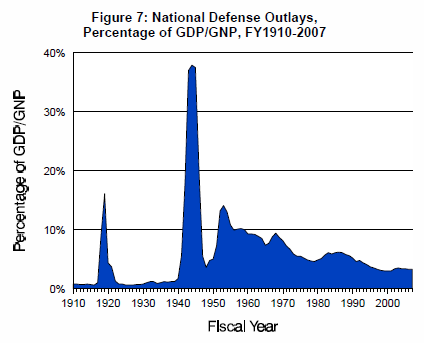
File:US defense spending by GDP percentage 1910 to 2007.png - Wikimedia Commons
The break-up of the Eastern Bloc/Iron Curtain and the new markets that blossomed there and in the USSR former client states, along with the ramp-up of trade with China, along with the "gridlock" of a GOP Congress/Senate and a Dem President all contributed to the 90's boom. To name any single stream as having the primary influence is difficult to substantiate.
06-02-2013 | 12:00 PM
#27
Prime Minister/Moderator
Joined: Jan 2006
Posts: 44,864
Likes: 663
From: Engines Turn or People Swim
I'd be careful about the cause/effect relationship with this. Military spending as a portion of GDP has actually declined since Vietnam, even with the Reagan build-up and the GWOT:
File:US defense spending by GDP percentage 1910 to 2007.png - Wikimedia Commons
The break-up of the Eastern Bloc/Iron Curtain and the new markets that blossomed there and in the USSR former client states, along with the ramp-up of trade with China, along with the "gridlock" of a GOP Congress/Senate and a Dem President all contributed to the 90's boom. To name any single stream as having the primary influence is difficult to substantiate.
File:US defense spending by GDP percentage 1910 to 2007.png - Wikimedia Commons
The break-up of the Eastern Bloc/Iron Curtain and the new markets that blossomed there and in the USSR former client states, along with the ramp-up of trade with China, along with the "gridlock" of a GOP Congress/Senate and a Dem President all contributed to the 90's boom. To name any single stream as having the primary influence is difficult to substantiate.
Also your graph is very hard to reference since there are two variables, and a change in either one moves the plot...can't tell (other than historical context) whether any given change is in defense spending or GDP, or both.
06-02-2013 | 03:07 PM
#28

Bracing for Fallacies
Joined: Jul 2007
Posts: 3,543
Likes: 0
From: In favor of good things, not in favor of bad things
..right now [our military] it is probably the only component of the federal government which could (if push came to shove) be relied upon to stand by the people rather than those shoveling...
Rick...I've heard this too and it concerns me. Either people don't trust their civil leaders (seems to be common place these days) and/or that Americans believe our good natured red, white, and blue small town military heroes will discern between civil leaders proper/improper use of the Insurrection Act to circumvent the Posse Comitatus Act and then if they disagree will somehow stand by their civilian brothers/sisters. I have my doubts.
Some sort of check an balance is a MUST. The draft may work for the Army, but as for the AF our systems are too complex and training takes too long and costs to much get ready for conflict. The Guard and Reserves for all the ad-hoc ways of hacking the mission (and they do) frustrate AD military leaders but stand as our best way, at present, of retaining some sort of connection between the govt, military and civilian sectors and serve a that check to unrestricted conflict.
I also concur with the author that taxes are a HUGE check and balance. It will wake up America more than most options absent the draft. So conspiracy theories on this then go to who doesn't want America to wake up?
Rick...I've heard this too and it concerns me. Either people don't trust their civil leaders (seems to be common place these days) and/or that Americans believe our good natured red, white, and blue small town military heroes will discern between civil leaders proper/improper use of the Insurrection Act to circumvent the Posse Comitatus Act and then if they disagree will somehow stand by their civilian brothers/sisters. I have my doubts.
Some sort of check an balance is a MUST. The draft may work for the Army, but as for the AF our systems are too complex and training takes too long and costs to much get ready for conflict. The Guard and Reserves for all the ad-hoc ways of hacking the mission (and they do) frustrate AD military leaders but stand as our best way, at present, of retaining some sort of connection between the govt, military and civilian sectors and serve a that check to unrestricted conflict.
I also concur with the author that taxes are a HUGE check and balance. It will wake up America more than most options absent the draft. So conspiracy theories on this then go to who doesn't want America to wake up?
What?
Filler
06-02-2013 | 06:34 PM
#29
Gets Weekends Off
Joined: Apr 2010
Posts: 236
Likes: 1
From: Pipers & RV-12
I agree with your statement here. My point is only that expecting any subsequent stimulus in the economy is not probable. The money saved will not be returned to the taxpayer. More likely it will go to unnecessary programs that kill individual initiative and responsibility in favor of dependency on government (to use just one possible redirect of the spending).
06-02-2013 | 08:06 PM
#30

On Reserve
Joined: Jun 2013
Posts: 24
Likes: 0
From: Right Seat


