Originally Posted by
Pineapple Guy
Carl was wrong.
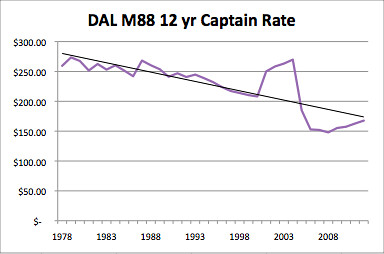
That's a very informative chart. Thanks, PG.
Here's my take on it. The chart starts in 1978. It would be interesting to see what it looked like prior to that (essentially, prior to deregulation). I suspect it would have some significant gains in the early to mid 20th century and then stay relatively flat (at about the buying power of 1978) through the 60's and 70's. That was definitely the "hey day" for airline pilots in terms of buying power. My opinion is that the "value" of an airline pilot had been written in blood and pretty well established by the time we got to the 60's and 70's. Safety was by far the #1 priority and airline pilot compensation reflected that. Then came deregulation. You take an industry that had been subsidized by the government and very poorly managed (didn't have to manage it well because the profits were virtually guaranteed). Suddenly, these companies have to actually compete in a free market. (Well sorta... airlines are still heavily regulated in many areas.) Anyway, it's literally taken decades for this industry to slowly recognize some of it's management flaws and begin to correct them. Then you add in the sense of entitlement to low airfares that people seem to have... and you have an industry that has allowed a real problem to develop in terms of the cost/revenue equation.
My take on PG's slowly declining buying power graph is that it reflects both the realities of the industry and ALPA's inability to effectively make the case for maintaining the value of airline pilots. I see C2K as simply a correction to get our buying power back to the well established value that we saw in the 60's and 70's. If you look at the graph, you can see that C2K set that buying power back to exactly what it was in 1978 before the decline started.
Then 9/11 happened. And we got into an era of irresponsible bean counting... disregarding tried and true business principles with a focus on short term performance numbers and stock price (instead of doing what is best for the company in the long run) and maximizing executive compensation. These bean counters have just about ruined our product (I'm talking the whole industry, not just Delta) and have turned employees into strictly a cost item, missing out on the real value of employees as one of the most important assets to the company.
The cuts we took just prior to and during BK were unprecedented and unwarranted. There is no way you can justify those massive cuts with a slowly declining line on a graph. What I think most of us are advocating is that we return that line on the graph to at or near that well established level of value that had been established for us for decades prior to 1978... you know, back when the overriding priority in the industry was safety, which includes having the best people possible in the cockpit. That's what I want to see from ALPA. I want them to make the case that what we do is no less valuable today than it was in 1978.
Sorry if I rambled a bit in this post... but I do not in any way believe that we have to accept a 50% reduction in the value of the career we signed up for. And I think we need to be realistic about the kind of numbers (increase) it will take to restore that reduction. Hint: It is not going to be accomplished with a "what are you willing to give up to get that" mentality.