


Drone strategic effectiveness…
 12-17-2025 | 09:49 AM
#1
Thread Starter
Perennial Reserve
Joined: Jan 2018
Posts: 14,261
Likes: 259
 Drone strategic effectiveness…
alt=""Another voice heard from…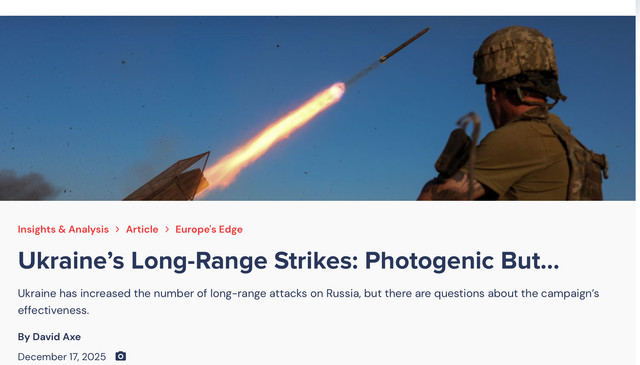
https://cepa.org/article/ukraines-long-range-strikes-photogenic-but/
https://cepa.org/article/ukraines-long-range-strikes-photogenic-but/
No one should dispute that Ukraine’s deep strike campaign is great public relations. Dramatic footage of drones and missiles slamming into Russian airfields, oil refineries and factories boosts Ukrainian morale and reassures allies that the country remains capable of offensive operations after 45 months of all-out Russian aggression.
But fiery Tik Toks set to thumping Ukrainian resistance anthems aren’t indicative of an effective deep strike campaign. Despite appearances, Kyiv’s drones and missiles aren’t striking hard enough to propel Russia toward defeat and Ukraine to victory.
That could change and there are some signs that the campaign is accelerating. But to meaningfully damage the Russian war effort, Ukraine needs much more powerful munitions, and lots of them.
The good news for the Ukrainians is that there are candidates: in particular, the new Flamingo cruise missile from Kyiv firm Fire Point. The badnews is that the Flamingo’s effectiveness is as yet unclear. And the most obvious replacement for the Flamingo, the American Tomahawk, remains out of reach for the Ukrainians.
The numbers tell the real story. Ukrainian President Volodymyr Zelenskyy said late last year that Ukrainian industry would produce 30,000 one-way attack drones in 2025 — and there’s no reason to believe the Ukrainians won’t meet that target.
But very few of those 30,000 drones strike their targets. And even fewer inflict serious damage. “The overall success rate of Ukrainian strikes has been that less than 10% of munitions have reached a target, and fewer still have delivered an effect,” the Royal United Services Institute (RUSI) in London concluded in a December report.
It’s one thing to hit a refinery with a drone or two. It’s another to disable them for long enough to seriously cut Russian petroleum production and exports, and for that to depress Russian military spending enough to cause significant front line effects.
“I think the amount of economic damage one has to inflict on Russia is probably more than Ukraine could create at the moment,” Sergey Vakulenko, a senior fellow at the Berlin-based Carnegie Russia Eurasia Center think tank, told CNN. “I believe that if push comes to shove, Russia could probably survive with half of its oil and gas exports.”
But a year of escalating Ukrainian oil raids — around 130 this year, compared to just 75 or so last year — has coincided with a mere 6% decrease in oil and gas Russian exports compared to 2024.
Again, pro-Ukrainian social media — with its dramatic celebration of every successful strike and its fiery aftermath — would try to suggest otherwise. “The regular images of fires in Russia have caused a perception that Russian air defenses are failing to protect the territory,” RUSI noted. “The reality is more complex.”
“Ukraine has, over time, become quite adept at attacking targets that lack air defense and has prioritized targets where flammable or sensitive materials will allow small numbers of munitions with limited payloads to cause cascading damage to a facility,” the London think tank explained.
Conversely, “this leaves large numbers of targets that the Russians have decided to defend, and that, consequently, Ukraine has struggled to hit.” According to RUSI, a typical Ukrainian raid will involve between 100 and 150 one-way attack drones in the class of the Fire Point FP-1 or FP-2 or the Ukroboronprom An-196, each drone costing as much as $80,000 for a total expenditure of around $12m.
That’s cheap, given that a single Tomahawk missile might cost $2 million. The problem, however, is payload. A Tomahawk packs a 1,000-pound warhead and delivers it at nearly 600 miles per hour (mph), adding kinetic energy to the explosive impact. An An-196 might have a 165-pound warhead and motors along at barely 250 mph.
Generously, those 15 drones that might get through in a 150-drone raid deliver the same weight of explosives as two or three Tomahawks. Bear in mind: US Navy submarines fired 30 Tomahawks at a pair of Iranian nuclear weapons sites back in June — and the Tomahawks weren’t even the most important munitions for that operation. US Air Force stealth bombers delivered the main firepower in the form of massive bunker-busting bombs.
Frontelligence Insight, an analysis group, estimated Ukrainian strikes on Russian refineries during those six months cost the Russian economy $863m. But Russia’s total revenue from oil exports in 2024 was $189bn. The cost to Moscow was, in other words, negligible.
President Trump has made clear that Tomahawks will not be supplied to Ukraine. And there are real questions over the domestically produced Flamingo cruise missiles even if its 600mph 2,200-pound warhead could be just the thing to flatten Russian refineries rather than simply scratch them.
But only if the Flamingo is as cheap and producible as Fire Point has claimed. But based on the evidence, it seems Ukraine has fired just nine Flamingos in four raids over six months resulting in two damaging hits. Maybe the Flamingo is a viable weapon like Fire Point’s one-way attack drones. But if so, there isn’t yet a lot of proof. Ominously, Fire Point is under investigation in Kyiv for corruption.
Maybe an uptick in FP-1/2 and An-196 production, and an increase in the pace of attacks, will add mass and frequency to Ukrainian strikes and result in more lasting damage that, for example, makes generous enlistment bonuses less affordable to Moscow — and, as a consequence, depresses the steady manpower mobilization that has been Russia’s biggest military advantage over manpower-starved Ukraine.
Or maybe Russia will largely shrug off Ukrainian deep strikes in 2026 the way it shrugged them off in 2025 and 2024.
But fiery Tik Toks set to thumping Ukrainian resistance anthems aren’t indicative of an effective deep strike campaign. Despite appearances, Kyiv’s drones and missiles aren’t striking hard enough to propel Russia toward defeat and Ukraine to victory.
That could change and there are some signs that the campaign is accelerating. But to meaningfully damage the Russian war effort, Ukraine needs much more powerful munitions, and lots of them.
The good news for the Ukrainians is that there are candidates: in particular, the new Flamingo cruise missile from Kyiv firm Fire Point. The badnews is that the Flamingo’s effectiveness is as yet unclear. And the most obvious replacement for the Flamingo, the American Tomahawk, remains out of reach for the Ukrainians.
The numbers tell the real story. Ukrainian President Volodymyr Zelenskyy said late last year that Ukrainian industry would produce 30,000 one-way attack drones in 2025 — and there’s no reason to believe the Ukrainians won’t meet that target.
But very few of those 30,000 drones strike their targets. And even fewer inflict serious damage. “The overall success rate of Ukrainian strikes has been that less than 10% of munitions have reached a target, and fewer still have delivered an effect,” the Royal United Services Institute (RUSI) in London concluded in a December report.
It’s one thing to hit a refinery with a drone or two. It’s another to disable them for long enough to seriously cut Russian petroleum production and exports, and for that to depress Russian military spending enough to cause significant front line effects.
“I think the amount of economic damage one has to inflict on Russia is probably more than Ukraine could create at the moment,” Sergey Vakulenko, a senior fellow at the Berlin-based Carnegie Russia Eurasia Center think tank, told CNN. “I believe that if push comes to shove, Russia could probably survive with half of its oil and gas exports.”
But a year of escalating Ukrainian oil raids — around 130 this year, compared to just 75 or so last year — has coincided with a mere 6% decrease in oil and gas Russian exports compared to 2024.
Again, pro-Ukrainian social media — with its dramatic celebration of every successful strike and its fiery aftermath — would try to suggest otherwise. “The regular images of fires in Russia have caused a perception that Russian air defenses are failing to protect the territory,” RUSI noted. “The reality is more complex.”
“Ukraine has, over time, become quite adept at attacking targets that lack air defense and has prioritized targets where flammable or sensitive materials will allow small numbers of munitions with limited payloads to cause cascading damage to a facility,” the London think tank explained.
Conversely, “this leaves large numbers of targets that the Russians have decided to defend, and that, consequently, Ukraine has struggled to hit.” According to RUSI, a typical Ukrainian raid will involve between 100 and 150 one-way attack drones in the class of the Fire Point FP-1 or FP-2 or the Ukroboronprom An-196, each drone costing as much as $80,000 for a total expenditure of around $12m.
That’s cheap, given that a single Tomahawk missile might cost $2 million. The problem, however, is payload. A Tomahawk packs a 1,000-pound warhead and delivers it at nearly 600 miles per hour (mph), adding kinetic energy to the explosive impact. An An-196 might have a 165-pound warhead and motors along at barely 250 mph.
Generously, those 15 drones that might get through in a 150-drone raid deliver the same weight of explosives as two or three Tomahawks. Bear in mind: US Navy submarines fired 30 Tomahawks at a pair of Iranian nuclear weapons sites back in June — and the Tomahawks weren’t even the most important munitions for that operation. US Air Force stealth bombers delivered the main firepower in the form of massive bunker-busting bombs.
Frontelligence Insight, an analysis group, estimated Ukrainian strikes on Russian refineries during those six months cost the Russian economy $863m. But Russia’s total revenue from oil exports in 2024 was $189bn. The cost to Moscow was, in other words, negligible.
President Trump has made clear that Tomahawks will not be supplied to Ukraine. And there are real questions over the domestically produced Flamingo cruise missiles even if its 600mph 2,200-pound warhead could be just the thing to flatten Russian refineries rather than simply scratch them.
But only if the Flamingo is as cheap and producible as Fire Point has claimed. But based on the evidence, it seems Ukraine has fired just nine Flamingos in four raids over six months resulting in two damaging hits. Maybe the Flamingo is a viable weapon like Fire Point’s one-way attack drones. But if so, there isn’t yet a lot of proof. Ominously, Fire Point is under investigation in Kyiv for corruption.
Maybe an uptick in FP-1/2 and An-196 production, and an increase in the pace of attacks, will add mass and frequency to Ukrainian strikes and result in more lasting damage that, for example, makes generous enlistment bonuses less affordable to Moscow — and, as a consequence, depresses the steady manpower mobilization that has been Russia’s biggest military advantage over manpower-starved Ukraine.
Or maybe Russia will largely shrug off Ukrainian deep strikes in 2026 the way it shrugged them off in 2025 and 2024.
12-17-2025 | 11:05 AM
#2

Line Holder
Joined: Feb 2015
Posts: 982
Likes: 83
From: NOYB
Pretty good summary of why for the common good Russia needs to lose. No need to tell me the author is "biased", it doesn't mean that what he says is wrong. Since it isn't behind a paywall I'll post the whole thing with a few highlights underlined for those who want to minimize time spent. And no, I am not interested in follow on discussion or other posters opinions so I will not be following up on any of the usual.
https://substack.com/home/post/p-181281251
The Gift of Defeat - What Russia needs and America won't give
By Andrew Chakoyan
Have you ever been accused of Russophobia? The charge is often leveled at anyone who criticizes Moscow’s wars, exposes Kremlin’s lies, or traces the imperial through-line from the Golden Horde to today’s “Federation.” But to confront the reality of a predatory state is not chauvinism. Russian aggression stems not from genetics but from a vicious historical cycle: Grievance feeds conquest, conquest is followed by denial, denial seeds the next false grievance.
To ask why a society repeatedly spawns mass violence or genocide is not to claim anything innately wrong with the people. But they are raised within a Moscow-centered polity that was never a nation-state in the Western sense. From inception, it functioned as an imperial system—one where political legitimacy rests on expansion, and where violence and impunity have been the only durable inheritance.
Russia’s war on Ukraine has now raged for nearly twelve years, beginning with the seizure of Crimea in 2014 and escalating into a full-scale invasion in 2022. It was born not of a single man’s whim but of grim historical momentum. In this sense, the decision to invade almost made itself. Vladimir Putin was both the driver and the vehicle—animated by the wheels of Russian history.
Blaming it all on a single villain—a wanted war criminal, no less—may feel intuitive, but it strips Russian people of agency and divorces citizenship from responsibility, which is, ironically, the essence of Putinism.
A refusal by the Russian people to confront their blood-soaked history sustains a narrative of perpetualmartyrdom, in which Moscow casts itself—cynically and incessantly—as the victim of outside forces. Russia co-initiated World War II by signing the Molotov–Ribbentrop Pact and its secret protocol to invade, occupy, and partition Poland. Yet in the Kremlin’s canonical narrative, blame rests exclusively with Hitler. Looking at Russian society today through the prism of “the victim rather than the accomplice,” German historian Franziska Davies has observed, is “strongly reminiscent of West German discourses after 1945.”
Russia threatens its neighbors, who then seek to join defensive alliances, but in Moscow’s upside-down world, NATO is somehow responsible for Kremlin’s belligerence. The claimed victimhood of the aggressor is not merely a distortion of reality; it is central to the crime itself.
What Moscow now bills as the “Russian Federation” is in reality a patchwork of subjugated nations—defeated peoples whose languages, cultures, and political autonomy have been, or are being, mercilessly erased. Conquest is staged to intimidate neighbors but, more importantly, to shore up the Kremlin’s internal legitimacy.
If not Putin alone, and not every Russian, then who is to blame?
The deeper culprit is what might be called Russia’s colonized–colonizer double bind: a political system that perpetually seeks to subjugate others abroad while reproducing submission at home. As Ukrainian philosopher Volodymyr Yermolenko has argued, Russian imperialism rests on imposed sameness—a demand that others, Russians included, exist only as extensions of Moscow. Out of this grows the archetype of the “little person”: a model citizen conditioned to submission yet sustained by messianic fantasies of national greatness.
In a recent lecture, the military historian Sarah Paine, who has spent decades studying imperial warfare, put it plainly: “Russia has posed existential threat to its neighbors forever. There are so many neighbors you have never heard of because they’ve disappeared from the pages of history, courtesy of the Russians.”
As documented by Foreign Policy, Russia’s 2022 mobilization disproportionately conscripted men from the country’s ethnic republics—from Siberian Buryatia to Dagestan and Bashkortostan—a reminder that forced resettlement and compulsory conscription remain the twin tools through which Moscow depletes, disperses, and ultimately dissolves the peoples it rules.
To admit the “Federation” is an empire is to admit it must one day collapse. That idea is unfathomable to Kremlin loyalists, politically taboo to the liberal opposition, and deeply feared in Western capitals, which confuse the inevitable disintegration of the Moscow-centric colonial order with global catastrophe. Yet a unitary Russian state is inseparable from violence—as demonstrated in Ichkeria, Georgia, Syria, Crimea, Donbas, and now the entirety of Ukraine.
The world did not end when the British Empire dissolved. Freedom expanded when fourteen of Russia’s former colonies gained independence in 1991.
When Muscovy, the precursor to modern Russia, transitioned from a vassal of the Khans into a continental empire, it never developed the political architecture of a nation-state. Where Western nations built legitimacy through citizenship and law, Muscovy built cohesion through expansion and coercion. Every nation has a founding myth. Muscovy simply appropriated Ukraine’s—rebranding itself as “Russia” by looting the very name Rusʹ from Kyiv. Many of Russia’s contradictions and social pathologies trace back to this foundational act of historical theft.
Few empires have so brazenly weaponized the language of justice. Russia colonizes in the name of “anti-imperialism,” it “shields” Russian-speakers from harm with missile strikes, and brings “freedom” through occupation. Lies are the glue holding a Frankenstein state together—a convenient stand-in for a national idea it never possessed. The extreme nature of the falsehoods isn’t a flaw but a feature of the Kremlin’s governance model. This is how learned helplessness is produced: governance through humiliation.
Naturally, Russia’s “national interests” diverge sharply from the interests of its people. Moscow maintains a cruel, extractive, self-serving order by offering conquest and fantasies of greatness in exchange for political freedom—and by plundering disproportionate wealth from citizens, especially ethnic minorities in resource-rich regions of the Caucasus, Siberia, or the Urals.
As Nobel laureate Oleksandra Matviychuk hasobserved, Russia’s long history of state-ordered violence—carried out by ordinary people under bureaucratic command—has created a morass of complicity from which no one fully escapes. From Stalin’s gulags to Bucha, the cycle persists because neither those who command, nor those who obey, nor the society that bears silent witness is ever made to answer.
No single reform or enlightened leader can address such a condition, because a structural disease cannot be made to yield by personalvirtue. Empires rarely reform themselves into democracies while they remain empires. Historically, meaningful change is triggered only when the last colonial war is lost. This creates the precondition for freedom among the oppressed, and, paradoxically, for moral regeneration among the former oppressors.
As historian Timothy Snyder points out: “Defeating Russia is the best thing we could do for Russia.” Until such a reckoning arrives, Moscow will continue to disempower its internal nations, attack its neighbors, and generate policies that outside observers will endlessly misread as ideological aberrations rather than imperial reflex.
“Putin is not the cause of Russia being a terrorist state; he is the result,” Ukrainian filmmaker Nariman Aliev has observed. The self-colonization paradox—where tormentors are also tormented—may help explain Russia’s pervasive political passivity. But explanation is not exculpation. Structural coercion may condition submission, yet moral responsibility still exists along a gradient. Those who design the violence, those who execute it, and those who normalize it all participate differently—but participate nonetheless.
The Free World must therefore commit not merely to Ukrainian survival, but to Ukrainian victory—and to Russia’s unambiguous defeat. Not humiliation for its own sake, but the irreversible loss of imperial capacity: defeat on the battlefield, the end of colonial occupation, the collapse of coercive security absolutism, and the forced confrontation with historical truth.
Peace through strength is not merely a slogan in this context. It is the only remaining path—for Ukraine’s freedom, for Europe’s security, and for the long-deferred possibility of a post-imperial, democratic future in Russia itself.
Andrew Chakhoyan is an Academic Director at the University of Amsterdam and a former US government official at the Millennium Challenge Corporation. A Ukrainian-American, he studied at Harvard Kennedy School and Donetsk State Technical University.
https://substack.com/home/post/p-181281251
The Gift of Defeat - What Russia needs and America won't give
By Andrew Chakoyan
Have you ever been accused of Russophobia? The charge is often leveled at anyone who criticizes Moscow’s wars, exposes Kremlin’s lies, or traces the imperial through-line from the Golden Horde to today’s “Federation.” But to confront the reality of a predatory state is not chauvinism. Russian aggression stems not from genetics but from a vicious historical cycle: Grievance feeds conquest, conquest is followed by denial, denial seeds the next false grievance.
To ask why a society repeatedly spawns mass violence or genocide is not to claim anything innately wrong with the people. But they are raised within a Moscow-centered polity that was never a nation-state in the Western sense. From inception, it functioned as an imperial system—one where political legitimacy rests on expansion, and where violence and impunity have been the only durable inheritance.
Russia’s war on Ukraine has now raged for nearly twelve years, beginning with the seizure of Crimea in 2014 and escalating into a full-scale invasion in 2022. It was born not of a single man’s whim but of grim historical momentum. In this sense, the decision to invade almost made itself. Vladimir Putin was both the driver and the vehicle—animated by the wheels of Russian history.
Blaming it all on a single villain—a wanted war criminal, no less—may feel intuitive, but it strips Russian people of agency and divorces citizenship from responsibility, which is, ironically, the essence of Putinism.
A refusal by the Russian people to confront their blood-soaked history sustains a narrative of perpetualmartyrdom, in which Moscow casts itself—cynically and incessantly—as the victim of outside forces. Russia co-initiated World War II by signing the Molotov–Ribbentrop Pact and its secret protocol to invade, occupy, and partition Poland. Yet in the Kremlin’s canonical narrative, blame rests exclusively with Hitler. Looking at Russian society today through the prism of “the victim rather than the accomplice,” German historian Franziska Davies has observed, is “strongly reminiscent of West German discourses after 1945.”
Russia threatens its neighbors, who then seek to join defensive alliances, but in Moscow’s upside-down world, NATO is somehow responsible for Kremlin’s belligerence. The claimed victimhood of the aggressor is not merely a distortion of reality; it is central to the crime itself.
What Moscow now bills as the “Russian Federation” is in reality a patchwork of subjugated nations—defeated peoples whose languages, cultures, and political autonomy have been, or are being, mercilessly erased. Conquest is staged to intimidate neighbors but, more importantly, to shore up the Kremlin’s internal legitimacy.
If not Putin alone, and not every Russian, then who is to blame?
The deeper culprit is what might be called Russia’s colonized–colonizer double bind: a political system that perpetually seeks to subjugate others abroad while reproducing submission at home. As Ukrainian philosopher Volodymyr Yermolenko has argued, Russian imperialism rests on imposed sameness—a demand that others, Russians included, exist only as extensions of Moscow. Out of this grows the archetype of the “little person”: a model citizen conditioned to submission yet sustained by messianic fantasies of national greatness.
In a recent lecture, the military historian Sarah Paine, who has spent decades studying imperial warfare, put it plainly: “Russia has posed existential threat to its neighbors forever. There are so many neighbors you have never heard of because they’ve disappeared from the pages of history, courtesy of the Russians.”
As documented by Foreign Policy, Russia’s 2022 mobilization disproportionately conscripted men from the country’s ethnic republics—from Siberian Buryatia to Dagestan and Bashkortostan—a reminder that forced resettlement and compulsory conscription remain the twin tools through which Moscow depletes, disperses, and ultimately dissolves the peoples it rules.
To admit the “Federation” is an empire is to admit it must one day collapse. That idea is unfathomable to Kremlin loyalists, politically taboo to the liberal opposition, and deeply feared in Western capitals, which confuse the inevitable disintegration of the Moscow-centric colonial order with global catastrophe. Yet a unitary Russian state is inseparable from violence—as demonstrated in Ichkeria, Georgia, Syria, Crimea, Donbas, and now the entirety of Ukraine.
The world did not end when the British Empire dissolved. Freedom expanded when fourteen of Russia’s former colonies gained independence in 1991.
When Muscovy, the precursor to modern Russia, transitioned from a vassal of the Khans into a continental empire, it never developed the political architecture of a nation-state. Where Western nations built legitimacy through citizenship and law, Muscovy built cohesion through expansion and coercion. Every nation has a founding myth. Muscovy simply appropriated Ukraine’s—rebranding itself as “Russia” by looting the very name Rusʹ from Kyiv. Many of Russia’s contradictions and social pathologies trace back to this foundational act of historical theft.
Few empires have so brazenly weaponized the language of justice. Russia colonizes in the name of “anti-imperialism,” it “shields” Russian-speakers from harm with missile strikes, and brings “freedom” through occupation. Lies are the glue holding a Frankenstein state together—a convenient stand-in for a national idea it never possessed. The extreme nature of the falsehoods isn’t a flaw but a feature of the Kremlin’s governance model. This is how learned helplessness is produced: governance through humiliation.
Naturally, Russia’s “national interests” diverge sharply from the interests of its people. Moscow maintains a cruel, extractive, self-serving order by offering conquest and fantasies of greatness in exchange for political freedom—and by plundering disproportionate wealth from citizens, especially ethnic minorities in resource-rich regions of the Caucasus, Siberia, or the Urals.
As Nobel laureate Oleksandra Matviychuk hasobserved, Russia’s long history of state-ordered violence—carried out by ordinary people under bureaucratic command—has created a morass of complicity from which no one fully escapes. From Stalin’s gulags to Bucha, the cycle persists because neither those who command, nor those who obey, nor the society that bears silent witness is ever made to answer.
No single reform or enlightened leader can address such a condition, because a structural disease cannot be made to yield by personalvirtue. Empires rarely reform themselves into democracies while they remain empires. Historically, meaningful change is triggered only when the last colonial war is lost. This creates the precondition for freedom among the oppressed, and, paradoxically, for moral regeneration among the former oppressors.
As historian Timothy Snyder points out: “Defeating Russia is the best thing we could do for Russia.” Until such a reckoning arrives, Moscow will continue to disempower its internal nations, attack its neighbors, and generate policies that outside observers will endlessly misread as ideological aberrations rather than imperial reflex.
“Putin is not the cause of Russia being a terrorist state; he is the result,” Ukrainian filmmaker Nariman Aliev has observed. The self-colonization paradox—where tormentors are also tormented—may help explain Russia’s pervasive political passivity. But explanation is not exculpation. Structural coercion may condition submission, yet moral responsibility still exists along a gradient. Those who design the violence, those who execute it, and those who normalize it all participate differently—but participate nonetheless.
The Free World must therefore commit not merely to Ukrainian survival, but to Ukrainian victory—and to Russia’s unambiguous defeat. Not humiliation for its own sake, but the irreversible loss of imperial capacity: defeat on the battlefield, the end of colonial occupation, the collapse of coercive security absolutism, and the forced confrontation with historical truth.
Peace through strength is not merely a slogan in this context. It is the only remaining path—for Ukraine’s freedom, for Europe’s security, and for the long-deferred possibility of a post-imperial, democratic future in Russia itself.
Andrew Chakhoyan is an Academic Director at the University of Amsterdam and a former US government official at the Millennium Challenge Corporation. A Ukrainian-American, he studied at Harvard Kennedy School and Donetsk State Technical University.
12-17-2025 | 01:25 PM
#3
Line Holder
Joined: Oct 2009
Posts: 1,154
Likes: 192
Pretty good summary of why for the common good Russia needs to lose. No need to tell me the author is "biased", it doesn't mean that what he says is wrong. Since it isn't behind a paywall I'll post the whole thing with a few highlights underlined for those who want to minimize time spent. And no, I am not interested in follow on discussion or other posters opinions so I will not be following up on any of the usual.
https://substack.com/home/post/p-181281251
The Gift of Defeat - What Russia needs and America won't give
By Andrew Chakoyan
Have you ever been accused of Russophobia? The charge is often leveled at anyone who criticizes Moscow’s wars, exposes Kremlin’s lies, or traces the imperial through-line from the Golden Horde to today’s “Federation.” But to confront the reality of a predatory state is not chauvinism. Russian aggression stems not from genetics but from a vicious historical cycle: Grievance feeds conquest, conquest is followed by denial, denial seeds the next false grievance.
To ask why a society repeatedly spawns mass violence or genocide is not to claim anything innately wrong with the people. But they are raised within a Moscow-centered polity that was never a nation-state in the Western sense. From inception, it functioned as an imperial system—one where political legitimacy rests on expansion, and where violence and impunity have been the only durable inheritance.
Russia’s war on Ukraine has now raged for nearly twelve years, beginning with the seizure of Crimea in 2014 and escalating into a full-scale invasion in 2022. It was born not of a single man’s whim but of grim historical momentum. In this sense, the decision to invade almost made itself. Vladimir Putin was both the driver and the vehicle—animated by the wheels of Russian history.
Blaming it all on a single villain—a wanted war criminal, no less—may feel intuitive, but it strips Russian people of agency and divorces citizenship from responsibility, which is, ironically, the essence of Putinism.
A refusal by the Russian people to confront their blood-soaked history sustains a narrative of perpetualmartyrdom, in which Moscow casts itself—cynically and incessantly—as the victim of outside forces. Russia co-initiated World War II by signing the Molotov–Ribbentrop Pact and its secret protocol to invade, occupy, and partition Poland. Yet in the Kremlin’s canonical narrative, blame rests exclusively with Hitler. Looking at Russian society today through the prism of “the victim rather than the accomplice,” German historian Franziska Davies has observed, is “strongly reminiscent of West German discourses after 1945.”
Russia threatens its neighbors, who then seek to join defensive alliances, but in Moscow’s upside-down world, NATO is somehow responsible for Kremlin’s belligerence. The claimed victimhood of the aggressor is not merely a distortion of reality; it is central to the crime itself.
What Moscow now bills as the “Russian Federation” is in reality a patchwork of subjugated nations—defeated peoples whose languages, cultures, and political autonomy have been, or are being, mercilessly erased. Conquest is staged to intimidate neighbors but, more importantly, to shore up the Kremlin’s internal legitimacy.
If not Putin alone, and not every Russian, then who is to blame?
The deeper culprit is what might be called Russia’s colonized–colonizer double bind: a political system that perpetually seeks to subjugate others abroad while reproducing submission at home. As Ukrainian philosopher Volodymyr Yermolenko has argued, Russian imperialism rests on imposed sameness—a demand that others, Russians included, exist only as extensions of Moscow. Out of this grows the archetype of the “little person”: a model citizen conditioned to submission yet sustained by messianic fantasies of national greatness.
In a recent lecture, the military historian Sarah Paine, who has spent decades studying imperial warfare, put it plainly: “Russia has posed existential threat to its neighbors forever. There are so many neighbors you have never heard of because they’ve disappeared from the pages of history, courtesy of the Russians.”
As documented by Foreign Policy, Russia’s 2022 mobilization disproportionately conscripted men from the country’s ethnic republics—from Siberian Buryatia to Dagestan and Bashkortostan—a reminder that forced resettlement and compulsory conscription remain the twin tools through which Moscow depletes, disperses, and ultimately dissolves the peoples it rules.
To admit the “Federation” is an empire is to admit it must one day collapse. That idea is unfathomable to Kremlin loyalists, politically taboo to the liberal opposition, and deeply feared in Western capitals, which confuse the inevitable disintegration of the Moscow-centric colonial order with global catastrophe. Yet a unitary Russian state is inseparable from violence—as demonstrated in Ichkeria, Georgia, Syria, Crimea, Donbas, and now the entirety of Ukraine.
The world did not end when the British Empire dissolved. Freedom expanded when fourteen of Russia’s former colonies gained independence in 1991.
When Muscovy, the precursor to modern Russia, transitioned from a vassal of the Khans into a continental empire, it never developed the political architecture of a nation-state. Where Western nations built legitimacy through citizenship and law, Muscovy built cohesion through expansion and coercion. Every nation has a founding myth. Muscovy simply appropriated Ukraine’s—rebranding itself as “Russia” by looting the very name Rusʹ from Kyiv. Many of Russia’s contradictions and social pathologies trace back to this foundational act of historical theft.
Few empires have so brazenly weaponized the language of justice. Russia colonizes in the name of “anti-imperialism,” it “shields” Russian-speakers from harm with missile strikes, and brings “freedom” through occupation. Lies are the glue holding a Frankenstein state together—a convenient stand-in for a national idea it never possessed. The extreme nature of the falsehoods isn’t a flaw but a feature of the Kremlin’s governance model. This is how learned helplessness is produced: governance through humiliation.
Naturally, Russia’s “national interests” diverge sharply from the interests of its people. Moscow maintains a cruel, extractive, self-serving order by offering conquest and fantasies of greatness in exchange for political freedom—and by plundering disproportionate wealth from citizens, especially ethnic minorities in resource-rich regions of the Caucasus, Siberia, or the Urals.
As Nobel laureate Oleksandra Matviychuk hasobserved, Russia’s long history of state-ordered violence—carried out by ordinary people under bureaucratic command—has created a morass of complicity from which no one fully escapes. From Stalin’s gulags to Bucha, the cycle persists because neither those who command, nor those who obey, nor the society that bears silent witness is ever made to answer.
No single reform or enlightened leader can address such a condition, because a structural disease cannot be made to yield by personalvirtue. Empires rarely reform themselves into democracies while they remain empires. Historically, meaningful change is triggered only when the last colonial war is lost. This creates the precondition for freedom among the oppressed, and, paradoxically, for moral regeneration among the former oppressors.
As historian Timothy Snyder points out: “Defeating Russia is the best thing we could do for Russia.” Until such a reckoning arrives, Moscow will continue to disempower its internal nations, attack its neighbors, and generate policies that outside observers will endlessly misread as ideological aberrations rather than imperial reflex.
“Putin is not the cause of Russia being a terrorist state; he is the result,” Ukrainian filmmaker Nariman Aliev has observed. The self-colonization paradox—where tormentors are also tormented—may help explain Russia’s pervasive political passivity. But explanation is not exculpation. Structural coercion may condition submission, yet moral responsibility still exists along a gradient. Those who design the violence, those who execute it, and those who normalize it all participate differently—but participate nonetheless.
The Free World must therefore commit not merely to Ukrainian survival, but to Ukrainian victory—and to Russia’s unambiguous defeat. Not humiliation for its own sake, but the irreversible loss of imperial capacity: defeat on the battlefield, the end of colonial occupation, the collapse of coercive security absolutism, and the forced confrontation with historical truth.
Peace through strength is not merely a slogan in this context. It is the only remaining path—for Ukraine’s freedom, for Europe’s security, and for the long-deferred possibility of a post-imperial, democratic future in Russia itself.
Andrew Chakhoyan is an Academic Director at the University of Amsterdam and a former US government official at the Millennium Challenge Corporation. A Ukrainian-American, he studied at Harvard Kennedy School and Donetsk State Technical University.
https://substack.com/home/post/p-181281251
The Gift of Defeat - What Russia needs and America won't give
By Andrew Chakoyan
Have you ever been accused of Russophobia? The charge is often leveled at anyone who criticizes Moscow’s wars, exposes Kremlin’s lies, or traces the imperial through-line from the Golden Horde to today’s “Federation.” But to confront the reality of a predatory state is not chauvinism. Russian aggression stems not from genetics but from a vicious historical cycle: Grievance feeds conquest, conquest is followed by denial, denial seeds the next false grievance.
To ask why a society repeatedly spawns mass violence or genocide is not to claim anything innately wrong with the people. But they are raised within a Moscow-centered polity that was never a nation-state in the Western sense. From inception, it functioned as an imperial system—one where political legitimacy rests on expansion, and where violence and impunity have been the only durable inheritance.
Russia’s war on Ukraine has now raged for nearly twelve years, beginning with the seizure of Crimea in 2014 and escalating into a full-scale invasion in 2022. It was born not of a single man’s whim but of grim historical momentum. In this sense, the decision to invade almost made itself. Vladimir Putin was both the driver and the vehicle—animated by the wheels of Russian history.
Blaming it all on a single villain—a wanted war criminal, no less—may feel intuitive, but it strips Russian people of agency and divorces citizenship from responsibility, which is, ironically, the essence of Putinism.
A refusal by the Russian people to confront their blood-soaked history sustains a narrative of perpetualmartyrdom, in which Moscow casts itself—cynically and incessantly—as the victim of outside forces. Russia co-initiated World War II by signing the Molotov–Ribbentrop Pact and its secret protocol to invade, occupy, and partition Poland. Yet in the Kremlin’s canonical narrative, blame rests exclusively with Hitler. Looking at Russian society today through the prism of “the victim rather than the accomplice,” German historian Franziska Davies has observed, is “strongly reminiscent of West German discourses after 1945.”
Russia threatens its neighbors, who then seek to join defensive alliances, but in Moscow’s upside-down world, NATO is somehow responsible for Kremlin’s belligerence. The claimed victimhood of the aggressor is not merely a distortion of reality; it is central to the crime itself.
What Moscow now bills as the “Russian Federation” is in reality a patchwork of subjugated nations—defeated peoples whose languages, cultures, and political autonomy have been, or are being, mercilessly erased. Conquest is staged to intimidate neighbors but, more importantly, to shore up the Kremlin’s internal legitimacy.
If not Putin alone, and not every Russian, then who is to blame?
The deeper culprit is what might be called Russia’s colonized–colonizer double bind: a political system that perpetually seeks to subjugate others abroad while reproducing submission at home. As Ukrainian philosopher Volodymyr Yermolenko has argued, Russian imperialism rests on imposed sameness—a demand that others, Russians included, exist only as extensions of Moscow. Out of this grows the archetype of the “little person”: a model citizen conditioned to submission yet sustained by messianic fantasies of national greatness.
In a recent lecture, the military historian Sarah Paine, who has spent decades studying imperial warfare, put it plainly: “Russia has posed existential threat to its neighbors forever. There are so many neighbors you have never heard of because they’ve disappeared from the pages of history, courtesy of the Russians.”
As documented by Foreign Policy, Russia’s 2022 mobilization disproportionately conscripted men from the country’s ethnic republics—from Siberian Buryatia to Dagestan and Bashkortostan—a reminder that forced resettlement and compulsory conscription remain the twin tools through which Moscow depletes, disperses, and ultimately dissolves the peoples it rules.
To admit the “Federation” is an empire is to admit it must one day collapse. That idea is unfathomable to Kremlin loyalists, politically taboo to the liberal opposition, and deeply feared in Western capitals, which confuse the inevitable disintegration of the Moscow-centric colonial order with global catastrophe. Yet a unitary Russian state is inseparable from violence—as demonstrated in Ichkeria, Georgia, Syria, Crimea, Donbas, and now the entirety of Ukraine.
The world did not end when the British Empire dissolved. Freedom expanded when fourteen of Russia’s former colonies gained independence in 1991.
When Muscovy, the precursor to modern Russia, transitioned from a vassal of the Khans into a continental empire, it never developed the political architecture of a nation-state. Where Western nations built legitimacy through citizenship and law, Muscovy built cohesion through expansion and coercion. Every nation has a founding myth. Muscovy simply appropriated Ukraine’s—rebranding itself as “Russia” by looting the very name Rusʹ from Kyiv. Many of Russia’s contradictions and social pathologies trace back to this foundational act of historical theft.
Few empires have so brazenly weaponized the language of justice. Russia colonizes in the name of “anti-imperialism,” it “shields” Russian-speakers from harm with missile strikes, and brings “freedom” through occupation. Lies are the glue holding a Frankenstein state together—a convenient stand-in for a national idea it never possessed. The extreme nature of the falsehoods isn’t a flaw but a feature of the Kremlin’s governance model. This is how learned helplessness is produced: governance through humiliation.
Naturally, Russia’s “national interests” diverge sharply from the interests of its people. Moscow maintains a cruel, extractive, self-serving order by offering conquest and fantasies of greatness in exchange for political freedom—and by plundering disproportionate wealth from citizens, especially ethnic minorities in resource-rich regions of the Caucasus, Siberia, or the Urals.
As Nobel laureate Oleksandra Matviychuk hasobserved, Russia’s long history of state-ordered violence—carried out by ordinary people under bureaucratic command—has created a morass of complicity from which no one fully escapes. From Stalin’s gulags to Bucha, the cycle persists because neither those who command, nor those who obey, nor the society that bears silent witness is ever made to answer.
No single reform or enlightened leader can address such a condition, because a structural disease cannot be made to yield by personalvirtue. Empires rarely reform themselves into democracies while they remain empires. Historically, meaningful change is triggered only when the last colonial war is lost. This creates the precondition for freedom among the oppressed, and, paradoxically, for moral regeneration among the former oppressors.
As historian Timothy Snyder points out: “Defeating Russia is the best thing we could do for Russia.” Until such a reckoning arrives, Moscow will continue to disempower its internal nations, attack its neighbors, and generate policies that outside observers will endlessly misread as ideological aberrations rather than imperial reflex.
“Putin is not the cause of Russia being a terrorist state; he is the result,” Ukrainian filmmaker Nariman Aliev has observed. The self-colonization paradox—where tormentors are also tormented—may help explain Russia’s pervasive political passivity. But explanation is not exculpation. Structural coercion may condition submission, yet moral responsibility still exists along a gradient. Those who design the violence, those who execute it, and those who normalize it all participate differently—but participate nonetheless.
The Free World must therefore commit not merely to Ukrainian survival, but to Ukrainian victory—and to Russia’s unambiguous defeat. Not humiliation for its own sake, but the irreversible loss of imperial capacity: defeat on the battlefield, the end of colonial occupation, the collapse of coercive security absolutism, and the forced confrontation with historical truth.
Peace through strength is not merely a slogan in this context. It is the only remaining path—for Ukraine’s freedom, for Europe’s security, and for the long-deferred possibility of a post-imperial, democratic future in Russia itself.
Andrew Chakhoyan is an Academic Director at the University of Amsterdam and a former US government official at the Millennium Challenge Corporation. A Ukrainian-American, he studied at Harvard Kennedy School and Donetsk State Technical University.
(Also called the inhuman land)
thank you for posting this
12-17-2025 | 01:25 PM
#4
Gets Weekends Off
Joined: Jul 2013
Posts: 5,290
Likes: 111
-My thoughts/opinions are the only ones that matter and NO ONE is capable of asking me questions or debating, for I, CLazarus, is the learned one".
Jesus man........
12-17-2025 | 02:04 PM
#5
Gets Weekends Off
Joined: Jul 2013
Posts: 5,290
Likes: 111
1) Just checked the price of tea in China
2) Russia continues on.......
12-17-2025 | 02:59 PM
#6
Gets Weekends Off
Joined: Apr 2011
Posts: 3,517
Likes: 143
“God created war so that Americans would learn geography.”
― Mark Twain
It’s war. Bad one. But like any other, no place to be unless you’ve finally tripped over something worth killing & dying for. Drone death efficiency will improve. Enemies in our crosshairs will come & go. Police actions can save souls. Laying targets down for a purpose you can’t defend, war crime. https://youtu.be/LFA5JgwdEy4?si=8zMSQNE6dvV8snjo
― Mark Twain
It’s war. Bad one. But like any other, no place to be unless you’ve finally tripped over something worth killing & dying for. Drone death efficiency will improve. Enemies in our crosshairs will come & go. Police actions can save souls. Laying targets down for a purpose you can’t defend, war crime. https://youtu.be/LFA5JgwdEy4?si=8zMSQNE6dvV8snjo
12-17-2025 | 04:37 PM
#9
Thread Starter
Perennial Reserve
Joined: Jan 2018
Posts: 14,261
Likes: 259
There are many opinions on why and how this war happened.
https://nationalsecurityjournal.org/...ad-each-other/
 Tu-95. Image Credit: Creative Commons.
-Moscow read the same moves as encroachment by a military bloc edging toward Russia’s borders.
-Those narratives accumulated, shaping how the Kremlin interpreted Ukraine’s westward drift as a closing window, not normal diplomacy.
-None of this excuses Russia’s invasion or its crimes. But it clarifies how strategic misperception—intentions divorced from perceptions—made war thinkable.
-The lesson is not to deny small-state agency, but to build security orders that acknowledge power realities and manage rival red lines before they harden into violence.
Moscow saw something else entirely. Not reconciliation, but encroachment. Not a “zone of peace,” but a military alliance—once built to contain the Soviet Union—moving ever closer to Russia’s borders. That disconnect was not a footnote to post–Cold War history. It was a structural misperception that accumulated over decades. And while it was not the sole cause of Russia’s invasion of Ukraine, it was one of the conditions that made war thinkable.
The tragedy of Ukraine is not that one side lied and the other told the truth. It is that each side acted rationally within its own strategic narrative—and failed to grasp how profoundly the other disagreed.
Russian leaders—and the broader Russian population—consistently rejected that framing. They understood NATO less as a values-based club than as a military bloc whose history and capabilities mattered more than its rhetoric. Each new member shifted the balance of proximity, warning time, and perceived vulnerability. What NATO saw as reassurance, Russia described as erosion.
Neither interpretation was delusional. But each understanding was mutually incompatible. And because NATO largely treated Russian objections as politically motivated or ultimately surmountable, the alliance focused on consultation rather than accommodation—building mechanisms for dialogue while proceeding on the assumption that enlargement itself was non-negotiable.
Yet international politics never quite got the memo. Great powersstill care intensely about what happens along their borders. They still draw informal red lines. And when those lines are crossed repeatedly, they eventually respond—not always wisely, but often forcefully.
Russia’s conception of its “near abroad” was never purely ideological. It was strategic. Ukraine, in particular, mattered because of geography, history, military depth, and symbolism. The question was never whether Ukrainians had agency—they do—but whether their choices could be insulated from the reactions of a neighboring great power that viewed those choices as altering the regional balance.
Ignoring that dynamic did not make it disappear. It merely delayed the reckoning.
But NATO expansion mattered because it shaped how those other factors were interpreted. Russian officials increasingly described Ukraine’s deepening ties to Western institutions—military, political, and economic—as evidence that time was working against Moscow. What Western capitals framed as gradual integration was portrayed in Moscow as a closing strategic window.
Misperception is not simply misunderstanding. It is the failure to appreciate how one’s actions are interpreted by others operating under different assumptions. NATO believed it was reducing insecurity. Russia insisted that insecurity was being produced.
That gap widened for years. Eventually, it snapped.
But strategic responsibility is a different question. If the goal is to understand how Europe arrived at its most violent conflict since 1945—and how to avoid repeating it—then uncomfortable truths matter. One of those truths is that NATO assumed Russian objections could be managed through dialogue rather than through limits. Another is that the alliance mistook prolonged restraint for acceptance.
Russia’s response was brutal and criminal. It was also, in its own logic, reactive rather than aggressive. That distinction does not absolve Moscow. It simply clarifies the pathway to war.
 Tu-95 Bear Bomber. Image Credit: Creative Commons.
That reality is beginning to reassert itself even amid the fighting. Quiet discussions about security guarantees, neutrality formulas, and limits on alliance expansion—once dismissed as taboo—have re-entered diplomatic space. This is not capitulation. It is an acknowledgment that power realities cannot be willed away.
Multipolar worlds are less forgiving than unipolar ones. They punish strategic complacency. As power diffuses and competition intensifies, ignoring how rivals define their core interests becomes a recipe for escalation.
Europe is now living with the consequences of a long series of choices made in good faith but without sufficient strategic empathy. The task ahead is not to rewrite the past, but to absorb its lessons. Peace does not emerge from denying power realities. It emerges from engaging them before misperception hardens into catastrophe.
https://nationalsecurityjournal.org/...ad-each-other/
UKRAINE WAR
Two Stories, One Collision: How NATO And Russia Misread Each Other
Andrew LathamUkraine Can Be Summed Up in 1 Word: Misperception
Key Points and Summary on Ukraine War Crisis – Europe treated NATO enlargement after 1991 as a “zone of peace” project—locking in democracy and deterring instability.Tu-95. Image Credit: Creative Commons.-Moscow read the same moves as encroachment by a military bloc edging toward Russia’s borders.
-Those narratives accumulated, shaping how the Kremlin interpreted Ukraine’s westward drift as a closing window, not normal diplomacy.
-None of this excuses Russia’s invasion or its crimes. But it clarifies how strategic misperception—intentions divorced from perceptions—made war thinkable.
-The lesson is not to deny small-state agency, but to build security orders that acknowledge power realities and manage rival red lines before they harden into violence.
The Strategic Misperception Behind The Ukraine War
Europe spent the 1990s congratulating itself. The Cold War had ended without catastrophe, borders were opening, liberal institutions were globalizing, and war between major powers seemed not just unlikely but obsolete. NATO’s steady eastward enlargement was framed as the natural extension of that triumph—a benign process that would lock in democracy, prosperity, and peace.Moscow saw something else entirely. Not reconciliation, but encroachment. Not a “zone of peace,” but a military alliance—once built to contain the Soviet Union—moving ever closer to Russia’s borders. That disconnect was not a footnote to post–Cold War history. It was a structural misperception that accumulated over decades. And while it was not the sole cause of Russia’s invasion of Ukraine, it was one of the conditions that made war thinkable.
The tragedy of Ukraine is not that one side lied and the other told the truth. It is that each side acted rationally within its own strategic narrative—and failed to grasp how profoundly the other disagreed.
TWO STORIES, ONE EXPANDING ALLIANCE
From Washington, Brussels, and Berlin, NATO expansion was framed as not being about Russia. It was about Europe’s unfinished business. States emerging from Soviet domination wanted hard security guarantees, not vague assurances. NATO offered credibility, predictability, and the institutional glue needed to anchor fragile democracies. Enlargement was defensive, voluntary, and stabilizing.Russian leaders—and the broader Russian population—consistently rejected that framing. They understood NATO less as a values-based club than as a military bloc whose history and capabilities mattered more than its rhetoric. Each new member shifted the balance of proximity, warning time, and perceived vulnerability. What NATO saw as reassurance, Russia described as erosion.
Neither interpretation was delusional. But each understanding was mutually incompatible. And because NATO largely treated Russian objections as politically motivated or ultimately surmountable, the alliance focused on consultation rather than accommodation—building mechanisms for dialogue while proceeding on the assumption that enlargement itself was non-negotiable.
SPHERES OF INFLUENCE NEVER DIED
Much of the post–Cold War debate rested on a comforting illusion: that spheres of influence were relics of a darker age. Rules, not power, would govern Europe; consent, not coercion. In that world, no state had the right to veto another’s alliances.Yet international politics never quite got the memo. Great powersstill care intensely about what happens along their borders. They still draw informal red lines. And when those lines are crossed repeatedly, they eventually respond—not always wisely, but often forcefully.
Russia’s conception of its “near abroad” was never purely ideological. It was strategic. Ukraine, in particular, mattered because of geography, history, military depth, and symbolism. The question was never whether Ukrainians had agency—they do—but whether their choices could be insulated from the reactions of a neighboring great power that viewed those choices as altering the regional balance.
Ignoring that dynamic did not make it disappear. It merely delayed the reckoning.
MISPERCEPTION AS A PATHWAY TO WAR
Wars are rarely caused by a single decision or grievance. They are over-determined—produced by converging pressures that narrow options and harden preferences. In Russia’s case, NATO expansion interacted with several other forces: domestic authoritarian consolidation, imperial nostalgia, fear of democratic contagion, misjudgments about Western resolve, and Vladimir Putin’s own worldview.But NATO expansion mattered because it shaped how those other factors were interpreted. Russian officials increasingly described Ukraine’s deepening ties to Western institutions—military, political, and economic—as evidence that time was working against Moscow. What Western capitals framed as gradual integration was portrayed in Moscow as a closing strategic window.
Misperception is not simply misunderstanding. It is the failure to appreciate how one’s actions are interpreted by others operating under different assumptions. NATO believed it was reducing insecurity. Russia insisted that insecurity was being produced.
That gap widened for years. Eventually, it snapped.
RESPONSIBILITY WITHOUT MORAL EQUIVALENCE
Acknowledging NATO’s role in shaping the strategic environment does not excuse Russia’s invasion. Nothing justifies the widespread killing of civilians, the destruction of cities, or the attempt to erase a sovereign state by force. Moral responsibility for the war rests squarely with the Kremlin.But strategic responsibility is a different question. If the goal is to understand how Europe arrived at its most violent conflict since 1945—and how to avoid repeating it—then uncomfortable truths matter. One of those truths is that NATO assumed Russian objections could be managed through dialogue rather than through limits. Another is that the alliance mistook prolonged restraint for acceptance.
Russia’s response was brutal and criminal. It was also, in its own logic, reactive rather than aggressive. That distinction does not absolve Moscow. It simply clarifies the pathway to war.
WHAT THIS MEANS GOING FORWARD
The lesson of Ukraine is not that NATO expansion was wrong in principle or that small states must defer to large neighbors. It is that durable security orders require more than moral certainty. They require sustained efforts to align intentions with perceptions—and to manage spheres of influence rather than deny their existence.Tu-95 Bear Bomber. Image Credit: Creative Commons.That reality is beginning to reassert itself even amid the fighting. Quiet discussions about security guarantees, neutrality formulas, and limits on alliance expansion—once dismissed as taboo—have re-entered diplomatic space. This is not capitulation. It is an acknowledgment that power realities cannot be willed away.
Multipolar worlds are less forgiving than unipolar ones. They punish strategic complacency. As power diffuses and competition intensifies, ignoring how rivals define their core interests becomes a recipe for escalation.
Europe is now living with the consequences of a long series of choices made in good faith but without sufficient strategic empathy. The task ahead is not to rewrite the past, but to absorb its lessons. Peace does not emerge from denying power realities. It emerges from engaging them before misperception hardens into catastrophe.
12-17-2025 | 04:48 PM
#10
Thread Starter
Perennial Reserve
Joined: Jan 2018
Posts: 14,261
Likes: 259
alt=""
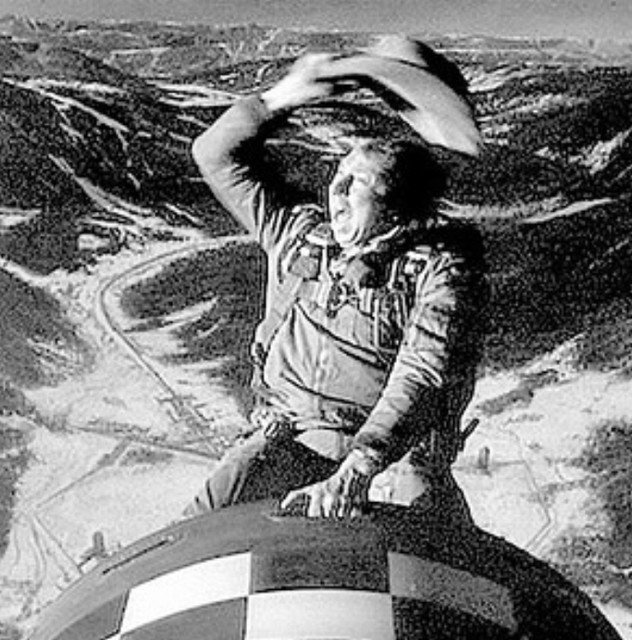
That would seem to be the logical final solution you would need for solving the Russian untermenschen problem.
Last edited by Excargodog; 12-17-2025 at 05:04 PM.

Thread
Thread Starter
Forum
Replies
Last Post


