


Ef-111

 05-20-2009 | 01:00 PM
#2
No one's home
Joined: Aug 2006
Posts: 1,091
Likes: 0

Age?
Info from a reliable source.
EF-111A Raven
Friend of mine in UPT got an F-111 but never flew them due to problems early on.
Another fellow aviator later went into FBs and was lost over the North Atlantic. They never found so much as an oil slick.
Instructor friend flew them and wadded one up at Holloman after an engine failure.
YouTube - EF-111 Raven Landing
The Aussies still fly the FBs.
Oh.. last paper I wrote in USAF ROTC was on the TFX which later became the -111. Long and difficult teething and it got too fat, too heavy and too fast for the Navy. It was McNamara's baby... one plane to do everything.
Info from a reliable source.
EF-111A Raven
Friend of mine in UPT got an F-111 but never flew them due to problems early on.
Another fellow aviator later went into FBs and was lost over the North Atlantic. They never found so much as an oil slick.
Instructor friend flew them and wadded one up at Holloman after an engine failure.
YouTube - EF-111 Raven Landing
The Aussies still fly the FBs.
Oh.. last paper I wrote in USAF ROTC was on the TFX which later became the -111. Long and difficult teething and it got too fat, too heavy and too fast for the Navy. It was McNamara's baby... one plane to do everything.
05-20-2009 | 06:34 PM
#4

Gets Weekends Off
Joined: Jan 2008
Posts: 1,890
Likes: 0
From: 737A
I was at Cannon when the varks were going away in the late nineties. They were great at what they did. They could carry a lot of weapons, and go a long way with them, but they were a pain in the butt to take care of. It really all came down to money...too much money to maintain a pretty small fleet of airplanes, especially the EF's. They were real gas hogs compared to the Navy/Marine EA-6B's that did the same mission. The EA's could carry HARM missiles as well, which the EF's couldn't do. They basically turned the whole mission over the the EA-6B's when they parked the EF-111s.
 05-20-2009 | 06:47 PM
#6
Gets Weekends Off
Joined: Jan 2008
Posts: 1,890
Likes: 0
From: 737A
Honestly, a "B" would have made the most sense, because it ended up being mostly a bomber, with a very limited self defense air-to-air capability. But yes, it does go back to the TFX roots. The F-111B was supposed to be the Navy version to do fleet defense, but it was just too damn big and heavy for carrier ops. They did actually launch one off a carrier somewhere along the way. They never bought the B models...ended up getting the F-14's instead.
05-21-2009 | 08:29 AM
#7
No one's home
Joined: Aug 2006
Posts: 1,091
Likes: 0
It was never a fighter and not intended for air-air. And the USAF at that time did not have any active "A" machines. The Navy did..
It was deployed with not so stellar results to Thailand during the Vietnam war and some were lost, some never found. But it was a great low level machine and for ingress, it was reported superb. I remember reading about guys going through the Grand Canyon, hands off with the terrain following radar. Maybe not that big a deal today but in the late 60s, early 70s.. BIG deal.
The FB then evolved planning on low level ingress to Russia. And from that later came the "Spark Vark".
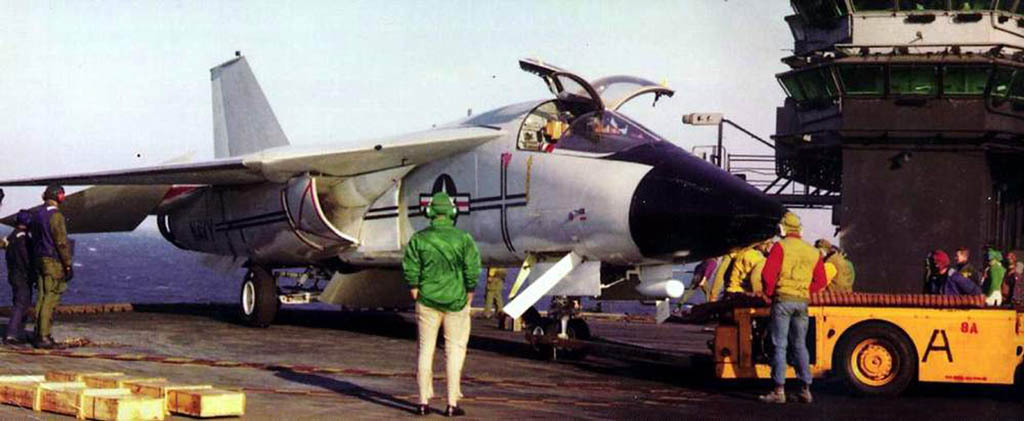
Tough to find but this is an image of the chubby Navy version before the Navy CANXed the program.
 05-21-2009 | 09:30 AM
#8
Moderate Moderator
Joined: Mar 2008
Posts: 5,681
Likes: 0
From: Curator at Static Display
Going Back in Time...
I guess I'm the only one here old enough to know all the details.
Yes, MacNamara tried to apply the principles of the civilian auto-industry to the military services. He reasoned that instead of the Navy and Air Force demanding different aircraft to meet their mission requirements, with multiple developmental costs, one-size-could-fit-all. Development costs would be reduced perhaps by two-thirds, and logistical support would be greatly reduced. Divert to someone else's airfield? They should have parts if you need them.
He ordered the TFX to be evaluated by the USAF and Navy.
He was also in charge when the services standardized the designation system for aircraft. The USAF system was what it is now. But the Navy system was very confusing. If you look at WWII aircraft, Corsairs built by different companies were either F4U-(letter-suffix), or FG-1, or (cloudy on this one, F2-something,I think). The designation reflected the manufacturer as well as the role.
This will play-in momentarily.
Remember: at this time, the Big Generals in the Air Force were mostly bomber guys who rose to power during or after WWII. They dictated a lot of the design requirements for aircraft. (Re: Robert Coram's book about John Boyd).
To them "fast" was the prime design requirement of a fighter, and stations to bolt the weapons to.
They were used to side-by-side seating, so they wanted the cockpit that way (because they envisioned it having a dual-role as a penetrating nuke bomber, and because the Navy wanted a two-seat jet).
Due to the standardizing of nomenclature, the question must have come up: what to call it?
It was intended to have an air-to-air role and air to ground role. They didn't want to designate it "B-111," nor "A-111." (Politics probably came into play as the Air Force was lobbying for money for the B-70. Another "B" airplane would have reduced their arguments). They did designate the SAC airplanes as FB-111, because they were heavier (more gas), had longer wings (and possibly fuselage) and had no intended air-to-air capability.
I think the powers that be (powers that were?) equated Afterburners with Fighter. So there you had it: F-111.
Reality:
Side-by-side is no way to build for max performance...and that's what a fighter must be. Lots of profile drag. More drag means more power required to hit design top-speed.
That means more fuel to hit required range.
That means more wing to support the weight of that fuel.
That means heavier landing gear...
The F-111 is an awesome low-level bomber. It can haul a$$ like nothing else I have seen. It can easily do Mach 1.1 to maybe 1.3 at 300 ft. From the even older guys, the only thing faster on the deck was the F-105 (which, I'm told, could hit 1000 kts indicated at 200 AGL!!)
But it was never a fighter. The radar really had no capability against airplanes. Cockpit visibility was crap to the rear or right (had to ask the WSO). Yeah, they put AIM-9Ps and later 9Ms on it..."for Self-defense." But the Vaark turned so poorly, that (I was told by a former vaark-driver) that it was illegal to perform a loop. I know a guy who said he did one: he had to get supersonic, and keep it in burner the whole way around.
That's not a fighter.
The Navy knew this, and went through the motions of carrier-testing it. But some Admiral, testifying before Congress, was asked why it wasn't suitable for the Navy. The Congressman/Senator asked "What if we put bigger engines on it?"
And the Admiral stated "All the thrust in Christendom wouldn't make that airplane a fighter!!"
Interesting segue: todya, the most expensive fighter contract in history is supposed to fly for the Air Force, Navy and Marines. One-size-fits-all.
Except, each model is a little different.
And it is uglier than the airplanes it is supposed to replace. Sorry, the F-35 is not a very good-looking airplane. The F-16 and F-18 are.
Yes, MacNamara tried to apply the principles of the civilian auto-industry to the military services. He reasoned that instead of the Navy and Air Force demanding different aircraft to meet their mission requirements, with multiple developmental costs, one-size-could-fit-all. Development costs would be reduced perhaps by two-thirds, and logistical support would be greatly reduced. Divert to someone else's airfield? They should have parts if you need them.
He ordered the TFX to be evaluated by the USAF and Navy.
He was also in charge when the services standardized the designation system for aircraft. The USAF system was what it is now. But the Navy system was very confusing. If you look at WWII aircraft, Corsairs built by different companies were either F4U-(letter-suffix), or FG-1, or (cloudy on this one, F2-something,I think). The designation reflected the manufacturer as well as the role.
This will play-in momentarily.
Remember: at this time, the Big Generals in the Air Force were mostly bomber guys who rose to power during or after WWII. They dictated a lot of the design requirements for aircraft. (Re: Robert Coram's book about John Boyd).
To them "fast" was the prime design requirement of a fighter, and stations to bolt the weapons to.
They were used to side-by-side seating, so they wanted the cockpit that way (because they envisioned it having a dual-role as a penetrating nuke bomber, and because the Navy wanted a two-seat jet).
Due to the standardizing of nomenclature, the question must have come up: what to call it?
It was intended to have an air-to-air role and air to ground role. They didn't want to designate it "B-111," nor "A-111." (Politics probably came into play as the Air Force was lobbying for money for the B-70. Another "B" airplane would have reduced their arguments). They did designate the SAC airplanes as FB-111, because they were heavier (more gas), had longer wings (and possibly fuselage) and had no intended air-to-air capability.
I think the powers that be (powers that were?) equated Afterburners with Fighter. So there you had it: F-111.
Reality:
Side-by-side is no way to build for max performance...and that's what a fighter must be. Lots of profile drag. More drag means more power required to hit design top-speed.
That means more fuel to hit required range.
That means more wing to support the weight of that fuel.
That means heavier landing gear...
The F-111 is an awesome low-level bomber. It can haul a$$ like nothing else I have seen. It can easily do Mach 1.1 to maybe 1.3 at 300 ft. From the even older guys, the only thing faster on the deck was the F-105 (which, I'm told, could hit 1000 kts indicated at 200 AGL!!)
But it was never a fighter. The radar really had no capability against airplanes. Cockpit visibility was crap to the rear or right (had to ask the WSO). Yeah, they put AIM-9Ps and later 9Ms on it..."for Self-defense." But the Vaark turned so poorly, that (I was told by a former vaark-driver) that it was illegal to perform a loop. I know a guy who said he did one: he had to get supersonic, and keep it in burner the whole way around.
That's not a fighter.
The Navy knew this, and went through the motions of carrier-testing it. But some Admiral, testifying before Congress, was asked why it wasn't suitable for the Navy. The Congressman/Senator asked "What if we put bigger engines on it?"
And the Admiral stated "All the thrust in Christendom wouldn't make that airplane a fighter!!"
Interesting segue: todya, the most expensive fighter contract in history is supposed to fly for the Air Force, Navy and Marines. One-size-fits-all.
Except, each model is a little different.
And it is uglier than the airplanes it is supposed to replace. Sorry, the F-35 is not a very good-looking airplane. The F-16 and F-18 are.
05-21-2009 | 09:47 AM
#9
Moderate Moderator
Joined: Mar 2008
Posts: 5,681
Likes: 0
From: Curator at Static Display
Part Deux
The EF came out of the lessons of Vietnam. That was our first exposure to radar-guided weapons....particulalry, SAMs. The Air Force did a rush-job and developed self-protection jamming pods. They work OK, but have limitations, and only protect your airplane.
The Generals wanted something with 10 times as much power, that could cover an entire strike package. The Vark has a big internal bomb-bay, so the electronics could be put in there. It has lots of gas and loiter time.
The Navy did this in parallel, but used the EA-6A, later the EA-6B.
The Vark's strengths wer it could keep up with the strike package, and if threatened, could run away so fast that enemy fighters generally couldn't threaten it. (I'm talking the reality of the middle east, not Red Flag where your opponent is a very capable US pilot).
Biggest weakness: frequency range was not as great as the EA-6, and it carried no offensive weapons. It also cost about $15,000 an hour to fly in 1992, so probably about $30,000 today. Mostly fuel, but maintenance was heavy, too.
The EF-111 and the F-4G Wild Weasel worked (normally) as a team: The EF-111 would jam the search radars (think of them as 'binoculars), forcing the enemy to use their targeting radars to find us (think of them as 'a telescope'). While they searched wildly for us by looking through a straw, we would triangulate their emissions and send a HARM to greet them.
The EA-6's strengths are a wider frequency range for jamming than the EF-111, and the ability to shoot a HARM (although their HARM shooting was not as capable as the F-4G I flew).
The biggest limitation on the Prowler is speed and fatigue. It can't keep-up with the strike package, so they either have to "push" early and lead the way, or trail behind. Neither is optimum.
Fatigue: the jets are old, the wings have cracks, g-limits are very low, and there seems to be a tendency for them to catch on fire.
If you are ever flying DEN to SFO and yor weather radar gets wierd, north of your position, and towards Reno, you're probably getting jammed by an EA-6. Just ask Oakland Center to ask Fallon to "cease music."
05-21-2009 | 10:00 AM
#10
Moderate Moderator
Joined: Mar 2008
Posts: 5,681
Likes: 0
From: Curator at Static Display
Sportin' a Vark
They had to do that to make the fuselage short enough to fit on the carrier's hangar-deck elevator.

And that makes it look like it has baby-fat.


