


Fair Trade?
 11-21-2008 | 06:56 PM
#1

Thread Starter
With The Resistance
Joined: Jan 2006
Posts: 6,191
Likes: 0
From: Burning the Agitprop of the Apparat
 Fair Trade?
Unfair Competition From Overseas Deadly For American Car Industry
By PATRICK J. BUCHANAN | Posted Friday, November 21, 2008 4:30 PM PT
Who killed the U.S. auto industry?
To hear the media tell it, arrogant corporate chiefs failed to foresee the demand for small, fuel-efficient cars and made gas-guzzling road-hog SUVs no one wanted, while the clever, far-sighted Japanese, Germans and Koreans prepared and built for the future.
I dissent. What killed Detroit was Washington, the government of the United States, politicians, journalists and muckrakers who have long harbored a deep animus against the manufacturing class that ran the smokestack industries that won World War II.
As far back as the 1950s, an intellectual elite that produces mostly methane had its knives out for the auto industry of which Ike's Treasury secretary, ex-GM chief Charles Wilson, had boasted, "What's good for America is good for General Motors, and vice versa."
"Engine Charlie" was relentlessly mocked, even in Al Capp's L'il Abner cartoon strip, where a bloviating "General Bullmoose" had as his motto, "What's good for Bullmoose is good for America!"
How did Big Government do in the U.S. auto industry?
Washington imposed a minimum wage higher than the average wage in war-devastated Germany and Japan. The Feds ordered that U.S. plants be made the healthiest and safest worksites in the world, creating OSHA to see to it.
It enacted civil rights laws to ensure the labor force reflected our diversity. Environmental laws came next, to ensure U.S. factories became the most pollution-free on earth. It then clamped fuel-efficiency standards on the entire U.S. car fleet.
Next, Washington imposed a corporate tax rate of 35%, raking off another 15% of autoworkers' wages in Social Security payroll taxes. State governments imposed income and sales taxes, and local governments property taxes to subsidize services and schools.
The United Auto Workers struck repeatedly to win the highest wages and most generous benefits on earth — vacations, holidays, work breaks, health care, pensions — for workers and their families, and retirees.
Now there is nothing wrong with making U.S. plants the cleanest and safest on earth or having U.S. autoworkers the highest-paid wage earners. That is the dream, what we all wanted for America. And under the 14th Amendment, GM, Ford and Chrysler had to obey the same U.S. laws and pay at the same tax rates.
Outside the United States, however, there was and is no equality of standards or taxes. Thus when America was thrust into the Global Economy, GM and Ford had to compete with cars made overseas in factories in postwar Japan and Germany, then Korea, where health and safety standards were much lower, wages were a fraction of those paid U.S. workers, and taxes were and are often forgiven on exports to the United States.
All three nations built "export-driven" economies. The Beetle and early Japanese imports were made in factories where wages were far beneath U.S. wages and working conditions would have gotten U.S. auto executives sent to prison.
The competition was manifestly unfair, like forcing Secretariat to carry 100 pounds in his saddlebags in the Derby.
Japan, China and South Korea do not believe in free trade as we understand it. To us, they are our "trading partners." To them, the relationship is not like that of Evans & Novak or Fred Astaire and Ginger Rogers.
It is not even like the Redskins and Cowboys. For the Cowboys only want to defeat the Redskins. They do not want to put their franchise out of business and end the competition — as the Japanese did to our TV industry by dumping Sonys here until they killed it.
While we think the Global Economy is about what is best for the consumer, they think about what is best for the nation. Like Alexander Hamilton, they understand that manufacturing is the key to national power. And they manipulate currencies, grant tax rebates to their exporters and thieve our technology to win.
Last year, as trade expert Bill Hawkins writes, South Korea exported 700,000 cars to us, while importing 5,000 cars from us. That's Asia's idea of free trade.
How has this Global Economy profited or prospered America? In the 1950s, we made all our own toys, clothes, shoes, bikes, furniture, motorcycles, cars, cameras, telephones, TVs, etc. You name it. We made it.
Are we better off now that these things are made by foreigners? Are we better off now that we have ceased to be self-sufficient? Are we better off now that the real wages of our workers and median income of our families no longer grow as they once did? Are we better off now that manufacturing, for the first time in U.S. history, employs fewer workers than government?
We no longer build commercial ships. We have but one airplane company, and it outsources. China produces our computers. And if GM goes Chapter 11, America will soon be out of the auto business.
Our politicians and pundits may not understand what is going on. Historians will have no problem explaining the decline and fall of the Americans.
By PATRICK J. BUCHANAN | Posted Friday, November 21, 2008 4:30 PM PT
Who killed the U.S. auto industry?
To hear the media tell it, arrogant corporate chiefs failed to foresee the demand for small, fuel-efficient cars and made gas-guzzling road-hog SUVs no one wanted, while the clever, far-sighted Japanese, Germans and Koreans prepared and built for the future.
I dissent. What killed Detroit was Washington, the government of the United States, politicians, journalists and muckrakers who have long harbored a deep animus against the manufacturing class that ran the smokestack industries that won World War II.
As far back as the 1950s, an intellectual elite that produces mostly methane had its knives out for the auto industry of which Ike's Treasury secretary, ex-GM chief Charles Wilson, had boasted, "What's good for America is good for General Motors, and vice versa."
"Engine Charlie" was relentlessly mocked, even in Al Capp's L'il Abner cartoon strip, where a bloviating "General Bullmoose" had as his motto, "What's good for Bullmoose is good for America!"
How did Big Government do in the U.S. auto industry?
Washington imposed a minimum wage higher than the average wage in war-devastated Germany and Japan. The Feds ordered that U.S. plants be made the healthiest and safest worksites in the world, creating OSHA to see to it.
It enacted civil rights laws to ensure the labor force reflected our diversity. Environmental laws came next, to ensure U.S. factories became the most pollution-free on earth. It then clamped fuel-efficiency standards on the entire U.S. car fleet.
Next, Washington imposed a corporate tax rate of 35%, raking off another 15% of autoworkers' wages in Social Security payroll taxes. State governments imposed income and sales taxes, and local governments property taxes to subsidize services and schools.
The United Auto Workers struck repeatedly to win the highest wages and most generous benefits on earth — vacations, holidays, work breaks, health care, pensions — for workers and their families, and retirees.
Now there is nothing wrong with making U.S. plants the cleanest and safest on earth or having U.S. autoworkers the highest-paid wage earners. That is the dream, what we all wanted for America. And under the 14th Amendment, GM, Ford and Chrysler had to obey the same U.S. laws and pay at the same tax rates.
Outside the United States, however, there was and is no equality of standards or taxes. Thus when America was thrust into the Global Economy, GM and Ford had to compete with cars made overseas in factories in postwar Japan and Germany, then Korea, where health and safety standards were much lower, wages were a fraction of those paid U.S. workers, and taxes were and are often forgiven on exports to the United States.
All three nations built "export-driven" economies. The Beetle and early Japanese imports were made in factories where wages were far beneath U.S. wages and working conditions would have gotten U.S. auto executives sent to prison.
The competition was manifestly unfair, like forcing Secretariat to carry 100 pounds in his saddlebags in the Derby.
Japan, China and South Korea do not believe in free trade as we understand it. To us, they are our "trading partners." To them, the relationship is not like that of Evans & Novak or Fred Astaire and Ginger Rogers.
It is not even like the Redskins and Cowboys. For the Cowboys only want to defeat the Redskins. They do not want to put their franchise out of business and end the competition — as the Japanese did to our TV industry by dumping Sonys here until they killed it.
While we think the Global Economy is about what is best for the consumer, they think about what is best for the nation. Like Alexander Hamilton, they understand that manufacturing is the key to national power. And they manipulate currencies, grant tax rebates to their exporters and thieve our technology to win.
Last year, as trade expert Bill Hawkins writes, South Korea exported 700,000 cars to us, while importing 5,000 cars from us. That's Asia's idea of free trade.
How has this Global Economy profited or prospered America? In the 1950s, we made all our own toys, clothes, shoes, bikes, furniture, motorcycles, cars, cameras, telephones, TVs, etc. You name it. We made it.
Are we better off now that these things are made by foreigners? Are we better off now that we have ceased to be self-sufficient? Are we better off now that the real wages of our workers and median income of our families no longer grow as they once did? Are we better off now that manufacturing, for the first time in U.S. history, employs fewer workers than government?
We no longer build commercial ships. We have but one airplane company, and it outsources. China produces our computers. And if GM goes Chapter 11, America will soon be out of the auto business.
Our politicians and pundits may not understand what is going on. Historians will have no problem explaining the decline and fall of the Americans.
11-21-2008 | 08:05 PM
#2

Gets Weekends Off
Joined: Jun 2008
Posts: 1,398
Likes: 0
From: USAF
Washington may have given them the gun, but their management pulled the trigger. Foreign car companies that have plants in the US still adhere to the same standards and taxes (well somewhat) that the big three do. European standards are even more strict, although the VAT is better for marketing/building in the US. 70% of the US GDP is consumer spending, we happen to be one of the largest consumer nations out there... and it is a huge market for any auto manufacturer.
In 2006, GM spend $17 million on Viagra alone for its employees, part of the $5.4 billion for healthcare coverage for its employees. That accounts for $1500 per car. While the corporate income tax can be argued, the money spent lobbying for higher EPA fuel economy ratings would take a chunk out of the money needed for "innovation".
The fact of the matter is that an over-inflated credit base is what set the pace for manufacturing. Washington may have added fuel to the fire, but the companies themselves started the blaze.
I would agree that the greens spell progress R-e-c-e-s-s-i-o-n
In 2006, GM spend $17 million on Viagra alone for its employees, part of the $5.4 billion for healthcare coverage for its employees. That accounts for $1500 per car. While the corporate income tax can be argued, the money spent lobbying for higher EPA fuel economy ratings would take a chunk out of the money needed for "innovation".
The fact of the matter is that an over-inflated credit base is what set the pace for manufacturing. Washington may have added fuel to the fire, but the companies themselves started the blaze.
I would agree that the greens spell progress R-e-c-e-s-s-i-o-n
Last edited by ryan1234; 11-21-2008 at 08:12 PM.
11-22-2008 | 02:15 PM
#3
Gets Weekends Off
Joined: Jun 2008
Posts: 190
Likes: 0
Wow, Pat Buchanan through his "reasoned" analysis of Detroit's woes made it through an entire post without blaming zionism or homophobes? Try this on for size
GM, Ford, and Chrysler, who embodied industrial excellence and manufactured much of the equipment that defeated Japan and Germany more than sixty years ago, are reduced to begging the federal government to prevent their bankruptcy. But there is little schadenfreude in the executive suites of Stuttgart and Toyota City. The inhabitants realize that the very success of the Big Three created the conditions for the American industry's undoing, and recognize their own vulnerability. After all, Korea and China loom as formidable competition, blessed with lower labor costs.
The Oligopoly Forms
In 1945, the men who had just pulled off the biggest and most successful industrial mobilization in the history of the world began to construct the biggest and most profitable oligopoly the world had ever seen. Economies of scale and competition on the basis of advertising, marketing, styling and other factors difficult for the small fry to match, enabled the Big Three to squeeze out their smaller rivals like Packard, Hudson, Nash, and Studebaker, excellent manufacturers all. The most acclaimed production genius of the home front was Henry Kaiser, an entrepreneur who had built Liberty Ships with mass production techniques (a Richmond, California Yard once built a ship in four days). Converting the famous Willow Run bomber assembly line plant to automobile production, Kaiser tried to break into the business, but Kaiser Motors was driven from the American market in a mere ten years, its equipment shipped off to Brazil and Argentina.
During the 1950s and 1960s, the Big Three ruled the automotive world and made big profits, as oligopolies often are able to do.
Labor gets on board
Big three management, arguably the most powerful executives in America and the world, faced a worthy bargaining adversary in Walter P. Reuther, whose United Auto Workers Union monopolized their labor supply. Reuther was a smart, brave and honorable man. He had been beaten by company goons twice in strikes when building the union. Yet he refused to tolerate wildcat strikes during the World War II production effort, and for good measure had thrown Communists out of the American union movement in the postwar years.
Reuther took advantage of his monopoly (technically: monopsony) position by playing the three rivals off against each other. He would target one manufacturer at a time -- the one he deemed most likely to cave in. The union would go on strike against that company and drive the market share to its two competitors. Although management would put up a struggle at every stage, wages rose and rose, and benefits multiplied.
The company which caved in first knew that its rivals would have to match its concessions, so that giving in didn't mean enduring a competitive disadvantage for very long. In oligopolies, market share is particularly prized because the largest producer typically gets an even larger share of total industry profits. Size does matter when it comes to relative profitability.
Under the circumstances, the phrase "buying labor peace" made a lot of sense to management and shareholders alike. The executives who acquiesced in these policies were regarded as wise, even enlightened. They weren't stupid, though later on locking in high labor costs created a lot of trouble when the oligopoly was challenged and broken by foreign competition.
Overseas competition breaks the oligopoly
The first danger sign came with the growing success the Volkswagen Beetle enjoyed in the American automobile market. Detroit tried to compete at the small and inexpensive ("compact") end of the market, but it wasn't very easy to make money on competing with (then) lower wage foreign labor. The innovative Chevrolet Corvair ran into trouble from Ralph Nader, who alleged it was "unsafe at any speed." Because General Motors stupidly employed a prostitute to try to compromise him, Nader became a martyr, public hostility to the industry grew, and the Corvair languished and was discontinued.
To Volkswagen, Toyota, and many other auto makers struggling to catch up to Detroit in the 1950s and 60s, GM, Ford and Chrysler appeared mighty beyond compare. In the mid-1960s, government planners at Japan's Ministry of International Trade and Industry tried to force the much smaller Japanese automobile manufacturers to merge together, in order to be able to more effectively compete with GM and the other giants, as the Japanese expanded into global markets. Fortunately for the Japanese automobile industry, the bureaucrats bullied only two companies into merging -- Nissan and Prince Motors, which went on to lose significant market share to Toyota. Japan's auto industry remained fragmented and highly competitive, if not nearly as profitable as Detroit's.
Even before 1973 it was apparent that Detroit was ceding low end market segments to foreign producers, but the oil crisis gave Japanese manufacturers a huge leg up, with their ability to provide plentiful, fuel efficient, high quality small cars. The market share the Japanese won when gasoline was scarce never came back, and the new entrants from abroad moved into more upscale market segments with fatter profit margins.
If the oligopolists of OPEC had been able to maintain their cartel as effectively as Detroit maintained its oligopoly following the war, it is conceivable that Detroit might have focused more resources on the fuel efficient segment of the American market. But when oil prices went up, new producers were attracted to drilling oil, and the cartel's hold weakened. Oil prices went down.
And because Americans love driving their cars and Detroit loved producing big cars (with comparatively little foreign competition), American taxes at the pump remained far lower than in Europe and Japan, skewing the overseas markets in the direction of fuel economy. The combination of market forces and domestic politics kept gasoline cheaper in the American market than in Europe and Japan, resulting in larger scale more efficient production of fuel-sipping cars overseas.
Lost Oligopoly
The days of the automobile oligopoly are gone forever, barring the kind of protectionism that would send the world into a global depression. If GM, Ford, and Chrysler are to survive and become self-sustaining, they must adopt structures, practices and a mindset different from those of a member of an oligopoly. The size of the world automobile industry has attracted a host of new entrants, with more certain to come in the decades ahead. But GM, Ford, and Chrysler remain burdened by the obligations incurred to labor and distribution. Unless those obligations are severed in voluntary bankruptcy proceedings, the three companies will remain handicapped in their competition with foreign producers, even those manufacturing in the United States.
It is conceivable that a major company can throw off the habits and mentality of the past. Sometimes companies do renew themselves, cognizant of the evanescence of success and the threat of competitive extinction. That is a challenging task under the best of circumstances, and success is far from certain. Sometimes the change comes via bankruptcy, and new management comes in and changes operations radically. The new boss cajoles or threatens the workforce into leaving old habits and procedures behind. The prospect that the company will fail and be dissolved, with everyone losing their jobs, is the motivation for accepting unwelcome change in these cases.
But if the federal treasury is believed to be on tap, it is much less likely that the Big Three will be able to right their ways, no matter how sincere the intentions of everyone involved. Competitiveness in the global automobile industry is a moving target. Continuous improvement (kaizen) is a way of life now for everyone. Only the lean survive.
If the Big Three pass from the scene, the American automobile industry will survive, but it will be largely based in the South, almost exclusively non-union, and owned by corporations based in foreign countries. The larger and more venerable among these "transplant" producers do engineering, design, and other high value-added functions in America, and even export their American-made products to foreign markets, employing tens of thousands of Americans. None of whom are asking for a bailout, but who would pay taxes to finance their competition if the Big Three get one.
The fruits of oligopoly can be lush, but like all fruit, they ripen and eventually spoil. Without the discipline of competition, bad habits develop, become ingrained and institutionalized, and ultimately weaken the competitor.
GM, Ford, and Chrysler, who embodied industrial excellence and manufactured much of the equipment that defeated Japan and Germany more than sixty years ago, are reduced to begging the federal government to prevent their bankruptcy. But there is little schadenfreude in the executive suites of Stuttgart and Toyota City. The inhabitants realize that the very success of the Big Three created the conditions for the American industry's undoing, and recognize their own vulnerability. After all, Korea and China loom as formidable competition, blessed with lower labor costs.
The Oligopoly Forms
In 1945, the men who had just pulled off the biggest and most successful industrial mobilization in the history of the world began to construct the biggest and most profitable oligopoly the world had ever seen. Economies of scale and competition on the basis of advertising, marketing, styling and other factors difficult for the small fry to match, enabled the Big Three to squeeze out their smaller rivals like Packard, Hudson, Nash, and Studebaker, excellent manufacturers all. The most acclaimed production genius of the home front was Henry Kaiser, an entrepreneur who had built Liberty Ships with mass production techniques (a Richmond, California Yard once built a ship in four days). Converting the famous Willow Run bomber assembly line plant to automobile production, Kaiser tried to break into the business, but Kaiser Motors was driven from the American market in a mere ten years, its equipment shipped off to Brazil and Argentina.
During the 1950s and 1960s, the Big Three ruled the automotive world and made big profits, as oligopolies often are able to do.
Labor gets on board
Big three management, arguably the most powerful executives in America and the world, faced a worthy bargaining adversary in Walter P. Reuther, whose United Auto Workers Union monopolized their labor supply. Reuther was a smart, brave and honorable man. He had been beaten by company goons twice in strikes when building the union. Yet he refused to tolerate wildcat strikes during the World War II production effort, and for good measure had thrown Communists out of the American union movement in the postwar years.
Reuther took advantage of his monopoly (technically: monopsony) position by playing the three rivals off against each other. He would target one manufacturer at a time -- the one he deemed most likely to cave in. The union would go on strike against that company and drive the market share to its two competitors. Although management would put up a struggle at every stage, wages rose and rose, and benefits multiplied.
The company which caved in first knew that its rivals would have to match its concessions, so that giving in didn't mean enduring a competitive disadvantage for very long. In oligopolies, market share is particularly prized because the largest producer typically gets an even larger share of total industry profits. Size does matter when it comes to relative profitability.
Under the circumstances, the phrase "buying labor peace" made a lot of sense to management and shareholders alike. The executives who acquiesced in these policies were regarded as wise, even enlightened. They weren't stupid, though later on locking in high labor costs created a lot of trouble when the oligopoly was challenged and broken by foreign competition.
Overseas competition breaks the oligopoly
The first danger sign came with the growing success the Volkswagen Beetle enjoyed in the American automobile market. Detroit tried to compete at the small and inexpensive ("compact") end of the market, but it wasn't very easy to make money on competing with (then) lower wage foreign labor. The innovative Chevrolet Corvair ran into trouble from Ralph Nader, who alleged it was "unsafe at any speed." Because General Motors stupidly employed a prostitute to try to compromise him, Nader became a martyr, public hostility to the industry grew, and the Corvair languished and was discontinued.
To Volkswagen, Toyota, and many other auto makers struggling to catch up to Detroit in the 1950s and 60s, GM, Ford and Chrysler appeared mighty beyond compare. In the mid-1960s, government planners at Japan's Ministry of International Trade and Industry tried to force the much smaller Japanese automobile manufacturers to merge together, in order to be able to more effectively compete with GM and the other giants, as the Japanese expanded into global markets. Fortunately for the Japanese automobile industry, the bureaucrats bullied only two companies into merging -- Nissan and Prince Motors, which went on to lose significant market share to Toyota. Japan's auto industry remained fragmented and highly competitive, if not nearly as profitable as Detroit's.
Even before 1973 it was apparent that Detroit was ceding low end market segments to foreign producers, but the oil crisis gave Japanese manufacturers a huge leg up, with their ability to provide plentiful, fuel efficient, high quality small cars. The market share the Japanese won when gasoline was scarce never came back, and the new entrants from abroad moved into more upscale market segments with fatter profit margins.
If the oligopolists of OPEC had been able to maintain their cartel as effectively as Detroit maintained its oligopoly following the war, it is conceivable that Detroit might have focused more resources on the fuel efficient segment of the American market. But when oil prices went up, new producers were attracted to drilling oil, and the cartel's hold weakened. Oil prices went down.
And because Americans love driving their cars and Detroit loved producing big cars (with comparatively little foreign competition), American taxes at the pump remained far lower than in Europe and Japan, skewing the overseas markets in the direction of fuel economy. The combination of market forces and domestic politics kept gasoline cheaper in the American market than in Europe and Japan, resulting in larger scale more efficient production of fuel-sipping cars overseas.
Lost Oligopoly
The days of the automobile oligopoly are gone forever, barring the kind of protectionism that would send the world into a global depression. If GM, Ford, and Chrysler are to survive and become self-sustaining, they must adopt structures, practices and a mindset different from those of a member of an oligopoly. The size of the world automobile industry has attracted a host of new entrants, with more certain to come in the decades ahead. But GM, Ford, and Chrysler remain burdened by the obligations incurred to labor and distribution. Unless those obligations are severed in voluntary bankruptcy proceedings, the three companies will remain handicapped in their competition with foreign producers, even those manufacturing in the United States.
It is conceivable that a major company can throw off the habits and mentality of the past. Sometimes companies do renew themselves, cognizant of the evanescence of success and the threat of competitive extinction. That is a challenging task under the best of circumstances, and success is far from certain. Sometimes the change comes via bankruptcy, and new management comes in and changes operations radically. The new boss cajoles or threatens the workforce into leaving old habits and procedures behind. The prospect that the company will fail and be dissolved, with everyone losing their jobs, is the motivation for accepting unwelcome change in these cases.
But if the federal treasury is believed to be on tap, it is much less likely that the Big Three will be able to right their ways, no matter how sincere the intentions of everyone involved. Competitiveness in the global automobile industry is a moving target. Continuous improvement (kaizen) is a way of life now for everyone. Only the lean survive.
If the Big Three pass from the scene, the American automobile industry will survive, but it will be largely based in the South, almost exclusively non-union, and owned by corporations based in foreign countries. The larger and more venerable among these "transplant" producers do engineering, design, and other high value-added functions in America, and even export their American-made products to foreign markets, employing tens of thousands of Americans. None of whom are asking for a bailout, but who would pay taxes to finance their competition if the Big Three get one.
The fruits of oligopoly can be lush, but like all fruit, they ripen and eventually spoil. Without the discipline of competition, bad habits develop, become ingrained and institutionalized, and ultimately weaken the competitor.
11-22-2008 | 02:38 PM
#4
Thread Starter
With The Resistance
Joined: Jan 2006
Posts: 6,191
Likes: 0
From: Burning the Agitprop of the Apparat
Interesting article, did you write that?
A lot of information on the rise and fall of the big three, but a very little on what constitutes fair trade. Certainly the oil crisis of 1973 opened the door for more fuel efficient imports and the big three were slow to get into that market segment.
Japan has not been very kind to imports from europe or the US for many reasons. There does seem to be an imbalance that goes beyond the products offered. GM and Ford have both done well in europe and many other areas of the world. China's auto industry was started by GM and Chrysler.
A lot of information on the rise and fall of the big three, but a very little on what constitutes fair trade. Certainly the oil crisis of 1973 opened the door for more fuel efficient imports and the big three were slow to get into that market segment.
Japan has not been very kind to imports from europe or the US for many reasons. There does seem to be an imbalance that goes beyond the products offered. GM and Ford have both done well in europe and many other areas of the world. China's auto industry was started by GM and Chrysler.
11-22-2008 | 10:16 PM
#5

Gets Weekends Off
Joined: Nov 2008
Posts: 626
Likes: 0
From: Livin' the dream
Aargh.
I've been waking up late at night plagued by recurrent nightmares of what the continuing decline (near death) of the American manufacturing sector means.
I think maybe what Jungle is trying to stir up is a bit of long delayed loyalty to the idea of driving a Chevy versus a god-damned Toyota or Honda.
If that is the case, I agree with Jungle.
At one point, way back in the late nine-teen-80's, when I'd just gotten my driving license, my Pop would have disowned me if I'd preferred a Datsun over a Ford.
Do you understand that? Did you experience that? At all? Have you gotten that far from wherever the f it was that you were raised, that you've forgotten the old timers that still, even 40 or so years after The War, despised the Japanese ("Japs" to be incorrect)(or Nazis?)?
Have you driven through Flint or maybe even Detroit lately in your Honda, Toyota, Nissan, Subaru, BMW, Volkswagen, Volvo, Lexus, Saab, Hyundai, KIA (an unfortunate name my buddy who served in Vietnam commented on) or whatever other non "Big 3" vehicle you're sipping you're spendy coffee in?
Sorry. I'll calm down. A little. But maybe, if you've never been there, check out our Rust Belt. It's big, and sad. It stretches from PA to MI, at the least.
I liked Jungle's pasted Buchanan screed. It's true.
If you, for some reason, feel a need to **** on the workers at our last remaining large scale manufacturing jobs within these borders I have to ask- Why?
Because they did not build, on a large scale, an electric vehicle that you would not have bought because it was unreliable, and would only travel about 150 miles without another charge?
Because their "fit and finish" was not up to your standards?
Because you were seriously only interested in performance, fuel economy, and safety standards?
Because you were totally detached from the idea of supporting American workers producing American vehicles for a decent wage and secure standard of living in America?
Sure, Some of those above mentioned outfits produce vehicles in America now. In what are called "right to work states". Anti-union states. Down South. Plenty of those states' elected reps are now salivating at the idea of the deaths of all connected to the UAW.
All the profits from those cars go away. To another country.
But most vehicles now, even the "Big Three" are produced partly or wholly from assemblies from outside our shores.
We are doomed.
Do you know anyone who makes anything? Builds anything? Creates anything tangible?
Do you want to fly an Airbus? Have you ever researched the corporate spying that European governments did to Boeing in order to build their Airbuses?
Aagh. This ****es me off. Hearing so many idiots wax eloquent about how much better off the "big three", and our country would be if they just failed.
F'n Morons. Traitors. Enjoy your $8 an hour jobs. Someday soon there's going to be an undocumented worker pilot in your seat.
I've been waking up late at night plagued by recurrent nightmares of what the continuing decline (near death) of the American manufacturing sector means.
I think maybe what Jungle is trying to stir up is a bit of long delayed loyalty to the idea of driving a Chevy versus a god-damned Toyota or Honda.
If that is the case, I agree with Jungle.
At one point, way back in the late nine-teen-80's, when I'd just gotten my driving license, my Pop would have disowned me if I'd preferred a Datsun over a Ford.
Do you understand that? Did you experience that? At all? Have you gotten that far from wherever the f it was that you were raised, that you've forgotten the old timers that still, even 40 or so years after The War, despised the Japanese ("Japs" to be incorrect)(or Nazis?)?
Have you driven through Flint or maybe even Detroit lately in your Honda, Toyota, Nissan, Subaru, BMW, Volkswagen, Volvo, Lexus, Saab, Hyundai, KIA (an unfortunate name my buddy who served in Vietnam commented on) or whatever other non "Big 3" vehicle you're sipping you're spendy coffee in?
Sorry. I'll calm down. A little. But maybe, if you've never been there, check out our Rust Belt. It's big, and sad. It stretches from PA to MI, at the least.
I liked Jungle's pasted Buchanan screed. It's true.
If you, for some reason, feel a need to **** on the workers at our last remaining large scale manufacturing jobs within these borders I have to ask- Why?
Because they did not build, on a large scale, an electric vehicle that you would not have bought because it was unreliable, and would only travel about 150 miles without another charge?
Because their "fit and finish" was not up to your standards?
Because you were seriously only interested in performance, fuel economy, and safety standards?
Because you were totally detached from the idea of supporting American workers producing American vehicles for a decent wage and secure standard of living in America?
Sure, Some of those above mentioned outfits produce vehicles in America now. In what are called "right to work states". Anti-union states. Down South. Plenty of those states' elected reps are now salivating at the idea of the deaths of all connected to the UAW.
All the profits from those cars go away. To another country.
But most vehicles now, even the "Big Three" are produced partly or wholly from assemblies from outside our shores.
We are doomed.
Do you know anyone who makes anything? Builds anything? Creates anything tangible?
Do you want to fly an Airbus? Have you ever researched the corporate spying that European governments did to Boeing in order to build their Airbuses?
Aagh. This ****es me off. Hearing so many idiots wax eloquent about how much better off the "big three", and our country would be if they just failed.
F'n Morons. Traitors. Enjoy your $8 an hour jobs. Someday soon there's going to be an undocumented worker pilot in your seat.
11-23-2008 | 05:59 AM
#6
Gets Weekends Off
Joined: Jun 2008
Posts: 1,398
Likes: 0
From: USAF
I would be curious to see where that computer screen is made at that you are staring at? Or perhaps the clothes you are wearing?
Sorry if I prefer a car built by Zee Germans.....because I enjoy driving the car and I'd had my share of American cars... most of which were POS. The bottom line is that American cars have over-inflated cost living in a currently deflating economy. I don't feel sorry for them. If there was not any Japanese/German imports ever allowed on US soil, we would probably still be driving the 70's generation of cars! Most foreign cars are assembled on US soil, providing realistic jobs for the southern folk "salivating in the idea of a UAW failure".
And by the way UAW is not the pinnacle of a corruption free environment...
Welcome to the real world!
Sorry if I prefer a car built by Zee Germans.....because I enjoy driving the car and I'd had my share of American cars... most of which were POS. The bottom line is that American cars have over-inflated cost living in a currently deflating economy. I don't feel sorry for them. If there was not any Japanese/German imports ever allowed on US soil, we would probably still be driving the 70's generation of cars! Most foreign cars are assembled on US soil, providing realistic jobs for the southern folk "salivating in the idea of a UAW failure".
And by the way UAW is not the pinnacle of a corruption free environment...
Welcome to the real world!
Last edited by ryan1234; 11-23-2008 at 07:37 AM.
11-23-2008 | 06:52 AM
#7
Gets Weekends Off
Joined: Nov 2008
Posts: 626
Likes: 0
From: Livin' the dream
Yes, my computer is a Toshiba, Japanese company, but I'm pretty sure it was assembled in a place with cheaper labor than Japan. And my clothing is almost entirely from someplace with extremely low labor and material costs. I was amazed two weeks ago to look at the label of my recently purchased New Balance running shoes and see that they were produced in the U.S. I'd thought that New Balance had outsourced all of it's production lately. After doing a web search saw that they do manufacture a portion of their shoes in the Northeast still. Amazing.
I did not mean to imply too much that I'm a fire breathing protectionist, or a great union supporter. My car, I sheepishly admit, is an old BMW. An awesome car. Great reliability, good mileage, classy, and lots of fun to drive on the highway cross country. I think my Dad would probably approve but I'm not sure as he's no longer around. I guess he was, in today's terms, a fire breathing protectionist. He'd jumped out of airplanes in the 1950's with senior Army NCO's who'd fought the Japanese and Nazi's. (Sorry if I offend anybody there).
What I should have explained better in my previous post is my concern about some of the displayed animosity in the media and public lately toward the American worker who is/was fortunate to make a decent/secure living at basically a lifetime job. Almost every media report I've seen or read has referenced the inflated labor costs the Big Three have faced in the past versus their foreign competitors. Sure, it's true. I do agree that perhaps the labor unions have been mighty instrumental in their own troubles. The big three corporate leadership is obviously not without blame. Nor is Washington.
What I have a problem with is that very few of the media reports lately have made a connection to what I see as a great divide between the people in this country who are engaged in producing things, and those who work in more of a service type industry. Another poster on a different board who was even more hotheaded in his writing wrote about how someday soon we're all going to be running around serving lattes to each other, lattes paid for by our earnings at Wal-Mart.
I apologize for my temper. I do not harbor any long standing animosity at the Japanese or Germans or any of us who buy foreign products. I am just well read enough to know that their overseas workers under many different flags are facing the same troubles ours are.
I do however have problems with people who display resentment toward our manufacturing, working class people out there. Not only because I believe America is, on a good day, supposed to be pretty exempt from the class system, but because in the long run, it bodes ill for all of us.
I did not mean to imply too much that I'm a fire breathing protectionist, or a great union supporter. My car, I sheepishly admit, is an old BMW. An awesome car. Great reliability, good mileage, classy, and lots of fun to drive on the highway cross country. I think my Dad would probably approve but I'm not sure as he's no longer around. I guess he was, in today's terms, a fire breathing protectionist. He'd jumped out of airplanes in the 1950's with senior Army NCO's who'd fought the Japanese and Nazi's. (Sorry if I offend anybody there).
What I should have explained better in my previous post is my concern about some of the displayed animosity in the media and public lately toward the American worker who is/was fortunate to make a decent/secure living at basically a lifetime job. Almost every media report I've seen or read has referenced the inflated labor costs the Big Three have faced in the past versus their foreign competitors. Sure, it's true. I do agree that perhaps the labor unions have been mighty instrumental in their own troubles. The big three corporate leadership is obviously not without blame. Nor is Washington.
What I have a problem with is that very few of the media reports lately have made a connection to what I see as a great divide between the people in this country who are engaged in producing things, and those who work in more of a service type industry. Another poster on a different board who was even more hotheaded in his writing wrote about how someday soon we're all going to be running around serving lattes to each other, lattes paid for by our earnings at Wal-Mart.
I apologize for my temper. I do not harbor any long standing animosity at the Japanese or Germans or any of us who buy foreign products. I am just well read enough to know that their overseas workers under many different flags are facing the same troubles ours are.
I do however have problems with people who display resentment toward our manufacturing, working class people out there. Not only because I believe America is, on a good day, supposed to be pretty exempt from the class system, but because in the long run, it bodes ill for all of us.
11-23-2008 | 08:07 AM
#8
Thread Starter
With The Resistance
Joined: Jan 2006
Posts: 6,191
Likes: 0
From: Burning the Agitprop of the Apparat
Good points. I see much of the debate here centered on placing the blame on either management or the workers. Certainly they both have their faults, yet I also know that any of the big three are capable of building the finest vehicles in the world.
So why are Toyota and Honda happily churning out cars while the others are begging for taxpayer money?
Much of the problem is related to the economy, and the foreign makers are also suffering, but the big three are suffering more. The obvious problems of high labor cost and poor choices in both design and marketing by management have caused them pain. The third component is the economic policy of our country and the attitude of the public. In many ways the public seems to put the support of the worker so far ahead of support for measures that could strengthen our national industries and interest that they have forgotten that the industries must exist before there can be any jobs.
There are many proven low or zero cost ways to boost the economy, yet these measures are hardly ever mentioned. All we hear is the cry for more money, money that is in extremely short supply due to very poor management of government revenue from the taxpayer. It is a sad truth that all of us are never going to have everything.
Ultimately much of our industry is going to have to be restructured to survive, and much of that third leg-government economic policy and public sector spending is going to have to undergo a massive restructure.
So why are Toyota and Honda happily churning out cars while the others are begging for taxpayer money?
Much of the problem is related to the economy, and the foreign makers are also suffering, but the big three are suffering more. The obvious problems of high labor cost and poor choices in both design and marketing by management have caused them pain. The third component is the economic policy of our country and the attitude of the public. In many ways the public seems to put the support of the worker so far ahead of support for measures that could strengthen our national industries and interest that they have forgotten that the industries must exist before there can be any jobs.
There are many proven low or zero cost ways to boost the economy, yet these measures are hardly ever mentioned. All we hear is the cry for more money, money that is in extremely short supply due to very poor management of government revenue from the taxpayer. It is a sad truth that all of us are never going to have everything.
Ultimately much of our industry is going to have to be restructured to survive, and much of that third leg-government economic policy and public sector spending is going to have to undergo a massive restructure.
Last edited by jungle; 11-23-2008 at 08:20 AM.
 11-23-2008 | 12:28 PM
#10
Gets Weekends Off
Joined: Jun 2008
Posts: 190
Likes: 0
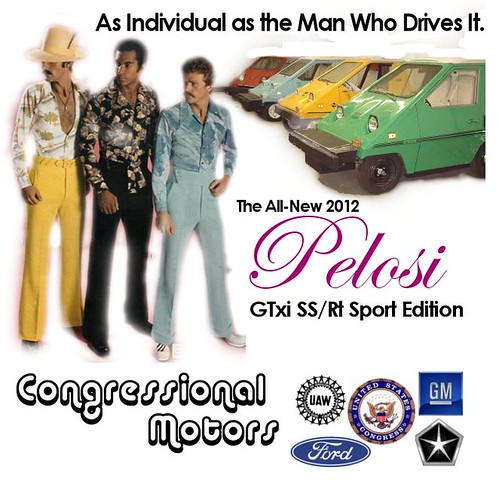
It's in the way you dress. The way you boogie down. The way you sign your unemployment check. You're a man who likes to do things your own way. And on those special odd-numbered Saturdays when driving is permitted, you want it in your car. It's that special feeling of a zero-emissions wind at your back and a road ahead meandering with possibilities. The kind of feeling you get behind the wheel of the Pelosi GTxi SS/Rt Sport Edition from Congressional Motors.
All new for 2012, the Pelosi GTxi SS/Rt Sport Edition is the mandatory American car so advanced it took $100 billion and an entire Congress to design it. We started with same reliable 7-way hybrid ethanol-biodeisel-electric-clean coal-wind-solar-pedal power plant behind the base model Pelosi, but packed it with extra oomph and the sassy styling pizazz that tells the world that 1974 Detroit is back again -- with a vengeance.
We've subsidized the features you want and taxed away the rest. With its advanced Al Gore-designed V-3 under the hood pumping out 22.5 thumping, carbon-neutral ponies of Detroit muscle, you'll never be late for the Disco or the Day Labor Shelter. Engage the pedal drive or strap on the optional jumbo mizzenmast, and the GTxi SS/Rt Sport Edition easily exceeds 2016 CAFE mileage standards. At an estimated 268 MPG, that's a savings of nearly $1800 per week in fuel cost over the 2011 Pelosi.
Even with increased performance we didn't skimp on safety. With 11-point passenger racing harnesses, 15-way airbags, and mandatory hockey helmet, you'll have the security knowing that you could survive a 45 MPH collision even if the GTxi SS/Rt were capable of that kind of illegal speed.
But the changes don't stop there. Sporty mag-style hubcaps and an all-new aggressive wedge shape designed by CM's Chief Stylist Ted Kennedy slices through the wind like an omnibus spending bill. It even features an airtight undercarriage to keep you and a passenger afloat up to 15 minutes -- even in the choppy waters of a Cape Cod inlet. Available a rainbow of color choices to match any wardrobe, from Harvest Avocado to French Mustard.
Inside, a luxurious all-velour interior designed by Barney Frank features thoughtful appointments like in-dash condom dispenser and detachable vibrating shift knob. A special high capacity hatchback holds up to 300 aluminum cans, meaning fewer trips to the redemption center. And the standard 3 speaker Fairness ActoPhonic FM low-band sound system means you'll never miss a segment of NPR again.
Best of all, the Pelosi GTxi SS/Rt is made right here in the U.S.A. by fully card-checked unionized workers and Detroit's famous visionary jet-set managers. Even if you don't own one, you can enjoy the patriotic satisfaction that you're supporting the high wages, good benefits, and generous political donations that are once again making the American car industry the envy of the world.
But why not buy one anyway? With an MSRP starting at only $629,999.99, it's affordable too. Don't forget to ask about dealer incentives, rebates, tax credits, and wealth redistribution plans for customers from dozens of qualifying special interest groups. Plus easy-pay financing programs from Fannie Mae.
So take the bus to your local CM dealer today and find out why the Pelosi GTxi SS/Rt Sport Edition is the only car endorsed by President Barack Obama. One test drive will convince you that you'd choose it over the import brands. Even if they were still legal.
All new for 2012, the Pelosi GTxi SS/Rt Sport Edition is the mandatory American car so advanced it took $100 billion and an entire Congress to design it. We started with same reliable 7-way hybrid ethanol-biodeisel-electric-clean coal-wind-solar-pedal power plant behind the base model Pelosi, but packed it with extra oomph and the sassy styling pizazz that tells the world that 1974 Detroit is back again -- with a vengeance.
We've subsidized the features you want and taxed away the rest. With its advanced Al Gore-designed V-3 under the hood pumping out 22.5 thumping, carbon-neutral ponies of Detroit muscle, you'll never be late for the Disco or the Day Labor Shelter. Engage the pedal drive or strap on the optional jumbo mizzenmast, and the GTxi SS/Rt Sport Edition easily exceeds 2016 CAFE mileage standards. At an estimated 268 MPG, that's a savings of nearly $1800 per week in fuel cost over the 2011 Pelosi.
Even with increased performance we didn't skimp on safety. With 11-point passenger racing harnesses, 15-way airbags, and mandatory hockey helmet, you'll have the security knowing that you could survive a 45 MPH collision even if the GTxi SS/Rt were capable of that kind of illegal speed.
But the changes don't stop there. Sporty mag-style hubcaps and an all-new aggressive wedge shape designed by CM's Chief Stylist Ted Kennedy slices through the wind like an omnibus spending bill. It even features an airtight undercarriage to keep you and a passenger afloat up to 15 minutes -- even in the choppy waters of a Cape Cod inlet. Available a rainbow of color choices to match any wardrobe, from Harvest Avocado to French Mustard.
Inside, a luxurious all-velour interior designed by Barney Frank features thoughtful appointments like in-dash condom dispenser and detachable vibrating shift knob. A special high capacity hatchback holds up to 300 aluminum cans, meaning fewer trips to the redemption center. And the standard 3 speaker Fairness ActoPhonic FM low-band sound system means you'll never miss a segment of NPR again.
Best of all, the Pelosi GTxi SS/Rt is made right here in the U.S.A. by fully card-checked unionized workers and Detroit's famous visionary jet-set managers. Even if you don't own one, you can enjoy the patriotic satisfaction that you're supporting the high wages, good benefits, and generous political donations that are once again making the American car industry the envy of the world.
But why not buy one anyway? With an MSRP starting at only $629,999.99, it's affordable too. Don't forget to ask about dealer incentives, rebates, tax credits, and wealth redistribution plans for customers from dozens of qualifying special interest groups. Plus easy-pay financing programs from Fannie Mae.
So take the bus to your local CM dealer today and find out why the Pelosi GTxi SS/Rt Sport Edition is the only car endorsed by President Barack Obama. One test drive will convince you that you'd choose it over the import brands. Even if they were still legal.

Thread
Thread Starter
Forum
Replies
Last Post


