


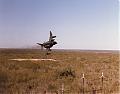
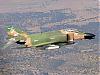
F-4 (Udvar-Hazy Center - IAD)



 06-24-2010 | 04:58 PM
#5
China Visa Applicant
Joined: Oct 2006
Posts: 1,962
Likes: 15
From: Midfield downwind
 08-06-2010 | 08:47 AM
#7
Moderate Moderator
Joined: Mar 2008
Posts: 5,681
Likes: 0
From: Curator at Static Display
 Complete Answer
The Boundary Layer starts at the leading edge of any aircraft or its surfaces. There is some complex math involved, but essentially, the boundary layer gets thicker and thicker as you move aft. The speed of the air in the boundary layer is supposed to be zero at the skin, and increase until it reaches your true airspeed as you move away from the skin.
The gap is the "Splitter Plate," and is supposed to keep the intake in free-stream air, instead of being mixed with some slow-moving boundary-layer air (which would make it turbulent).
The splitter doesn't 'retract:' the leading edge is fixed, and the portion at the front of the intake-lip moves out to partially close the intake at supersonic speeds. (So you could say it "Extends.") By reducing the area air can go in to the engine, it then expands behind the intake, and slows down...to subsonic speeds. Jet engines don't like supersonic air.
You will see this gap on any fuselage-mounted engine (MD-80; F-15; F-18, F-16). The Hornet and Viper have the gap "above" the inlet, but the concept is the same.
10-22-2010 | 03:52 PM
#8
Snakes & Nape
Joined: Nov 2006
Posts: 775
Likes: 0
From: B-767 Captain
 You Got an "A", Sir.
The Boundary Layer starts at the leading edge of any aircraft or its surfaces. There is some complex math involved, but essentially, the boundary layer gets thicker and thicker as you move aft. The speed of the air in the boundary layer is supposed to be zero at the skin, and increase until it reaches your true airspeed as you move away from the skin.
The gap is the "Splitter Plate," and is supposed to keep the intake in free-stream air, instead of being mixed with some slow-moving boundary-layer air (which would make it turbulent).
The splitter doesn't 'retract:' the leading edge is fixed, and the portion at the front of the intake-lip moves out to partially close the intake at supersonic speeds. (So you could say it "Extends.") By reducing the area air can go in to the engine, it then expands behind the intake, and slows down...to subsonic speeds. Jet engines don't like supersonic air.
The gap is the "Splitter Plate," and is supposed to keep the intake in free-stream air, instead of being mixed with some slow-moving boundary-layer air (which would make it turbulent).
The splitter doesn't 'retract:' the leading edge is fixed, and the portion at the front of the intake-lip moves out to partially close the intake at supersonic speeds. (So you could say it "Extends.") By reducing the area air can go in to the engine, it then expands behind the intake, and slows down...to subsonic speeds. Jet engines don't like supersonic air.
Thanks for the photo of the best damn fighter ever. Yea, yea, I know about the F-14, F-16 and others but even though it was a handful at times, what a hell of an aircraft !
Gads, I miss her.
 10-23-2010 | 08:04 AM
#9

Gets Weekends Off
Joined: Oct 2006
Posts: 163
Likes: 0
From: B777 Capt(retired)
But not an A+ - T38
My aero engineering and phantom memories(did/flew both) are getting faded but the ramp did not start moving until the 1.3-1.5+ mach regime. (Can't remember exactly). This was done to ANGLE the supersonic shock wave so the wave totally occured before hitting the compressor face(really bad). The ramp moving to reduce the area as T38 said is not really correct. Other fighters without moving ramps like the F104 (500 hrs in that) have longer inlets or adequate fixed ramps/cones to insure the shock wave happens and the air goes subsonic before getting to the compressor face. End of thread drift! Nice picture!
10-23-2010 | 11:02 AM
#10
Moderator
Joined: May 2006
Posts: 6,056
Likes: 0
From: ATP, CFI etc.
Nice explanation KN. I have an aero degree and I know all the science involved with supersonic inlet design, but it often takes model-specific knowledge to be able to say exactly what a design feature does even knowing the science so I generally prefer not to speculate. For example, in this case on the F-4 it is obvious the vertical blade is a boundary layer separator, but I did not know the whole thing moves. If I had known that I might have ventured a guess it changes the cross section area to slow down the air and it might have dawned on me it also relocates the shock a little bit, but model-specific information is needed to be able to say for sure.

Thread
Thread Starter
Forum
Replies
Last Post


