


Q3 earnings call
 10-11-2025 | 07:54 PM
#101
Line Holder
Joined: Oct 2009
Posts: 1,154
Likes: 192

There is not a business or organization that doesn't depend on some degree of government subsidy.
Collective investment into all the complex webs that make complex societies function is a requirement for daily life.
Without these subsidies everything would grind to a halt pretty quickly.
In fairness I know you are speaking of the egregious excesses. But where and how to rein them in isn't as straightforward as we think.
Example: a public company is awarded a no bid open ended contract during the Iraq war. Their stock soars. You, or your 401K , owns some of that stock. You become richer, without doing a thing.
The money for that no bid contract came from govt 10 year TBills. It's borrowed.
The large number of people who have zero stake in the market are negatively affected by this debt, as are you. But you also made money from this act of borrowing. Your 401K, or stock portfolio pockets a subsidy that was granted in a borderline corrupt fashion. A crackdown on this would generate howls from those with political power. Those who buy stocks have political power.
They (and that includes your economic group) don't want the egregious excesses reined in.
The philosophy of acting for the greater good was essentially killed by the 1980 Presidential election, and then put into practical application with Newt Gingrich becoming Speaker of the House.
Ending egregious excesses would take a sea change of political philosophy that has reigned for 45 years.
Collective investment into all the complex webs that make complex societies function is a requirement for daily life.
Without these subsidies everything would grind to a halt pretty quickly.
In fairness I know you are speaking of the egregious excesses. But where and how to rein them in isn't as straightforward as we think.
Example: a public company is awarded a no bid open ended contract during the Iraq war. Their stock soars. You, or your 401K , owns some of that stock. You become richer, without doing a thing.
The money for that no bid contract came from govt 10 year TBills. It's borrowed.
The large number of people who have zero stake in the market are negatively affected by this debt, as are you. But you also made money from this act of borrowing. Your 401K, or stock portfolio pockets a subsidy that was granted in a borderline corrupt fashion. A crackdown on this would generate howls from those with political power. Those who buy stocks have political power.
They (and that includes your economic group) don't want the egregious excesses reined in.
The philosophy of acting for the greater good was essentially killed by the 1980 Presidential election, and then put into practical application with Newt Gingrich becoming Speaker of the House.
Ending egregious excesses would take a sea change of political philosophy that has reigned for 45 years.
 10-12-2025 | 03:54 AM
#102

Can't abide NAI
Joined: Jun 2007
Posts: 12,078
Likes: 15
From: Douglas Aerospace post production Flight Test & Work Around Engineering bulletin dissembler
I'm sorry again. I'm a big casual rail nerd. I gotta speak up here too.
It's expensive but we have to start somewhere. HSR and rail in general is critical for our future.
1. The roads and cities can only fit so many cars. The geometry just isn't there. You can make a highway 20 lanes wide, but it will still be clogged by the weakest bottleneck. The highway may be wide but the destinations are not. The only cure for traffic is to get cars off the roads.
2. Climate disaster isn't slowing down. We are selling off our future. Even if you "don't believe" in climate change eventually oil will run out. We need the infrastructure in place sooner than later.
3. Long term expense. Private automobiles is by far the most energy inefficient and expensive way to transport people. This is a burden not just on individuals but the their economy. The cost is not just the energy but also the destruction of material and human life, and ultimately pointless industries like auto insurance and litigation. They are leeches on our economy. Rail has a up front cost but pays off over time.
Anyways, thanks for listening. Rail is the future. It was a mistake to over build for cars. It was a mistake to rip up 90% of our old rail lines. Thanks for listening to my nerdy rant. Peace
It's expensive but we have to start somewhere. HSR and rail in general is critical for our future.
1. The roads and cities can only fit so many cars. The geometry just isn't there. You can make a highway 20 lanes wide, but it will still be clogged by the weakest bottleneck. The highway may be wide but the destinations are not. The only cure for traffic is to get cars off the roads.
2. Climate disaster isn't slowing down. We are selling off our future. Even if you "don't believe" in climate change eventually oil will run out. We need the infrastructure in place sooner than later.
3. Long term expense. Private automobiles is by far the most energy inefficient and expensive way to transport people. This is a burden not just on individuals but the their economy. The cost is not just the energy but also the destruction of material and human life, and ultimately pointless industries like auto insurance and litigation. They are leeches on our economy. Rail has a up front cost but pays off over time.
Anyways, thanks for listening. Rail is the future. It was a mistake to over build for cars. It was a mistake to rip up 90% of our old rail lines. Thanks for listening to my nerdy rant. Peace
Anecdotally, some nerd “scratched my back and I took my foot off the brake pedal” to smash into the rear of my car this week and it is getting almost impossible to get to the Atlanta Airport from the North side of town regardless of how much time you allocated to the task. Our freeways are impassible for two thirds of the diurnal cycle.
10-12-2025 | 04:34 AM
#103
Gets Weekends Off
Joined: Jul 2013
Posts: 12,523
Likes: 1,113
Agree with your post and add that on my car podcast this week Motor Trend and the rest of the nerds are taking a helicopter to the track day because it is too damn hard to get there in a car.
Anecdotally, some nerd “scratched my back and I took my foot off the brake pedal” to smash into the rear of my car this week and it is getting almost impossible to get to the Atlanta Airport from the North side of town regardless of how much time you allocated to the task. Our freeways are impassible for two thirds of the diurnal cycle.
Anecdotally, some nerd “scratched my back and I took my foot off the brake pedal” to smash into the rear of my car this week and it is getting almost impossible to get to the Atlanta Airport from the North side of town regardless of how much time you allocated to the task. Our freeways are impassible for two thirds of the diurnal cycle.
10-12-2025 | 05:03 AM
#104
Line Holder
Joined: Aug 2024
Posts: 869
Likes: 266
There's something truly American about driving. A Tesla esque FSD on the highway would probably allow us to drastically increase capacity/highway speeds while decreasing ridiculous traffic snares caused by lookie lous. But, there will be a non-zero number of people who will refuse to use it because it's their right to do 15 over the speed limit, weaving in and out of traffic and making it worse for the rest of us. Being "forced" to take a train with the rest of us, even if it gets there faster, is too collective for them
10-12-2025 | 05:27 AM
#105
.
Joined: Nov 2017
Posts: 3,507
Likes: 678
I live in the area with arguably the best public transit in the US. (NYC metro)
I'm not super far out of town. 25 out of Newark and 35 to Manhattan.
Just for me to go downtown, to Penn Station is 1+30, with hourly trains. Granted it's Sunday but the time is the same on weekdays, just more trains. Then I have to get to the Denville station which is 4.5 miles from my house.
I took the train once to work because I deviated to Philly and drove back from Philly with my wife. It took 3 hours door to door. NJT to Penn, LIRR to Jamaica and Airtrain to JFK.
One way it was $38 just in fares. So $76 round trip. If I drove it would be $30 in tolls, $20 in diesel round trip. And less time.
The "last mile" (or 5 in my case) is often what kills mass transit reliably replacing cars and urban and suburban design play into that and it's not going to easily be changed.
I'm not super far out of town. 25 out of Newark and 35 to Manhattan.
Just for me to go downtown, to Penn Station is 1+30, with hourly trains. Granted it's Sunday but the time is the same on weekdays, just more trains. Then I have to get to the Denville station which is 4.5 miles from my house.
I took the train once to work because I deviated to Philly and drove back from Philly with my wife. It took 3 hours door to door. NJT to Penn, LIRR to Jamaica and Airtrain to JFK.
One way it was $38 just in fares. So $76 round trip. If I drove it would be $30 in tolls, $20 in diesel round trip. And less time.
The "last mile" (or 5 in my case) is often what kills mass transit reliably replacing cars and urban and suburban design play into that and it's not going to easily be changed.
10-12-2025 | 05:31 AM
#106
Moderator
Joined: Jul 2006
Posts: 7,485
Likes: 479
If we wanted to build an efficient passenger rail system for max use in the states, we'd have to suspend a metric ton of laws at every level of government, exercise a serious amount of eminent domain and essentially tell every lawyer in the nation to get bent. Personally, I'd love to see it happen. But given the extreme cost and snails pace of most large infrastructure projects we have, I won't hold my breath. Last I read, just to rebuild a bridge that was already there (F Scott Key), it's going to cost $2B and take another four years. Of course that's before any budget increases and delays due to whatever litigation can be dreamed up.
10-12-2025 | 05:41 AM
#107
.
Joined: Nov 2017
Posts: 3,507
Likes: 678
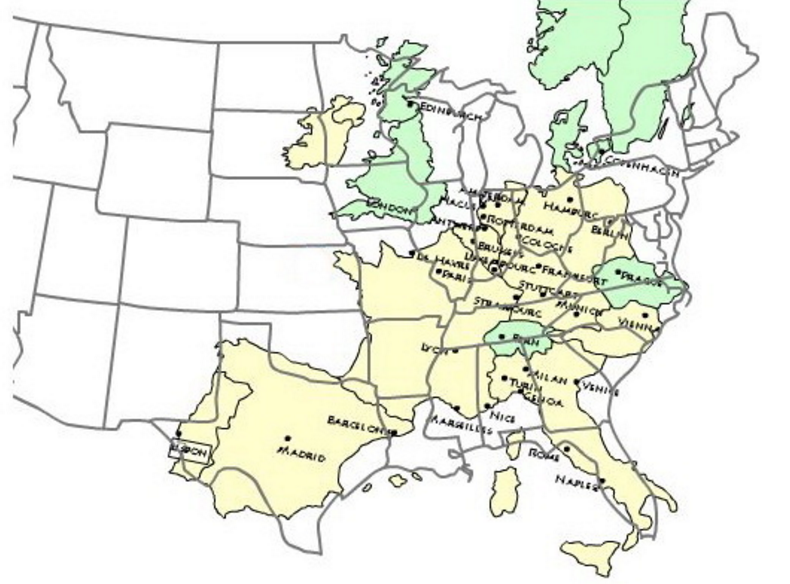
People often hold up Europe as a model of what to do.
Two big things they have that we dont:
They started with more or less a clean sheet post WWII rebuild with a lot of it funded under the Marshall plan or it's Soviet equivalent.
Their cities and villages were mainly laid out pre vehicular transport and only the rich had horses. By the time the US expanded off the east coast, even a ever family usually had a mule, horse, or other beast of burden.
Also, population density. People forget how empty a lot of the US is. I drive from NJ to CA and back most years and once you get west of the Mississippi it gets pretty sparse outside of a large town every 20 miles.
Two big things they have that we dont:
They started with more or less a clean sheet post WWII rebuild with a lot of it funded under the Marshall plan or it's Soviet equivalent.
Their cities and villages were mainly laid out pre vehicular transport and only the rich had horses. By the time the US expanded off the east coast, even a ever family usually had a mule, horse, or other beast of burden.
Also, population density. People forget how empty a lot of the US is. I drive from NJ to CA and back most years and once you get west of the Mississippi it gets pretty sparse outside of a large town every 20 miles.
10-12-2025 | 06:06 AM
#108

Line Holder
Joined: Mar 2007
Posts: 648
Likes: 4
People often hold up Europe as a model of what to do.
Two big things they have that we dont:
They started with more or less a clean sheet post WWII rebuild with a lot of it funded under the Marshall plan or it's Soviet equivalent.
Their cities and villages were mainly laid out pre vehicular transport and only the rich had horses. By the time the US expanded off the east coast, even a ever family usually had a mule, horse, or other beast of burden.
Also, population density. People forget how empty a lot of the US is. I drive from NJ to CA and back most years and once you get west of the Mississippi it gets pretty sparse outside of a large town every 20 miles.
Two big things they have that we dont:
They started with more or less a clean sheet post WWII rebuild with a lot of it funded under the Marshall plan or it's Soviet equivalent.
Their cities and villages were mainly laid out pre vehicular transport and only the rich had horses. By the time the US expanded off the east coast, even a ever family usually had a mule, horse, or other beast of burden.
Also, population density. People forget how empty a lot of the US is. I drive from NJ to CA and back most years and once you get west of the Mississippi it gets pretty sparse outside of a large town every 20 miles.
10-12-2025 | 06:40 AM
#109
Can’t find crew pickup
Joined: Jun 2021
Posts: 3,058
Likes: 200
I would reference crewdawgs post above. The Chinese government does whatever it wants, with total control, and zero regard for eminent domain, environmental concerns, or lawsuits.
10-12-2025 | 06:59 AM
#110
Moderator
Joined: Jul 2006
Posts: 7,485
Likes: 479
Not to mention cheaper cost to build, largely due to labor costs in China. CXT hit on some great points, but the last mile (or 10), is what makes it tough. A vast majority of America isn't walkable. Also, the bulk of their rail network encompasses an area that mostly fits east of the Mississippi. I'd love to see an amazing rail network in the states, but we should have hitched our horse to that wagon a long time ago.
https://www.youtube.com/watch?v=0JDoll8OEFE

Thread
Thread Starter
Forum
Replies
Last Post


