


19 seater turboprop


 03-13-2012 | 01:14 AM
#196

Day puke
Joined: Feb 2006
Posts: 3,865
Likes: 0
From: Out.

No, but some things are different.
Where I learned to fly if you had an engine failure in IMC (or simulated) you would fly the plane first and then after control was regained you would worry about shooting an approach to land, even if the failure was during an approach.
When I took my check-ride the examiner simulated an engine failure right when I was getting established on the LOC coming at a 30 degree angle.
So I did as I was used to, flew the plane, performed the procedures and then I worried about navigating to a fix where I could resume/restart the approach from. I didn't know at the time that I was supposed to keep tracking of the approach while performing the single-engine procedures.
The examiner told me I had failed and the reason why. We set up a date to go fly again the following week, which we did, and I passed the second time.
What's funny is that when I took the same check-ride abroad for the first time, the examiner's critique was that I should have just flown the plane first before worrying about the approach, he said to keep my a$$ in one piece and then navigate to an airport to land. So keeping that in mind made me fail here, oh well, just another learning experience!
Where I learned to fly if you had an engine failure in IMC (or simulated) you would fly the plane first and then after control was regained you would worry about shooting an approach to land, even if the failure was during an approach.
When I took my check-ride the examiner simulated an engine failure right when I was getting established on the LOC coming at a 30 degree angle.
So I did as I was used to, flew the plane, performed the procedures and then I worried about navigating to a fix where I could resume/restart the approach from. I didn't know at the time that I was supposed to keep tracking of the approach while performing the single-engine procedures.
The examiner told me I had failed and the reason why. We set up a date to go fly again the following week, which we did, and I passed the second time.
What's funny is that when I took the same check-ride abroad for the first time, the examiner's critique was that I should have just flown the plane first before worrying about the approach, he said to keep my a$$ in one piece and then navigate to an airport to land. So keeping that in mind made me fail here, oh well, just another learning experience!
I'm glad you took it as a learning experience. Good for you!
There is no absolute about when one responds to a warning and says "Noted, continue." One could argue for and against breaking off the approach to run the checklists for an engine failure. Personally, I agree with your post (going on what details I have): secure the engine, and get on the ground. Had it been an engine fire, I would agree even more. Unfortunately, many examiners believe "mine is the best way to do it." Had your examiner allowed the flight to continue, then in the debrief asked why you did what you did (as I would if I were an examiner), he might have understood your logic and agreed with you. There are many ways to skin a cat. Your choice to continue could have resulted in a good outcome. That said, his choice to stay aloft, run every checklist, then shoot the approach could have resulted in a good outcome. Which is better? Well, that is whichever the NTSB deems correct.
03-13-2012 | 01:27 AM
#197
Day puke
Joined: Feb 2006
Posts: 3,865
Likes: 0
From: Out.
Back in my day, you had to be a graduate from space camp to get a regional job. 510210501240921 hours total time, and be able to down 5 beers in 10 seconds while hanging upside down. I had to go out and CFI for 10 years, then fly night freight in a plane that flew by me flapping my arms all night, in ice, with no boots, and rabbit wolves in the cabin. After 25 years of that, you might get hired by great lakes.
Guys these days just are not ready for the RJ life. Not sure how guys under 1000 hours have been hired for over 12 years now to fly RJs. Its such a shock to me that it has begun to happen.
Guys these days just are not ready for the RJ life. Not sure how guys under 1000 hours have been hired for over 12 years now to fly RJs. Its such a shock to me that it has begun to happen.
Experience teaches us how to recover from being in a bad place (either man made or act of God). It isn't fool proof, but it does give us more tools.
03-13-2012 | 06:39 AM
#198
Gets Weekends Off
Joined: Feb 2011
Posts: 820
Likes: 0
Because they were hired to fly a transport aircraft straight and level. I might add, those RJs were designed to be flown by 250 hour pilots: little system knowledge required (when compared to a 707, 727, or DC8). Everything is great until something unusual happens (due to CAT, CBs, wake turbulence, etc): think of AF 447 or Colgan 3407.
Experience teaches us how to recover from being in a bad place (either man made or act of God). It isn't fool proof, but it does give us more tools.
Experience teaches us how to recover from being in a bad place (either man made or act of God). It isn't fool proof, but it does give us more tools.
03-13-2012 | 10:16 AM
#199
Works Every Weekend
Joined: Apr 2006
Posts: 1,210
Likes: 0
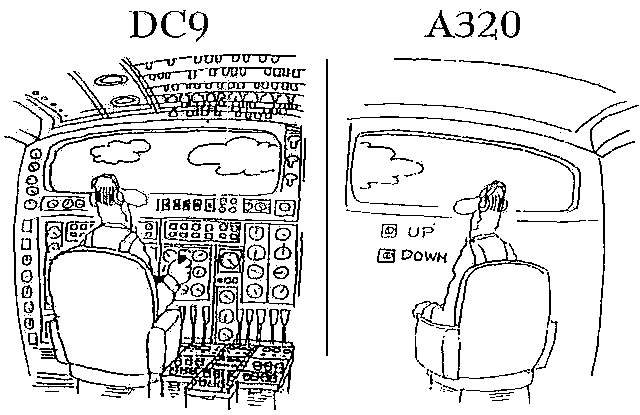
And to the above post about RJ's being much simpler systems-wise than a DC-8, 707, or 727..... of course they are. So is a 777, 747-400, 767, 757, 737, 717, A330, A340, A380, A320, and every other modern transport category airplane. Automation advances in 50 years.... enough to eliminate a crew-member.
03-13-2012 | 01:08 PM
#200
Gets Weekends Off
Joined: Jun 2010
Posts: 106
Likes: 0
See Air France.
And to the above post about RJ's being much simpler systems-wise than a DC-8, 707, or 727..... of course they are. So is a 777, 747-400, 767, 757, 737, 717, A330, A340, A380, A320, and every other modern transport category airplane. Automation advances in 50 years.... enough to eliminate a crew-member.
And to the above post about RJ's being much simpler systems-wise than a DC-8, 707, or 727..... of course they are. So is a 777, 747-400, 767, 757, 737, 717, A330, A340, A380, A320, and every other modern transport category airplane. Automation advances in 50 years.... enough to eliminate a crew-member.
Reminded me of this picture...

Thread
Thread Starter
Forum
Replies
Last Post


