


Notable developments in Russo-Ukraine War 2
 05-10-2026 | 07:58 PM
#261

Line Holder
Joined: Feb 2015
Posts: 982
Likes: 83
From: NOYB

How about we shut this thread down? It really has almost nothing to do with discussing the war in Ukraine itself. There have been a few notable developments there in the last couple of weeks that have not been brought up (According to Phillips O'Brien, in April for the first time the Ukrainians launched more "ranged" attacks inside Russia than vice versa - 7500 vs 6500. No wonder the Victory Day parade went eco friendly). I'm tired of reading about European ineptitude, at least they didn't blow half their wad in the space of a few weeks by starting a war they cannot actually win. Pretty sure they now fully understand they are on their own, and are slowly adjusting to their new reality.
 05-11-2026 | 05:39 AM
#262
Line Holder
Joined: Oct 2009
Posts: 1,154
Likes: 192
1. For over a year now the US has cut off aid to Ukraine, yet Ukraine is doing quite well without it.
2. The US lifted ssnctions on Russian oil.
3. The war in Iran spiked world oil and nat. Gas prices
2 and 3 have thrown Russia a cash lifeline.
Moral in Ukraine is up. They have come to terms with the fact that the US has gone to the dark side. That the stability of the world rules based order, let alone right or wrong, is no longer part of Washington's approach to Russia's war.
Also, winter is over. They froze, but they survived. It has again "uplifted the hearts".
05-11-2026 | 08:59 PM
#263
Line Holder
Joined: Mar 2015
Posts: 1,577
Likes: 71
So what?
None of us control what Europe says or does.
But we all know that you have supported russia’s murderous invasion for 4 years now.
You are a faithful servant of the kremlin.
.
05-11-2026 | 09:41 PM
#264
Thread Starter
Perennial Reserve
Joined: Jan 2018
Posts: 14,261
Likes: 259
Meanwhile, the current outlook:
alt=""
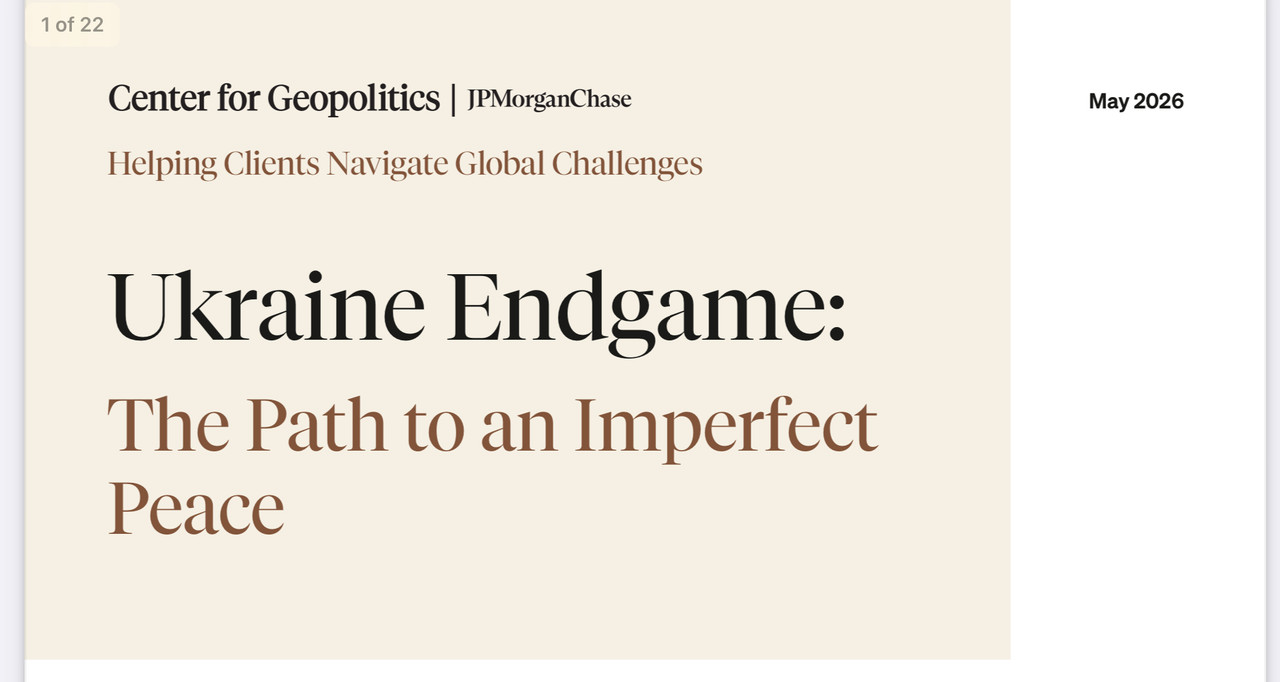
An executive summary:
alt=""
 05-12-2026 | 06:38 AM
#265
Gets Weekends Off
Joined: Apr 2011
Posts: 3,517
Likes: 143
05-12-2026 | 07:43 AM
#266
Thread Starter
Perennial Reserve
Joined: Jan 2018
Posts: 14,261
Likes: 259
Western European politics have become totally ugly. Merz and Starmer are polling not much higher favorability than Hantavirus. Meanwhile, Eastern Europe is doing their best to hold the transatlantic alliance together.
MAY 12, 2026 1:46 PM CET
BY VICTOR JACKAt least five NATO countries on Europe's eastern flank are rushing to bid for American troops on their soil after U.S. President Donald Trump said he would pull 5,000 or more soldiers from Germany.
Poland, Estonia, Lithuania, Latvia and Romania have all expressed interest in hosting more U.S. troops, both through public statements and private lobbying. The push comes after Trump announced the German drawdown earlier this month over an escalating spat with Berlin — sparked by Chancellor Friedrich Merz's comments that Tehran had "humiliated" Washington with its negotiation tactics in the Iran war.
“I firmly believe a stronger U.S. presence on the Eastern Flank is necessary … we would welcome a permanent U.S. presence on our territory,” Romania’s outgoing Deputy Defense Minister Sorin Moldovan told POLITICO. “Romania has consistently demonstrated its commitment to the [country's] Strategic Partnership with the U.S. and has proven itself a reliable partner.”
BY VICTOR JACKAt least five NATO countries on Europe's eastern flank are rushing to bid for American troops on their soil after U.S. President Donald Trump said he would pull 5,000 or more soldiers from Germany.
Poland, Estonia, Lithuania, Latvia and Romania have all expressed interest in hosting more U.S. troops, both through public statements and private lobbying. The push comes after Trump announced the German drawdown earlier this month over an escalating spat with Berlin — sparked by Chancellor Friedrich Merz's comments that Tehran had "humiliated" Washington with its negotiation tactics in the Iran war.
“I firmly believe a stronger U.S. presence on the Eastern Flank is necessary … we would welcome a permanent U.S. presence on our territory,” Romania’s outgoing Deputy Defense Minister Sorin Moldovan told POLITICO. “Romania has consistently demonstrated its commitment to the [country's] Strategic Partnership with the U.S. and has proven itself a reliable partner.”
https://www.politico.eu/article/germ...comeback-tour/
https://www.politico.eu/article/keir...-live-updates/
05-13-2026 | 04:23 AM
#268
Gets Weekends Off
Joined: Dec 2007
Posts: 6,434
Likes: 124
From: Window seat
Article yesterday mentioned that Russia's had more casualties in the last 4-5 months than it's replacement rate. It also mentioned that it deaths to wounded ration has gone from 1:2 or 1:3 to 2:1 as Ukrainians drone kill effectiveness has increased. It also looks like Russia's spring offensive is, overall, a net territory loser. Add Ukrainians deep drone abilities reaching deep into Russia, as well as Ukrainians ability to increase the depth of it's kill zone behind the FLOT/FEBA, and Russia's difficulties are increasing.
05-13-2026 | 04:05 PM
#269
Line Holder
Joined: Mar 2015
Posts: 1,577
Likes: 71
russias failed offensive
 Russia entered spring expecting another grinding advance across Ukraine’s front lines. It burned through tens of thousands of troops for marginal territorial gains instead, while Ukrainian drone warfare has been steadily dismantling Russia’s logistics, reserves, and offensive momentum. The first third of 2026 proved difficult for the Russian army, with only minimal advances. Considering that Ukraine managed to liberate between 400 and 500 square kilometers of territory in February and March, the effectiveness of Moscow’s operations can be called into question altogether: January through April 2026 became Russia’s worst period since 2023, and after an active 2025, it can be described as a failure. The trend is also worsening.
We bring you stories from the ground. Your support keeps our team in the field.
DONATE NOW“Russian forces have failed to achieve any significant operational progress over the past year,” despite continued offensive operations across multiple sectors of the front, the Institute for the Study of War (ISW) reported on May 10.
Russia occupied even less territory in April than in March—about 300 square kilometers in total over the two months, Ukrainian open-source intelligence (OSINT) project DeepState reported. The largest advance was in the Donetsk region, where Russian forces captured 53 square kilometers. For context, over the past month, Russia suffered its heaviest losses precisely in the Donetsk sector—more than 25,000 killed and wounded. That is 471 troops per square kilometer. DeepState says each square kilometer of captured territory costs Russia 36 assaults.
Ukraine still controls about 7,000 square kilometers of territory in the Donetsk region. Based on April’s statistics, capturing these territories would take decades—and cost millions of casualties.
The situation continued in April: over the month, Russian losses exceeded 35,000 troops, bringing the two-month total to more than 70,000. Should the trend continue—and daily reports from Ukraine’s General Staff indicate that it is continuing—total Russian army losses by the end of spring could exceed 100,000 troops.
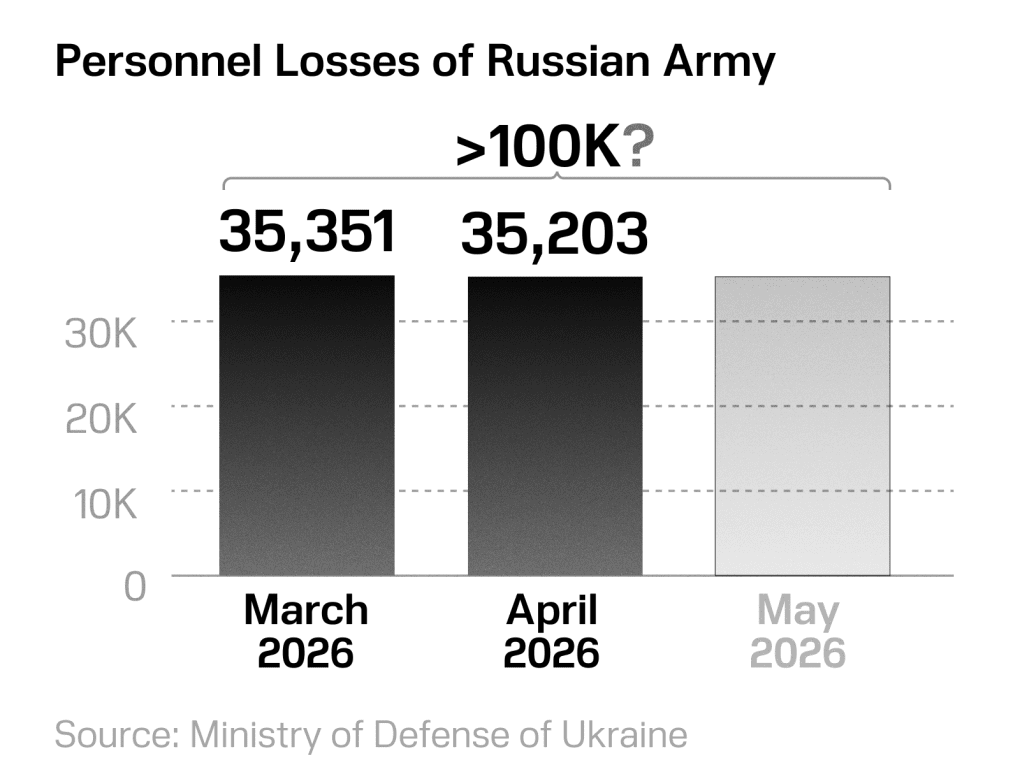 Infographic shows losses of Russian army in spring 2026. (Illustration: UNITED24 Media)At the moment, however, these losses do not appear justified for Russia: occupation forces cannot claim any serious results from their offensives. Meanwhile, the number of assaults increased by 2.2% in April compared with March.
Moreover, one-third of the captured territories are border areas in the Sumy region, where Russian military groups entered in recent months: overall, 44 square kilometers have been captured there. Minor advances, involving the capture of several villages, were recorded in the Kharkiv and Zaporizhzhia regions, while almost all of the Dnipropetrovsk region has been liberated.
The statistics are unforgiving for the Russian army: the spring offensive campaign has been disrupted, despite record losses of manpower and equipment.
In recent months, Ukraine has also begun actively deploying so-called Middle Strike attacks—drones that fly up to 200 kilometers deep. These strikes make it possible to destroy ammunition depots, weapons arsenals, drone and equipment storage sites, and to attack command posts. The middle Strike strategy has shaken Russian logistics, forcing equipment farther back from the border and lengthening logistics routes—for example, troops now take longer to reach their positions.
Thanks to Middle Strike, Ukrainian forces can now even strike Mariupol, through which, among other things, runs the land corridor to Crimea and to Ukraine’s occupied southern territories. This creates additional transport challenges for the Russian army and further complicates logistics.
Read more
Russia is now preparing for a new offensive campaign—the summer one. But it faces a new challenge: manpower. In recent months, recruiting new soldiers has become harder. Information that the life cycle of a Russian soldier may be measured in weeks has already reached every region of Russia, where people understand very well that even if they receive a payment worth tens of thousands of dollars, it is a one-way trip.
Russia’s Failed 2026 Spring Offensive Cost It Nearly 100,000 Troops as Ukraine Retakes Ground
Russia entered spring expecting another grinding advance across Ukraine’s front lines. It burned through tens of thousands of troops for marginal territorial gains instead, while Ukrainian drone warfare has been steadily dismantling Russia’s logistics, reserves, and offensive momentum. The first third of 2026 proved difficult for the Russian army, with only minimal advances. Considering that Ukraine managed to liberate between 400 and 500 square kilometers of territory in February and March, the effectiveness of Moscow’s operations can be called into question altogether: January through April 2026 became Russia’s worst period since 2023, and after an active 2025, it can be described as a failure. The trend is also worsening.We bring you stories from the ground. Your support keeps our team in the field.
DONATE NOW“Russian forces have failed to achieve any significant operational progress over the past year,” despite continued offensive operations across multiple sectors of the front, the Institute for the Study of War (ISW) reported on May 10.
Russia occupied even less territory in April than in March—about 300 square kilometers in total over the two months, Ukrainian open-source intelligence (OSINT) project DeepState reported. The largest advance was in the Donetsk region, where Russian forces captured 53 square kilometers. For context, over the past month, Russia suffered its heaviest losses precisely in the Donetsk sector—more than 25,000 killed and wounded. That is 471 troops per square kilometer. DeepState says each square kilometer of captured territory costs Russia 36 assaults.
Ukraine still controls about 7,000 square kilometers of territory in the Donetsk region. Based on April’s statistics, capturing these territories would take decades—and cost millions of casualties.
Disrupting the offensive campaign
UNITED24 Media previously reported that Russia’s March offensive campaign had failed: in the middle of the month, Russia organized a dozen assaults on different sections of the front—and all of them were destroyed. In three days, losses surpassed 5,000 troops killed and wounded, while various Ukrainian units reported record enemy losses in their sections of the front.The situation continued in April: over the month, Russian losses exceeded 35,000 troops, bringing the two-month total to more than 70,000. Should the trend continue—and daily reports from Ukraine’s General Staff indicate that it is continuing—total Russian army losses by the end of spring could exceed 100,000 troops.
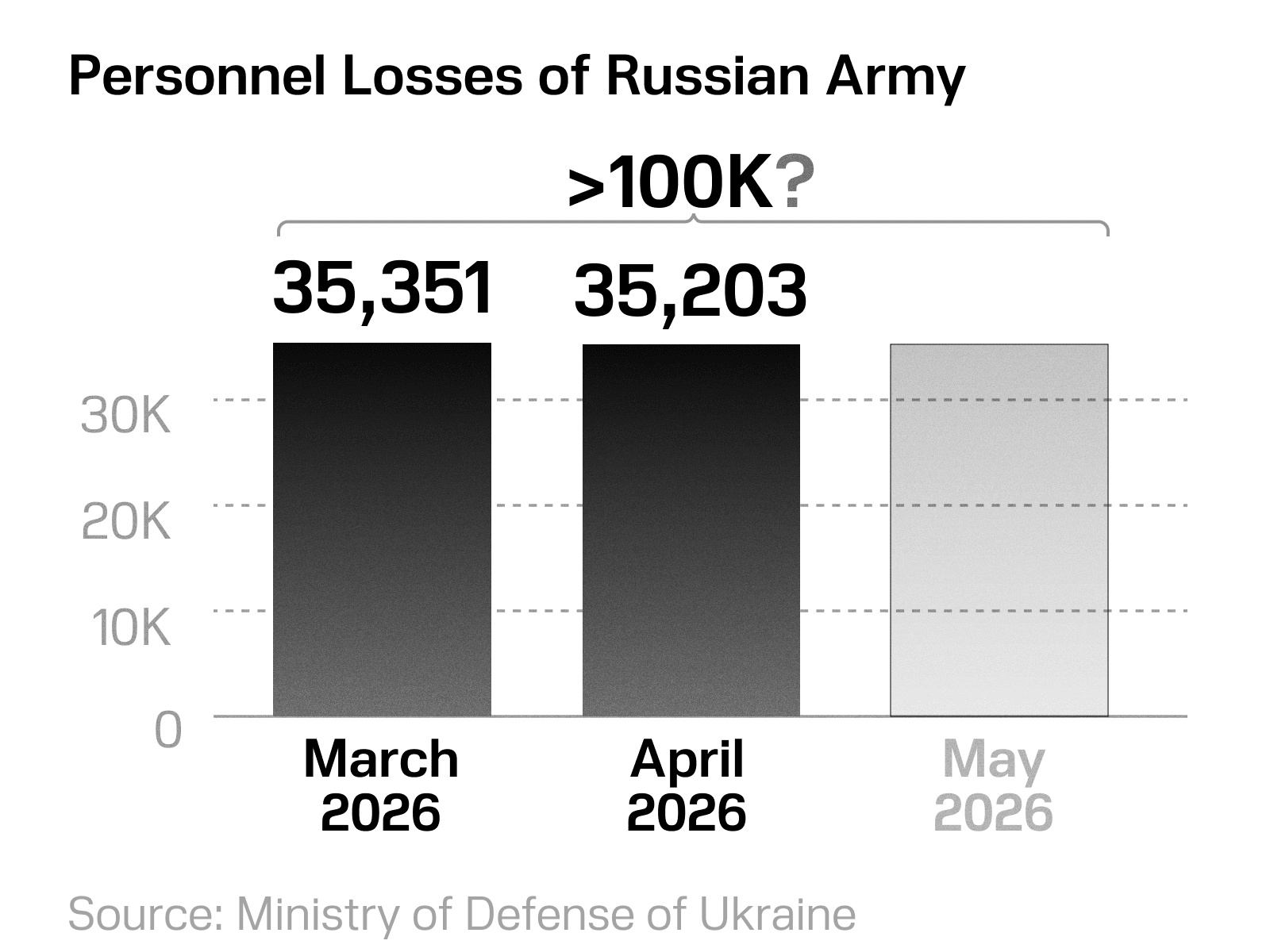 Infographic shows losses of Russian army in spring 2026. (Illustration: UNITED24 Media)At the moment, however, these losses do not appear justified for Russia: occupation forces cannot claim any serious results from their offensives. Meanwhile, the number of assaults increased by 2.2% in April compared with March.
Moreover, one-third of the captured territories are border areas in the Sumy region, where Russian military groups entered in recent months: overall, 44 square kilometers have been captured there. Minor advances, involving the capture of several villages, were recorded in the Kharkiv and Zaporizhzhia regions, while almost all of the Dnipropetrovsk region has been liberated.
The statistics are unforgiving for the Russian army: the spring offensive campaign has been disrupted, despite record losses of manpower and equipment.
0–200 km
The slowdown in Russia’s advance is attributed to the saturation of the line of contact with drones. But it would be incorrect to point only to FPV drones, even though they are indeed responsible today for more than 90% of the Russian army's losses.In recent months, Ukraine has also begun actively deploying so-called Middle Strike attacks—drones that fly up to 200 kilometers deep. These strikes make it possible to destroy ammunition depots, weapons arsenals, drone and equipment storage sites, and to attack command posts. The middle Strike strategy has shaken Russian logistics, forcing equipment farther back from the border and lengthening logistics routes—for example, troops now take longer to reach their positions.
Thanks to Middle Strike, Ukrainian forces can now even strike Mariupol, through which, among other things, runs the land corridor to Crimea and to Ukraine’s occupied southern territories. This creates additional transport challenges for the Russian army and further complicates logistics.
Read more
Russia is now preparing for a new offensive campaign—the summer one. But it faces a new challenge: manpower. In recent months, recruiting new soldiers has become harder. Information that the life cycle of a Russian soldier may be measured in weeks has already reached every region of Russia, where people understand very well that even if they receive a payment worth tens of thousands of dollars, it is a one-way trip.

Thread
Thread Starter
Forum
Replies
Last Post


