


Notable developments in Russo-Ukraine War 2
 04-29-2026 | 06:00 AM
#231

Thread Starter
Perennial Reserve
Joined: Jan 2018
Posts: 14,261
Likes: 259

Not directly part of the Russo-Ukraine War per se, but I would submit emblematic of WHY NATO deterrence in Europe failed to prevent this war.
Our NATO allies spent 35 years after the fall of the USSR gelding their own militaries by one “peace dividend” after another, one shortsighted decision piling on the previous and presaging the next. it was like the old tale of “boiling the frog” a 5% decrease didn’t seem like anything one couldn’t live for, and in a single year the difference between 100% and 95% really didn’t seem that much. But (0.95)^35 =0.166. So incrementally you give up a huge percentage of your capability. And many nations weren’t exactly pulling their own weight to begin with. What are you left with? Well, something like this:
https://nationalinterest.org/blog/bu...-sea-ps-042226
Some excerpts:
Our NATO allies have suffered “the death of a thousand cuts”, or at least the death of 35 years of cuts, and even if adequately funded TODAY it’ll likely take them a decade to recover from the unwise decisions of multiple administrations.
Our NATO allies spent 35 years after the fall of the USSR gelding their own militaries by one “peace dividend” after another, one shortsighted decision piling on the previous and presaging the next. it was like the old tale of “boiling the frog” a 5% decrease didn’t seem like anything one couldn’t live for, and in a single year the difference between 100% and 95% really didn’t seem that much. But (0.95)^35 =0.166. So incrementally you give up a huge percentage of your capability. And many nations weren’t exactly pulling their own weight to begin with. What are you left with? Well, something like this:
https://nationalinterest.org/blog/bu...-sea-ps-042226
Some excerpts:
Last month, President Donald Trump upset many in the British establishment by dismissing the capabilities of the Royal Navy’s flattops, describing them as “toys” and writing in a post on his Truth Social social media network that they “don’t work.”Trump’s commentary is, of course, his own opinion. The fact is that both carriers have had reliability issues that the Royal Navy would like to move past, but calling them “toys” with no military value is an exaggeration.
The two Queen Elizabeth-class vessels are the first aircraft carriers operated by the Royal Navy since the decommissioning of HMS Ark Royal in 2011. This new class of warship is far more automated and advanced, and can deploy 36 of the new F-35B Lightning II Joint Strike Fighters.
The bigger issue may not be the warships’ capabilities, but the lack of funding to adequately support them.
The Royal Navy’s two Queen Elizabeth-class aircraft carriers were approved in 2007 by then-Prime Minister Gordon Brown. HMS Prince of Wales was almost canceled and scrapped even before it set sail due to concerns over funding, yet it was determined that axing it would be more expensive than completing it.HMS Prince of Wales and HMS Queen Elizabeth cost a combined £7 billion ($9.4 billion), and it is widely accepted that the Royal Navy remains unable to adequately defend or operate them independently. The UK’s senior service has just one solid stores ship, RFA Fort Victoria, to support the carriers, and she is due to be retired in 2028.
Each of the 65,000-ton carriers requires a crew of 700, and the Royal Navy simply lacks the sailors to man them. It also lacks the escorts that would be necessary to protect the ships in the event of a conflict; it has no analogue to the enormous “carrier strike groups” that accompany the US Navy’s supercarriers everywhere they go.
As previously reported, the Royal Navy has more admirals than warships, and although both carriers took part in Indo-Pacific deployments in recent years, each relied on foreign naval support. That explains why neither HMS Queen Elizabeth nor HMS Prince of Wales was deployed to support the US Navy in its operations in the Middle East that confronted the Iranian-backed Houthis in Yemen. The Royal Navy couldn’t have sent a carrier to aid the US in the war with Iran for similar reasons.
HMS Queen Elizabeth may have been an “awe-inspiring sight” as she left Rosyth, but it would be more inspiring if the warship could actually be combat-capable and reliable.
The two Queen Elizabeth-class vessels are the first aircraft carriers operated by the Royal Navy since the decommissioning of HMS Ark Royal in 2011. This new class of warship is far more automated and advanced, and can deploy 36 of the new F-35B Lightning II Joint Strike Fighters.
The bigger issue may not be the warships’ capabilities, but the lack of funding to adequately support them.
The Royal Navy’s two Queen Elizabeth-class aircraft carriers were approved in 2007 by then-Prime Minister Gordon Brown. HMS Prince of Wales was almost canceled and scrapped even before it set sail due to concerns over funding, yet it was determined that axing it would be more expensive than completing it.HMS Prince of Wales and HMS Queen Elizabeth cost a combined £7 billion ($9.4 billion), and it is widely accepted that the Royal Navy remains unable to adequately defend or operate them independently. The UK’s senior service has just one solid stores ship, RFA Fort Victoria, to support the carriers, and she is due to be retired in 2028.
Each of the 65,000-ton carriers requires a crew of 700, and the Royal Navy simply lacks the sailors to man them. It also lacks the escorts that would be necessary to protect the ships in the event of a conflict; it has no analogue to the enormous “carrier strike groups” that accompany the US Navy’s supercarriers everywhere they go.
As previously reported, the Royal Navy has more admirals than warships, and although both carriers took part in Indo-Pacific deployments in recent years, each relied on foreign naval support. That explains why neither HMS Queen Elizabeth nor HMS Prince of Wales was deployed to support the US Navy in its operations in the Middle East that confronted the Iranian-backed Houthis in Yemen. The Royal Navy couldn’t have sent a carrier to aid the US in the war with Iran for similar reasons.
HMS Queen Elizabeth may have been an “awe-inspiring sight” as she left Rosyth, but it would be more inspiring if the warship could actually be combat-capable and reliable.
05-03-2026 | 07:07 PM
#232
Gets Weekends Off
Joined: Dec 2007
Posts: 6,434
Likes: 124
From: Window seat
Saw an article discussing the latest ISW (British intelligence organization) report stating Russia had, overall, lost territory in Ukraine in April 2026. That's despite their latest 'offensive.'
05-04-2026 | 04:28 AM
#233
Gets Weekends Off
Joined: Jul 2013
Posts: 5,290
Likes: 111
Thats sarcasm living in a post Oct 7 world….
How many years are we since the epic “spring offensive” with barely any square miles change hand?
Meanwhile, Russia continues on….
05-04-2026 | 09:58 AM
#234
Gets Weekends Off
Joined: Jun 2022
Posts: 2,278
Likes: 441
I also noticed it’s been pretty quiet from our regional propagandist. Plenty of very interesting and important news that’s been pushed out the last two months, but since it’s not pro Russia, I guess it doesn’t make the filter lol
At least Moscow is well defended now
05-04-2026 | 10:40 AM
#235
Gets Weekends Off
Joined: Dec 2007
Posts: 6,434
Likes: 124
From: Window seat
[QUOTE=CLazarus;4031714]
I keep seeing lots of speculation elsewhere about rumblings inside Russia. People there are coming to grips with the hard truth that they have gained a little territory at a cost that will be paid for many generations. If the wheels finally come off the Russian economy, watch out.
Bingo. Enough articles about there about the increased difficulties the Russian economy is facing. The flipside is we've heard these warnings for years. But the reality was the Russian economy shrugged the difficulties off for the couple of years but the current difficulties might be signaling the start of bigger problems.
I keep seeing lots of speculation elsewhere about rumblings inside Russia. People there are coming to grips with the hard truth that they have gained a little territory at a cost that will be paid for many generations. If the wheels finally come off the Russian economy, watch out.
05-04-2026 | 02:54 PM
#236
Gets Weekends Off
Joined: Apr 2011
Posts: 3,517
Likes: 143
Tbh, I foresaw Kiev’s fall when the US suspended proxy backing. Hasn’t happened so far which is very encouraging. Remarkable resolve, resilience, resourcefulness. Never count Ukraine out. Provided EU treasuries continue to pick up the slack, there may be room for a genuine summit before year’s end.
05-04-2026 | 04:38 PM
#237
Thread Starter
Perennial Reserve
Joined: Jan 2018
Posts: 14,261
Likes: 259
[QUOTE=Sliceback;4031718]
Bingo. Enough articles about there about the increased difficulties the Russian economy is facing. The flipside is we've heard these warnings for years. But the reality was the Russian economy shrugged the difficulties off for the couple of years but the current difficulties might be signaling the start of bigger problems.
While one might hope that is the case, the GDP per capita is still hanging right in there according to the World Bank.
alt=""
And, to some extent, the increased global oil prices is probably helping them out currently, as lots If countries struggle to get oil wherever they can.
Bingo. Enough articles about there about the increased difficulties the Russian economy is facing. The flipside is we've heard these warnings for years. But the reality was the Russian economy shrugged the difficulties off for the couple of years but the current difficulties might be signaling the start of bigger problems.
alt=""
And, to some extent, the increased global oil prices is probably helping them out currently, as lots If countries struggle to get oil wherever they can.
05-05-2026 | 07:40 PM
#238
Thread Starter
Perennial Reserve
Joined: Jan 2018
Posts: 14,261
Likes: 259
Another voice heard from…
https://prospect.org/2026/05/05/dron...on-of-ukraine/
alt=""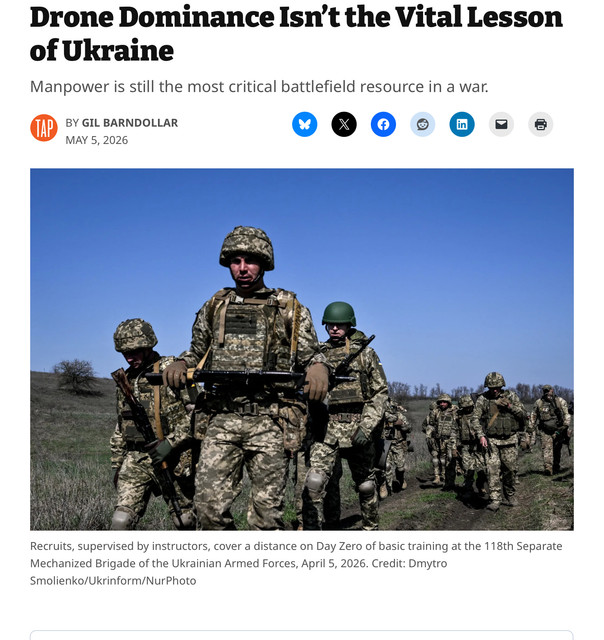
An excerpt:
alt=""
An excerpt:
UKRAINE – In a forest somewhere between Kyiv and the front line, nine men are learning how to stay alive. They are literal graybeards; all of them look older than 40, if not 50. Under the watchful eyes of a mixed team of army instructors and civilian volunteers, the men execute a “drunk drill.” Rifles elevated skyward, they spin slowly in circles. When they are sufficiently dizzy and disoriented (in order to simulate head wounds), a sharp command drops them to the ground, where they each scramble to apply a tourniquet to one of their limbs.
This is one of dozens of tasks they will need to master to fight and survive on the deadly battlefields of the Donbas. Success at turning these civilians into soldiers is the hinge between victory and defeat in Ukraine.
A few hours east of the training camp, in Kharkiv, a brigade mobilization officer tells me about finding the raw material to feed the training camps and then the frontline forces. His unit, though one of the most elite in the Armed Forces of Ukraine, now relies on conscripted soldiers for 80 percent of its manpower. Recruited volunteers and transfers of men who have gone SZCH (the Ukrainian acronym for AWOL, absent without official leave) from other brigades account for the remainder. At least 20 percent of the entire Ukrainian military is estimated to be SZCH at any given time.
Absent true machine autonomy, drone tactics don’t remove the need for troops; they simply move manpower around.
Finding enough men to man the 1,200-kilometer front line is a ceaseless struggle for Ukraine. The country has more than ten million military-aged men but is struggling to keep an army of one million in the field. There is no meaningful reserve and no ability to give soldiers the clarity and hope of a fixed term of service. Ukraine’s soldiers are serving until death, severe wounds, or the war’s end. Many soldiers are exhausted after years of war without rest.
Deployments to the messy, mingled frontline “gray zone” are measured in months, not days. The manpower crisis exacerbates this grim situation. Fearing that their men will disappear into the ranks of the SZCH once they are out of the frontline kill zone, commanders are incentivized to keep them out even longer. Doing so heightens the danger to soldiers and their units: A new study by Ukraine’s military ombudsman found that after 40 days of frontline duty, soldiers become apathetic and ineffective. The commander in chief of the Ukrainian armed forces, Gen. Oleksandr Syrskyi, has just decreed that no soldier should serve more than 60 days straight in the front line. Whether Ukrainian units can adhere to this order is an open question
This is one of dozens of tasks they will need to master to fight and survive on the deadly battlefields of the Donbas. Success at turning these civilians into soldiers is the hinge between victory and defeat in Ukraine.
A few hours east of the training camp, in Kharkiv, a brigade mobilization officer tells me about finding the raw material to feed the training camps and then the frontline forces. His unit, though one of the most elite in the Armed Forces of Ukraine, now relies on conscripted soldiers for 80 percent of its manpower. Recruited volunteers and transfers of men who have gone SZCH (the Ukrainian acronym for AWOL, absent without official leave) from other brigades account for the remainder. At least 20 percent of the entire Ukrainian military is estimated to be SZCH at any given time.
Absent true machine autonomy, drone tactics don’t remove the need for troops; they simply move manpower around.
Finding enough men to man the 1,200-kilometer front line is a ceaseless struggle for Ukraine. The country has more than ten million military-aged men but is struggling to keep an army of one million in the field. There is no meaningful reserve and no ability to give soldiers the clarity and hope of a fixed term of service. Ukraine’s soldiers are serving until death, severe wounds, or the war’s end. Many soldiers are exhausted after years of war without rest.
Deployments to the messy, mingled frontline “gray zone” are measured in months, not days. The manpower crisis exacerbates this grim situation. Fearing that their men will disappear into the ranks of the SZCH once they are out of the frontline kill zone, commanders are incentivized to keep them out even longer. Doing so heightens the danger to soldiers and their units: A new study by Ukraine’s military ombudsman found that after 40 days of frontline duty, soldiers become apathetic and ineffective. The commander in chief of the Ukrainian armed forces, Gen. Oleksandr Syrskyi, has just decreed that no soldier should serve more than 60 days straight in the front line. Whether Ukrainian units can adhere to this order is an open question
05-06-2026 | 07:13 AM
#239
Gets Weekends Off
Joined: Jun 2022
Posts: 2,278
Likes: 441
05-06-2026 | 08:08 AM
#240
Thread Starter
Perennial Reserve
Joined: Jan 2018
Posts: 14,261
Likes: 259
So you think the population disparity between the two sides is irrelevant to the conduct and outcome of the war. Got it. Ever do much war planning? Or command troops?

Thread
Thread Starter
Forum
Replies
Last Post


