


Fair wage scale for regionals?
 06-06-2013 | 02:38 PM
#1
Thread Starter
Gets Weekends Off
Joined: Jan 2011
Posts: 211
Likes: 0
 Fair wage scale for regionals?
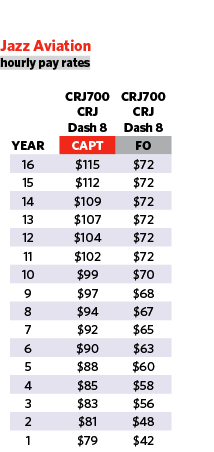
What would that be? I know we all want to make 100k our first year but that's not realistic. So what is? I'm asking about a minimum scale for the 37-50 seat planes and for it to go up from there. Yes I know if we made more the regionals would all shut down or fares would go up but let's just say we lived in a Capitalist country where supply and demand ruled the economy and our hands weren't tied to an old RLA law of the 1700s. Personally I like the Jazz pay scale. Same job so why should the pay scale be based on seats?
06-06-2013 | 02:42 PM
#2
Gets Weekends Off
Joined: May 2009
Posts: 1,272
Likes: 0
From: Another RJ FO
It would be nice to have a pay scale where first and second year FOs can potentially make more money than a high school kid working at mcdonalds does. First year flight attendants at my company make more than a first year FO due to holding lines quicker and not being restricted by duty regs and a FA can get a job with no degree and no prior experience. The pay scale is an insult to someone with a 4 year degree and 5-10 years of job experience.
By third and fourth year pay I think the wage becomes pretty fair. It's still not an amazing paying job but it's enough to live comfortably on. First and second year pay really need to be fixed.
By third and fourth year pay I think the wage becomes pretty fair. It's still not an amazing paying job but it's enough to live comfortably on. First and second year pay really need to be fixed.
 06-06-2013 | 03:05 PM
#5

Gets Weekends Off
Joined: Jun 2008
Posts: 426
Likes: 0
flat-rate pay with merit-based promotions and incentive bonuses
example:
76 seat jet
All Captains $90,000
All First Officers $50,000
No seniority. No unions. Upgrades will be actual promotions based on merit, knowledge, peer recommendations, and advanced performance tracking. Pay raises or bonuses in each seat dependent upon specific airline performance metrics being met. Cost of living raises to match national average every year.
The present system in place at most any airline is archaic. There is no merit to seniority-based upgrades. There is no incentive to motivate the juvenile and unprofessional to do a good job; moreover, they have endless job protection regardless of their actions and they receive raises annually for no reason.
A new system like the one I have suggested would elevate the people that actually perform well.
example:
76 seat jet
All Captains $90,000
All First Officers $50,000
No seniority. No unions. Upgrades will be actual promotions based on merit, knowledge, peer recommendations, and advanced performance tracking. Pay raises or bonuses in each seat dependent upon specific airline performance metrics being met. Cost of living raises to match national average every year.
The present system in place at most any airline is archaic. There is no merit to seniority-based upgrades. There is no incentive to motivate the juvenile and unprofessional to do a good job; moreover, they have endless job protection regardless of their actions and they receive raises annually for no reason.
A new system like the one I have suggested would elevate the people that actually perform well.
06-06-2013 | 03:08 PM
#6
Gets Weekends Off
Joined: Feb 2007
Posts: 2,610
Likes: 15
flat-rate pay with merit-based promotions and incentive bonuses
example:
76 seat jet
All Captains $90,000
All First Officer $45,000
No seniority. No unions. Upgrades will be actual promotions based on merit, knowledge, peer recommendations, and advanced performance tracking. Pay raises or bonuses in each seat dependent upon specific airline performance metrics being met.
The present system in place at most any airline is archaic. There is no merit to seniority-based upgrades. There is no incentive to motivate the juvenile and unprofessional to do a good job; moreover, they have endless job protection regardless of their actions and they receive raises annually for no reason.
example:
76 seat jet
All Captains $90,000
All First Officer $45,000
No seniority. No unions. Upgrades will be actual promotions based on merit, knowledge, peer recommendations, and advanced performance tracking. Pay raises or bonuses in each seat dependent upon specific airline performance metrics being met.
The present system in place at most any airline is archaic. There is no merit to seniority-based upgrades. There is no incentive to motivate the juvenile and unprofessional to do a good job; moreover, they have endless job protection regardless of their actions and they receive raises annually for no reason.
06-06-2013 | 03:10 PM
#7

Always Junior/Commuting
Joined: May 2013
Posts: 65
Likes: 0
From: USAF IP / A300 FO
I think the biggest argument most RJ pilots have is that the pay scale is not proportionate to the major airlines. Yes, RJ pilots fly less people. However, RJ pilots should be paid at a scale that is proportionate to the major airlines in relation to the number of “souls on board”. If a 777 5th year FO gets paid $155 per hour to fly 386 passengers that equates to $.40 per person per hour. A 5th year RJ FO should make that as well. Otherwise, then what the company is telling the RJ pilot, AND his/her customers, is that their lives are not as valuable as the lives on the Legacy airline. Make sense? Let's see if the math checks out.
If you take the first year pay from a Legacy airline's pay table (Delta in this case) and average it per person for the average number of seats on their airframes, you get a number that is the average pay per seat, per hour. Example, let's say Delta's median size aircraft, the 737-900, holds 177 seats. Their first year pay is $66 per hour. If we do that division we get $.37 per seat, per hour. If you apply that figure to a 50 seat RJ you get $18.60. That happens to be less than most regional airlines’ first year FO pay. If you do the same calculation for Delta's smallest aircraft, the 717, that equates to $28.20 per hour for a 50 seat RJ. That is much higher than most regional airlines’ 1st year pay. Let's do the same with the 5th year FO on a 717 at Delta. At $112 per hour that is $1.06 per person per hour, which equates to $52.83 per hour for a 5th year RJ FO at that rate. At AE the 5th year rate is $40 per hour. That's a significant pay difference. If you do the same for a 10 year CA on a Delta 717 that is $1.54 per person per hour which equates to $77.35 per hour for an AE 10 year Captain. Currently that CA gets $82. If we do the same for a 10 yr 777 CA they get $.65 per person per hour, which equates to $32.51 per hour for a 10 year RJ CA. That is obviously way worse than what a 10 yr RJ CA makes ($82).
I agree that a regional airline pilot feels like pay is extremely low, and in some cases there is definitely an argument for that. I also agree that the bigger the airplane the more expensive it is and that cost is factored into the pay for a mainline pilot. But even with that factor, the math tells us that the per person per hour cost for an RJ pilot IRT a mainline pilot isn’t too far skewed. The slap in the face then mainly comes from the fact that it’s a highly specialized field, with very expensive training, that takes many years to attain proficiency, that makes more life saving decisions per day than most professions do in a lifetime, only to be compensated the same as low technical fields that don’t require high amounts of human capital (restaurant worker, retail, bus driver, etc).
I think I just blacked out…..what happened….where are my pants?.....
If you take the first year pay from a Legacy airline's pay table (Delta in this case) and average it per person for the average number of seats on their airframes, you get a number that is the average pay per seat, per hour. Example, let's say Delta's median size aircraft, the 737-900, holds 177 seats. Their first year pay is $66 per hour. If we do that division we get $.37 per seat, per hour. If you apply that figure to a 50 seat RJ you get $18.60. That happens to be less than most regional airlines’ first year FO pay. If you do the same calculation for Delta's smallest aircraft, the 717, that equates to $28.20 per hour for a 50 seat RJ. That is much higher than most regional airlines’ 1st year pay. Let's do the same with the 5th year FO on a 717 at Delta. At $112 per hour that is $1.06 per person per hour, which equates to $52.83 per hour for a 5th year RJ FO at that rate. At AE the 5th year rate is $40 per hour. That's a significant pay difference. If you do the same for a 10 year CA on a Delta 717 that is $1.54 per person per hour which equates to $77.35 per hour for an AE 10 year Captain. Currently that CA gets $82. If we do the same for a 10 yr 777 CA they get $.65 per person per hour, which equates to $32.51 per hour for a 10 year RJ CA. That is obviously way worse than what a 10 yr RJ CA makes ($82).
I agree that a regional airline pilot feels like pay is extremely low, and in some cases there is definitely an argument for that. I also agree that the bigger the airplane the more expensive it is and that cost is factored into the pay for a mainline pilot. But even with that factor, the math tells us that the per person per hour cost for an RJ pilot IRT a mainline pilot isn’t too far skewed. The slap in the face then mainly comes from the fact that it’s a highly specialized field, with very expensive training, that takes many years to attain proficiency, that makes more life saving decisions per day than most professions do in a lifetime, only to be compensated the same as low technical fields that don’t require high amounts of human capital (restaurant worker, retail, bus driver, etc).
I think I just blacked out…..what happened….where are my pants?.....
 06-06-2013 | 03:17 PM
#9
Gets Weekends Off
Joined: Jun 2008
Posts: 426
Likes: 0
When I say performance tracking I don't mean on-time departures. I mean fuel-savings, customer comments, peer reviews, etc.. There's no issue there.
People love to say this is a profession, but hate the thought of it being operated like one. Change is hard for labor groups. Taking away entitlement-based pay raises and promotions will never happen because it's too scary to think you might have to earn your wage. Just a fun thought !

Thread
Thread Starter
Forum
Replies
Last Post


