


Leave DL for UA?
 10-30-2024 | 04:50 PM
#111

Line Holder

Joined: Jun 2019
Posts: 1,617
Likes: 180
From: B747 FO

Also in a similar situation to all these potential UAL hopefuls. I was hired at AA a year ago and never got the call despite UAL being my first choice - but hey, I had a job and I'm grateful. AA has been good so far but I've noticed the writing on the walls at AA. We've been shrinking in popular hubs, missing earnings, and hemorrhaging money ($143M this quarter) while still having a mountain of debt. It all points to trouble ahead. That combined with the union troubles and the push to join ALPA just makes me think the next contract might have concessions - I'm probably just being extremely paranoid. Overall I just don't feel confident. Moved recently from MIA to ORD and my seniority has been stagnant since we went on a hiring freeze this summer. UAL's presence here is much larger than AA's and it's the location I'd like to make long-term. The WB flying opportunities are also much better at UAL. I kept updating my app and was lucky to secure a CJO earlier this month. Still awaiting a class date but was wondering if the "stay where you are" dogma still applies if leaving American.
The plan is to focus on remaining in Chicago or possibly the West Coast in the future. I like the WB opportunities that UAL provides and I'm not confident in AA's finances, leadership, and aircraft fleet opportunities.
The plan is to focus on remaining in Chicago or possibly the West Coast in the future. I like the WB opportunities that UAL provides and I'm not confident in AA's finances, leadership, and aircraft fleet opportunities.
I also asked about UA because of Denver and I’m not blind to our AA issues, but no need to be so dramatic about it. Still a great place to be. Just the wrong management.
Aircraft fleet opportunities? Unless you wanna fly 75/76 which will be retired at some point…..the rest is identical, unless they do end up getting that pretty 350. WB flying…..no questions asked, UA is 100x better than AA.
10-30-2024 | 04:58 PM
#112
On Reserve
Joined: Apr 2023
Posts: 178
Likes: 4
Also in a similar situation to all these potential UAL hopefuls. I was hired at AA a year ago and never got the call despite UAL being my first choice - but hey, I had a job and I'm grateful. AA has been good so far but I've noticed the writing on the walls at AA. We've been shrinking in popular hubs, missing earnings, and hemorrhaging money ($143M this quarter) while still having a mountain of debt. It all points to trouble ahead. That combined with the union troubles and the push to join ALPA just makes me think the next contract might have concessions - I'm probably just being extremely paranoid. Overall I just don't feel confident. Moved recently from MIA to ORD and my seniority has been stagnant since we went on a hiring freeze this summer. UAL's presence here is much larger than AA's and it's the location I'd like to make long-term. The WB flying opportunities are also much better at UAL. I kept updating my app and was lucky to secure a CJO earlier this month. Still awaiting a class date but was wondering if the "stay where you are" dogma still applies if leaving American.
The plan is to focus on remaining in Chicago or possibly the West Coast in the future. I like the WB opportunities that UAL provides and I'm not confident in AA's finances, leadership, and aircraft fleet opportunities.
The plan is to focus on remaining in Chicago or possibly the West Coast in the future. I like the WB opportunities that UAL provides and I'm not confident in AA's finances, leadership, and aircraft fleet opportunities.
10-30-2024 | 05:52 PM
#114
Gets Weekends Off
Joined: Oct 2015
Posts: 3,195
Likes: 42
From: Gear slinger
Also in a similar situation to all these potential UAL hopefuls. I was hired at AA a year ago and never got the call despite UAL being my first choice - but hey, I had a job and I'm grateful. AA has been good so far but I've noticed the writing on the walls at AA. We've been shrinking in popular hubs, missing earnings, and hemorrhaging money ($143M this quarter) while still having a mountain of debt. It all points to trouble ahead. That combined with the union troubles and the push to join ALPA just makes me think the next contract might have concessions - I'm probably just being extremely paranoid. Overall I just don't feel confident. Moved recently from MIA to ORD and my seniority has been stagnant since we went on a hiring freeze this summer. UAL's presence here is much larger than AA's and it's the location I'd like to make long-term. The WB flying opportunities are also much better at UAL. I kept updating my app and was lucky to secure a CJO earlier this month. Still awaiting a class date but was wondering if the "stay where you are" dogma still applies if leaving American.
The plan is to focus on remaining in Chicago or possibly the West Coast in the future. I like the WB opportunities that UAL provides and I'm not confident in AA's finances, leadership, and aircraft fleet opportunities.
The plan is to focus on remaining in Chicago or possibly the West Coast in the future. I like the WB opportunities that UAL provides and I'm not confident in AA's finances, leadership, and aircraft fleet opportunities.
10-30-2024 | 06:59 PM
#115
Gets Weekends Off
Joined: Mar 2021
Posts: 2,847
Likes: 212
FWIW UAL has made dramatic progress in taking market share from AA in Chicago. The fundamentals are overwhelmingly in UALs favor so I see little chance it'll change. Kirby has been vocal about dominating ORD, so things will probably get worse for AA. Tough choice, but UAL is probably your better long game choice.
10-30-2024 | 07:10 PM
#116
On Reserve
Joined: Apr 2023
Posts: 178
Likes: 4
I would say that it is more like AA gave up its market share instead of UA taking it away. The price of ORD is too much for the penny pinchers in Skyview 6 and they wrongly decided to stuff too much through CLT and DFW. Now it looks like they may be changing their tune a bit by opening an ORD Airbus base and slightly growing the number of pilots. But yeah, UA gladly stepped in to fill the void that AA voluntarily gave up.
10-30-2024 | 07:20 PM
#117
Gets Weekends Off
Joined: Mar 2021
Posts: 2,847
Likes: 212
10-31-2024 | 04:59 AM
#118
Line Holder
Joined: Jul 2022
Posts: 1,592
Likes: 153
From: 787 FO
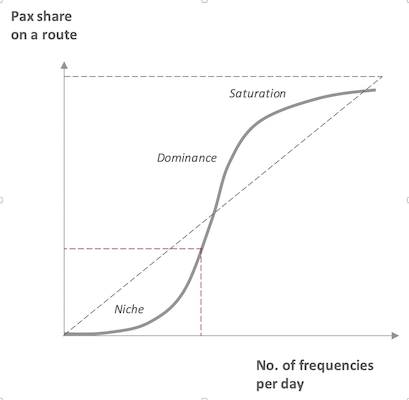
The S-curve effect is a phenomenon in airline competition that describes how a dominant airline can attract more passengers than expected with additional frequency. This is because service-oriented passengers, like business travelers, tend to favor airlines with a more frequent flight schedule.
The S-curve effect can be measured by using frequency share on the x-axis, which is the driver of preference for time-sensitive travelers. The effect can be seen at both the airport and route level.
Airlines can use the S-curve effect to their advantage by building dominant positions at airports and on routes. For example, Delta has a strong S-curve position in Atlanta, Detroit, Minneapolis, New York, and Seattle. In these markets, Delta has a far larger scope and depth of service than its competitors, which means that business travelers tend to choose Delta almost exclusively.
The S-curve effect can be measured by using frequency share on the x-axis, which is the driver of preference for time-sensitive travelers. The effect can be seen at both the airport and route level.
Airlines can use the S-curve effect to their advantage by building dominant positions at airports and on routes. For example, Delta has a strong S-curve position in Atlanta, Detroit, Minneapolis, New York, and Seattle. In these markets, Delta has a far larger scope and depth of service than its competitors, which means that business travelers tend to choose Delta almost exclusively.
10-31-2024 | 05:48 AM
#119
Codeshare the pain away
Joined: Jul 2023
Posts: 300
Likes: 130
From: one DUI away from running the airline
My air line >>> your airline
Until a pilot group gets a contract that limits working to 2 days a month and staying at all inclusive 5 star hotels with naked models in the room, all pretzels is the same.
Until a pilot group gets a contract that limits working to 2 days a month and staying at all inclusive 5 star hotels with naked models in the room, all pretzels is the same.
10-31-2024 | 06:32 AM
#120

Line Holder
Joined: Nov 2012
Posts: 281
Likes: 15
From: PM
The S-curve effect is a phenomenon in airline competition that describes how a dominant airline can attract more passengers than expected with additional frequency. This is because service-oriented passengers, like business travelers, tend to favor airlines with a more frequent flight schedule.
The S-curve effect can be measured by using frequency share on the x-axis, which is the driver of preference for time-sensitive travelers. The effect can be seen at both the airport and route level.
Airlines can use the S-curve effect to their advantage by building dominant positions at airports and on routes. For example, Delta has a strong S-curve position in Atlanta, Detroit, Minneapolis, New York, and Seattle. In these markets, Delta has a far larger scope and depth of service than its competitors, which means that business travelers tend to choose Delta almost exclusively.
The S-curve effect can be measured by using frequency share on the x-axis, which is the driver of preference for time-sensitive travelers. The effect can be seen at both the airport and route level.
Airlines can use the S-curve effect to their advantage by building dominant positions at airports and on routes. For example, Delta has a strong S-curve position in Atlanta, Detroit, Minneapolis, New York, and Seattle. In these markets, Delta has a far larger scope and depth of service than its competitors, which means that business travelers tend to choose Delta almost exclusively.

Thread
Thread Starter
Forum
Replies
Last Post


