


Training
 03-26-2022 | 09:42 AM
#81
Line Holder
Joined: Jul 2017
Posts: 579
Likes: 30

I absolutely think the pilots who remain need to do everything possible to attain a vastly improved contract.
Upgrade times at United and Delta are in the 1 year range, American isn’t too much longer, FedEx upgrades are quick as well. I think ours will be 8-10 when all the Airbus pilots are displaced to the Boeing. I think Alaska’s “growth plan” which is actually to shrink will just hurt them more as far as attracting new hires, if they are even needed in the future, and attrition will continue.
03-26-2022 | 09:56 AM
#82
Line Holder
Joined: Feb 2007
Posts: 1,292
Likes: 1
Alaska will be fine. If Shyguys napkin math shows we need 3000, throw in some management pilots, med leave, retirements, attrition, etc, and it’s about balanced. Throwing around the furlough word in this environment seems silly to me and just a scare tactic.
the reason we had 5 year upgrades recently is because 600 people bypassed because commuting to reserve or having 12 “days” off isn’t appealing to them. If those people upgraded on schedule we would see the actual time which is probably more like 8 years.
To anyone coming here, you will be fine. However there are better opportunities at other carriers, for sure. Even at 6 years here I’m constantly torn on whether to leave.. wish I had just kept my stuff updated this whole time and took the first of the big 3 to call, but it is what it is.
the reason we had 5 year upgrades recently is because 600 people bypassed because commuting to reserve or having 12 “days” off isn’t appealing to them. If those people upgraded on schedule we would see the actual time which is probably more like 8 years.
To anyone coming here, you will be fine. However there are better opportunities at other carriers, for sure. Even at 6 years here I’m constantly torn on whether to leave.. wish I had just kept my stuff updated this whole time and took the first of the big 3 to call, but it is what it is.
 03-26-2022 | 10:40 AM
#84
Line Holder
Joined: Jul 2017
Posts: 579
Likes: 30
Alaska will be fine. If Shyguys napkin math shows we need 3000, throw in some management pilots, med leave, retirements, attrition, etc, and it’s about balanced. Throwing around the furlough word in this environment seems silly to me and just a scare tactic.
the reason we had 5 year upgrades recently is because 600 people bypassed because commuting to reserve or having 12 “days” off isn’t appealing to them. If those people upgraded on schedule we would see the actual time which is probably more like 8 years.
To anyone coming here, you will be fine. However there are better opportunities at other carriers, for sure. Even at 6 years here I’m constantly torn on whether to leave.. wish I had just kept my stuff updated this whole time and took the first of the big 3 to call, but it is what it is.
the reason we had 5 year upgrades recently is because 600 people bypassed because commuting to reserve or having 12 “days” off isn’t appealing to them. If those people upgraded on schedule we would see the actual time which is probably more like 8 years.
To anyone coming here, you will be fine. However there are better opportunities at other carriers, for sure. Even at 6 years here I’m constantly torn on whether to leave.. wish I had just kept my stuff updated this whole time and took the first of the big 3 to call, but it is what it is.
03-26-2022 | 02:40 PM
#85
Gets Weekends Off
Joined: Mar 2015
Posts: 183
Likes: 0
Im glad I’m not the only one who can see reality.
I’d imagine once people start being downgraded and displaced, and the upgrade time goes to more like 8-10 years and reserve is forever, people may leave in higher numbers if the rest of the industry continues to hire while offering good opportunities. That may prevent the possibility of furloughs if we end up 400-500 pilots over staffed.
I’d imagine once people start being downgraded and displaced, and the upgrade time goes to more like 8-10 years and reserve is forever, people may leave in higher numbers if the rest of the industry continues to hire while offering good opportunities. That may prevent the possibility of furloughs if we end up 400-500 pilots over staffed.
From the same presentation, the company has options to expand up to 314 mainline aircraft by 2026. I realize those are options, but the history has been to never not exercise an option. Assuming that holds out with the same crew ratio, that means a 4,341-stong pilot group by the end of 2026. In other words, 44% growth in pilots over a 4-5 year span. IF there's not a change in the dynamics that cause some FOs to bypass upgrade, would it not be reasonable to assume that a similar upgrade/pilot progression timeline for new hires now continues into the next few years?
Like I said, I'm on the outside looking in. What am I missing?
03-26-2022 | 03:02 PM
#86
On Reserve
Joined: Nov 2021
Posts: 99
Likes: 1
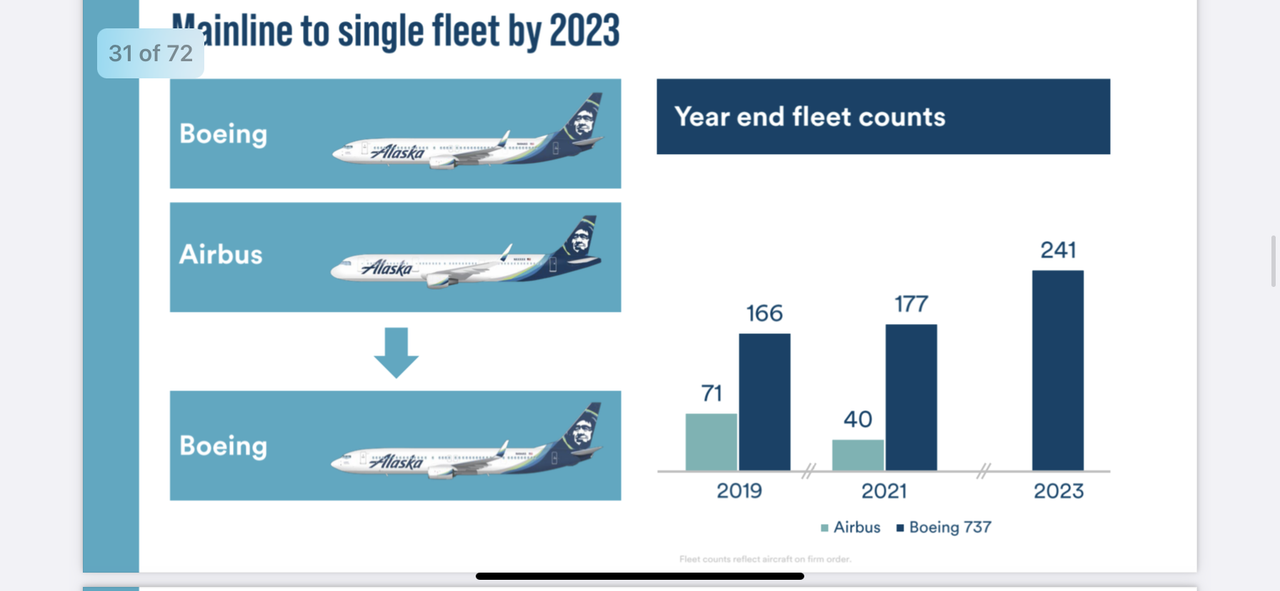
So I'm an outsider looking in, and I fully understand the A320 divestiture and early A321 divestiture will create displacements over the next two years, but how does that create the stagnation you're talking about over the long term? My understanding is that mainline Alaska currently has 217 aircraft in both fleets with ~3,000 pilots on property. That's 13.8ish pilots per aircraft. From the investor conference presentation (at https://investor.alaskaair.com/stati...a-6d4d96bfdd1c), by the end of 2023 between A320/321 divestiture and 737 acquisition there's 241 aircraft in the fleet. Assuming the crew staffing ratio stays the same, that's 3,332 pilots on property, so 10% pilot group growth in a little over a year and a half plus another 106 new pilots needed to replace mandatory retirements.
From the same presentation, the company has options to expand up to 314 mainline aircraft by 2026. I realize those are options, but the history has been to never not exercise an option. Assuming that holds out with the same crew ratio, that means a 4,341-stong pilot group by the end of 2026. In other words, 44% growth in pilots over a 4-5 year span. IF there's not a change in the dynamics that cause some FOs to bypass upgrade, would it not be reasonable to assume that a similar upgrade/pilot progression timeline for new hires now continues into the next few years?
Like I said, I'm on the outside looking in. What am I missing?
From the same presentation, the company has options to expand up to 314 mainline aircraft by 2026. I realize those are options, but the history has been to never not exercise an option. Assuming that holds out with the same crew ratio, that means a 4,341-stong pilot group by the end of 2026. In other words, 44% growth in pilots over a 4-5 year span. IF there's not a change in the dynamics that cause some FOs to bypass upgrade, would it not be reasonable to assume that a similar upgrade/pilot progression timeline for new hires now continues into the next few years?
Like I said, I'm on the outside looking in. What am I missing?
03-26-2022 | 03:35 PM
#87
Line Holder
Joined: Jul 2017
Posts: 579
Likes: 30
03-26-2022 | 03:51 PM
#88
Perennial Reserve
Joined: Jan 2018
Posts: 14,181
Likes: 237
Yeah, and the -700s are pretty much all 22-25 years old. And the older 900s 20+ as well. So some of that WILL be replacement, especially if fuel costs stay high.
03-26-2022 | 04:00 PM
#89
Gets Weekends Off
Joined: Mar 2015
Posts: 183
Likes: 0
03-26-2022 | 05:23 PM
#90
Gets Weekends Off
Joined: Dec 2005
Posts: 9,348
Likes: 331
So I'm an outsider looking in, and I fully understand the A320 divestiture and early A321 divestiture will create displacements over the next two years, but how does that create the stagnation you're talking about over the long term? My understanding is that mainline Alaska currently has 217 aircraft in both fleets with ~3,000 pilots on property. That's 13.8ish pilots per aircraft. From the investor conference presentation (at https://investor.alaskaair.com/stati...a-6d4d96bfdd1c), by the end of 2023 between A320/321 divestiture and 737 acquisition there's 241 aircraft in the fleet. Assuming the crew staffing ratio stays the same, that's 3,332 pilots on property, so 10% pilot group growth in a little over a year and a half plus another 106 new pilots needed to replace mandatory retirements.
From the same presentation, the company has options to expand up to 314 mainline aircraft by 2026. I realize those are options, but the history has been to never not exercise an option. Assuming that holds out with the same crew ratio, that means a 4,341-stong pilot group by the end of 2026. In other words, 44% growth in pilots over a 4-5 year span. IF there's not a change in the dynamics that cause some FOs to bypass upgrade, would it not be reasonable to assume that a similar upgrade/pilot progression timeline for new hires now continues into the next few years?
Like I said, I'm on the outside looking in. What am I missing?
From the same presentation, the company has options to expand up to 314 mainline aircraft by 2026. I realize those are options, but the history has been to never not exercise an option. Assuming that holds out with the same crew ratio, that means a 4,341-stong pilot group by the end of 2026. In other words, 44% growth in pilots over a 4-5 year span. IF there's not a change in the dynamics that cause some FOs to bypass upgrade, would it not be reasonable to assume that a similar upgrade/pilot progression timeline for new hires now continues into the next few years?
Like I said, I'm on the outside looking in. What am I missing?
Your 2024-2026 fleet assumptions are based on excercising every single option. I’ll believe that when we see it. For now, firm is all I’m looking at.
This next bid should be telling. If I had to bet, I think it’s a Delta style MOAB.

Thread
Thread Starter
Forum
Replies
Last Post


