


IATA Calls for Raising Pilot Age Limit to 67
 09-28-2025 | 07:37 AM
#1181
Gets Weekends Off
Joined: Dec 2011
Posts: 2,045
Likes: 257
From: A320 FO

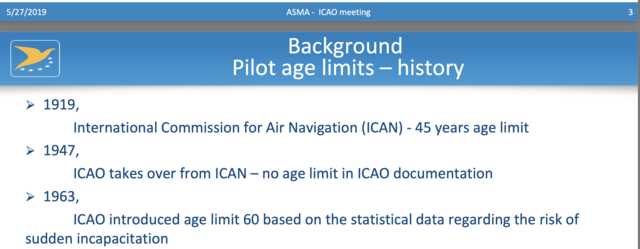
ICAO established 60 in 1947. The events you are talking about occurred in the late 50s when pilots challenged the 'forced retirements' which led to the FAA codifying the ICAO standard in regulation.
If anything ALPA spent far more effort opposing 60 than supporting it over those decades.
09-28-2025 | 07:49 AM
#1182

Leaves Biscoff crumbs


Joined: Jan 2020
Posts: 3,265
Likes: 941
From: Blue Juice Taste Tester
Lowering the retirement age is a far different rug pull than arguing against raising it. Although even that 'common knowledge' is revisionist history.
ICAO established 60 in 1947. The events you are talking about occurred in the late 50s when pilots challenged the 'forced retirements' which led to the FAA codifying the ICAO standard in regulation.
ICAO established 60 in 1947. The events you are talking about occurred in the late 50s when pilots challenged the 'forced retirements' which led to the FAA codifying the ICAO standard in regulation.
Imagine being an old Dork and not knowing the history of your profession. I guess when you're playing with god, fambily and country there arent any neurons left to digest the real world.
09-28-2025 | 07:53 AM
#1183
Line Holder
Joined: Mar 2016
Posts: 972
Likes: 1
Lowering the retirement age is a far different rug pull than arguing against raising it. Although even that common knowledge is revisionist history. ICAO established 60 in 1947. The events you are talking about occurred when pilots challenged the 'forced retirements' which led to the FAA codifying the ICAO standard in regulation.
I was talking about race, that old routine where people say, “You’re fine here; you can eat and sleep in this town,” but then point over there (insert Cape Air) like that’s where the line is. I thought I was going to be “unsafe”?
Yeah, that.
09-28-2025 | 07:57 AM
#1184
Line Holder
Joined: Mar 2016
Posts: 972
Likes: 1
Plus the fact that the airlines industry 70 years ago was a completely different animal. Pilot compensation, safety record, the routine nature of seasonal furloughs, all while operating in the pre-deregulation era. Part of the reason we got the retirement and compensation we have as pilots was in part thanks to having a mandatory retirement age.
Imagine being an old Dork and not knowing the history of your profession. I guess when you're playing with god, fambily and country there arent any neurons left to digest the real world.
Imagine being an old Dork and not knowing the history of your profession. I guess when you're playing with god, fambily and country there arent any neurons left to digest the real world.
Like "1947" when in fact it was 1963!
Classic!
!
09-28-2025 | 08:05 AM
#1185
Line Holder
Joined: Mar 2016
Posts: 972
Likes: 1
Plus the fact that the airlines industry 70 years ago was a completely different animal. Pilot compensation, safety record, the routine nature of seasonal furloughs, all while operating in the pre-deregulation era. Part of the reason we got the retirement and compensation we have as pilots was in part thanks to having a mandatory retirement age.
Imagine being an old Dork and not knowing the history of your profession. I guess when you're playing with god, fambily and country there arent any neurons left to digest the real world.
Imagine being an old Dork and not knowing the history of your profession. I guess when you're playing with god, fambily and country there arent any neurons left to digest the real world.
 09-28-2025 | 08:14 AM
#1186
Leaves Biscoff crumbs
Joined: Jan 2020
Posts: 3,265
Likes: 941
From: Blue Juice Taste Tester
From the executive summary of "Pilot Age and Accident Rates Report 4. Executive summary:
"The findings are consistent across the three analyses. First, for accidents occurringunder 14 CFR §121 and §135, the analyses supported the hypothesis that a "U"-shapedrelationship exists between the age of professional pilots holding ATP or commercial andfirst- or second-class medical certificates and their accident rate. Second, the accident ratefor the 60-63 age group was statistically greater than the accident rate for 55 or 56 to 59year old pilots in the a priori planned comparisons. Third, the main effect for age wasstatistically significant in all analyses. These findings suggested that the probability of anaviation accident under §121 and §135, as a function of pilot annual flight hours, wasrelated to pilot age."
"The findings are consistent across the three analyses. First, for accidents occurringunder 14 CFR §121 and §135, the analyses supported the hypothesis that a "U"-shapedrelationship exists between the age of professional pilots holding ATP or commercial andfirst- or second-class medical certificates and their accident rate. Second, the accident ratefor the 60-63 age group was statistically greater than the accident rate for 55 or 56 to 59year old pilots in the a priori planned comparisons. Third, the main effect for age wasstatistically significant in all analyses. These findings suggested that the probability of anaviation accident under §121 and §135, as a function of pilot annual flight hours, wasrelated to pilot age."
09-28-2025 | 08:16 AM
#1187
Leaves Biscoff crumbs
Joined: Jan 2020
Posts: 3,265
Likes: 941
From: Blue Juice Taste Tester
09-28-2025 | 08:21 AM
#1188

Gets Weekends Off


Joined: Apr 2007
Posts: 5,608
Likes: 622

Thread
Thread Starter
Forum
Replies
Last Post


