


Cleared Pre Contact....
 10-24-2012 | 09:14 AM
#41
Thread Starter
Banned
Joined: Mar 2009
Posts: 1,822
Likes: 0

Same video....
10-24-2012 | 11:02 AM
#42
Gets Weekends Off
Joined: Jun 2007
Posts: 4,196
Likes: 51
From: Legacy FO
10-24-2012 | 12:26 PM
#43

Gets Weekends Off
Joined: Feb 2006
Posts: 6,248
Likes: 0
From: 767A (Ret)
How it all started:
Aerial Refueling
The first actual transfer of fuel from one aircraft to another was little more than a stunt. On November 12, 1921, wingwalker Wesley May climbed from a Lincoln Standard to a Curtiss JN-4 airplane with a can of fuel strapped to his back. When he reached the JN-4, he poured the fuel into its gas tank. Needless to say, this was not the most practical way of refueling an airplane in flight.
10-24-2012 | 06:08 PM
#45

Gets Weekends Off
Joined: May 2006
Posts: 840
Likes: 0
While the first word which came to my mind is a form of excrement, I am compelled by polite company to instead declare you are full of bluster.
Because you found it hard? Everybody does it, by definition, the worst AF pilot can do it.
When I went through Castle in the early 80s on my way to a receiver variant of the -135, I had an opportunity to spend one brief session in a facility specifically designed and dedicated to teaching receiver air refueling. The B-52 Air Refueling Part Task Trainer consisted of a dedicated building with a simulator, complete with realistic (for its time) visual, an array of supporting training devices and computer banks, all supported by a dedicated staff of technical support and maintenance, as well as schedulers and instructors. It was there where I got my first glimpse of A/R from the receiver end of the boom.
Yea, that thing hasn't been used since Castle closed. So must have been important.
Ask yourself this. If receiver A/R was so dadgum easy, why did the Air Force invest so much money and resources into a device dedicated to teaching that task, and that task only? If it was so easy, they should have been able to teach the procedures in a classroom, and go practice it in flight on the first sortie.
Because the Air Force is stupid and wastes money.
I don't know what all the different communities do or have done in the past, or what they do today. I do know that in some airframes, copilots are not allowed to close beyond pre-contact without an Instructor who is specifically certified to instruct air refueling. Where I was, every aircraft commander could supervise copilot refueling. We did an awful lot of refueling -- rarely flying a sortie without it. Other folks had a hard time staying current. I would venture that the pilot flying in that video was on the low experience end of that spectrum. But whether you did it a little and struggled with it, or did it a lot and were very proficient -- it was hard, and dangerous.
Really? Hard, dangerous? We do it every day all over the country.
Remember when B-52 pilots had to wear parachutes and helmets to A/R? Was that a measure taken for comofort, or did it recognize the hazard?
We still do. It's because it's considered a critical phase of flight by the Life support reg. Like landings, high level bomb runs with 30 degrees of bank, and Takeoff. Very dangerous stuff.
CFIC -- Consolidated Flight Instructor Course, for KC-135 and B-52 Instructors. As long as the weather allowed, we all did the whifferdill while in contact. It was a confidence maneuver which demonstrated that the success of the aerial refueling had little to do with the attitude of the two airplanes -- bank, pitch, speed. Successful refueling depends on the smooth, stable platform provided by the tanker and the deliberate, steady inputs made by the receiver. If the receiver concentrated on the tanker, he would be surprised to see the strange horizon relative to the airplanes shown in the pictures.
I never said the whiff was easy, just AR. But certainly if you can stay on the boom at 90 degrees of bank, straight and level should be cake.
I'll give you the last word. I'm tired of discussing how difficult normal AR is. My opinion after doing it for 9 years in B-52's is that it is easy. Certainly if it's night, weather, and bad turbulence, it's harder, but day to day....not rocket surgery.
.
Because you found it hard? Everybody does it, by definition, the worst AF pilot can do it.
When I went through Castle in the early 80s on my way to a receiver variant of the -135, I had an opportunity to spend one brief session in a facility specifically designed and dedicated to teaching receiver air refueling. The B-52 Air Refueling Part Task Trainer consisted of a dedicated building with a simulator, complete with realistic (for its time) visual, an array of supporting training devices and computer banks, all supported by a dedicated staff of technical support and maintenance, as well as schedulers and instructors. It was there where I got my first glimpse of A/R from the receiver end of the boom.
Yea, that thing hasn't been used since Castle closed. So must have been important.
Ask yourself this. If receiver A/R was so dadgum easy, why did the Air Force invest so much money and resources into a device dedicated to teaching that task, and that task only? If it was so easy, they should have been able to teach the procedures in a classroom, and go practice it in flight on the first sortie.
Because the Air Force is stupid and wastes money.
I don't know what all the different communities do or have done in the past, or what they do today. I do know that in some airframes, copilots are not allowed to close beyond pre-contact without an Instructor who is specifically certified to instruct air refueling. Where I was, every aircraft commander could supervise copilot refueling. We did an awful lot of refueling -- rarely flying a sortie without it. Other folks had a hard time staying current. I would venture that the pilot flying in that video was on the low experience end of that spectrum. But whether you did it a little and struggled with it, or did it a lot and were very proficient -- it was hard, and dangerous.
Really? Hard, dangerous? We do it every day all over the country.
Remember when B-52 pilots had to wear parachutes and helmets to A/R? Was that a measure taken for comofort, or did it recognize the hazard?
We still do. It's because it's considered a critical phase of flight by the Life support reg. Like landings, high level bomb runs with 30 degrees of bank, and Takeoff. Very dangerous stuff.
CFIC -- Consolidated Flight Instructor Course, for KC-135 and B-52 Instructors. As long as the weather allowed, we all did the whifferdill while in contact. It was a confidence maneuver which demonstrated that the success of the aerial refueling had little to do with the attitude of the two airplanes -- bank, pitch, speed. Successful refueling depends on the smooth, stable platform provided by the tanker and the deliberate, steady inputs made by the receiver. If the receiver concentrated on the tanker, he would be surprised to see the strange horizon relative to the airplanes shown in the pictures.
I never said the whiff was easy, just AR. But certainly if you can stay on the boom at 90 degrees of bank, straight and level should be cake.
I'll give you the last word. I'm tired of discussing how difficult normal AR is. My opinion after doing it for 9 years in B-52's is that it is easy. Certainly if it's night, weather, and bad turbulence, it's harder, but day to day....not rocket surgery.
.
 10-24-2012 | 10:50 PM
#46
Gets Weekends Off
Joined: Nov 2008
Posts: 314
Likes: 0
From: UnemploymentJet
As a former BUFF driver of 23 years and almost 5000 hours, I'd hardly tell folks that AR is easy. Sure, it gets easier with experience. And in the BUFF, AR was easier the farther aft the CG. Before they changed the fuel sequence, we'd usually hit AR at about 28-30% MAC (mean aerodynamic chord). The change in fuel sequence moved the CG farther forward.
As a BUFF pilot, IMO you are most proficient at AR after graduating from CFIC. Your proficiency will go down somewhat from there due to lack of "yoke" time as an instructor. The old ARPTT was way more difficult than flying the actual aircraft, but it did teach you the very fine control inputs required by AR.
I was a co-pilot during the first gulf war when we did 3 ARs (2 pre combat, 1 post). We spent 7 months flying out of DG (6 months training, 1 month combat) and it wasn't long before I could take a 100K off load in a single contact. Again, as with anything, practice makes perfect.
The BUFF AR autopilot mode was never used in CFIC because we were always flying limits. IMO, that was somewhat negative training because the AR AP mode was quite useful when taking on large offloads. As an instructor, I always made a few contacts with and without the AP mode engaged and encouraged line pilots and trainees to do the same.
The scariest moment I had during AR was when the tanker autopilot kicked off without warning while approaching contact. A tanker AP disconnect with a heavy receiver passing through the tanker downwash will pitch the tanker tail down into the receiver. It is an eye opener to say the least. I wouldn't be surprised if that's what happened in this video.
As a BUFF pilot, IMO you are most proficient at AR after graduating from CFIC. Your proficiency will go down somewhat from there due to lack of "yoke" time as an instructor. The old ARPTT was way more difficult than flying the actual aircraft, but it did teach you the very fine control inputs required by AR.
I was a co-pilot during the first gulf war when we did 3 ARs (2 pre combat, 1 post). We spent 7 months flying out of DG (6 months training, 1 month combat) and it wasn't long before I could take a 100K off load in a single contact. Again, as with anything, practice makes perfect.
The BUFF AR autopilot mode was never used in CFIC because we were always flying limits. IMO, that was somewhat negative training because the AR AP mode was quite useful when taking on large offloads. As an instructor, I always made a few contacts with and without the AP mode engaged and encouraged line pilots and trainees to do the same.
The scariest moment I had during AR was when the tanker autopilot kicked off without warning while approaching contact. A tanker AP disconnect with a heavy receiver passing through the tanker downwash will pitch the tanker tail down into the receiver. It is an eye opener to say the least. I wouldn't be surprised if that's what happened in this video.
 10-25-2012 | 09:24 AM
#49
Gets Weekends Off
Joined: Dec 2007
Posts: 404
Likes: 0
From: Retired
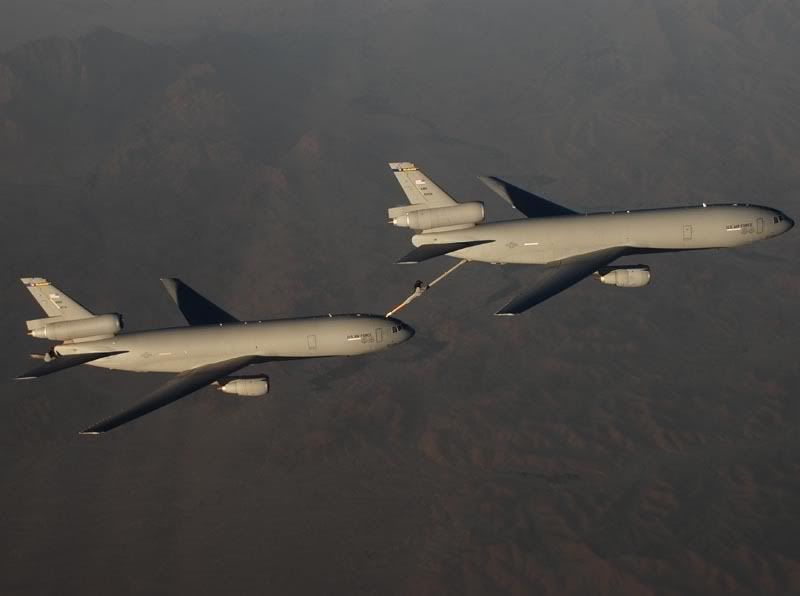
Couple of "old" war stories (key word is old). During the Viet Nam war we used to refuel the B-52s coming out of Guam. We would leave Okinawa and meet over the Phillipines. Lots of fun with 3 tankers, 3 B-52s, thunderstorms so high you couldn't paint the tops, max offloads, bombers had wall to wall externals (the old D Models) and we were all trying to fit through a hole in the weather about 5 to 10 miles wide with moderate turbulence. Guess I was too young to know it was scary.
Many years later, trying to get 6 Hornets over to the Gulf for the first war. Another one of those nights off the coast of Canada. Moderate (or greater) turbulence, visibility about 1/2 mile, St. Elmo's rolling off the windscreen, trying to get on the iron drogue. 2 of them never did get their fuel and one poor guy had the hose wrapped around his radome twice. They were Marines and were trying to hack the mission. I kept hinting about "bingo fuel", abort points, etc. Just kept pressing on. Finally passed them to a KC-10 about 40 West. Guess it went okay, never heard about anybody going swimming.
Ah, the good old days!!
Many years later, trying to get 6 Hornets over to the Gulf for the first war. Another one of those nights off the coast of Canada. Moderate (or greater) turbulence, visibility about 1/2 mile, St. Elmo's rolling off the windscreen, trying to get on the iron drogue. 2 of them never did get their fuel and one poor guy had the hose wrapped around his radome twice. They were Marines and were trying to hack the mission. I kept hinting about "bingo fuel", abort points, etc. Just kept pressing on. Finally passed them to a KC-10 about 40 West. Guess it went okay, never heard about anybody going swimming.
Ah, the good old days!!

Thread
Thread Starter
Forum
Replies
Last Post


