


Cleared Pre Contact....
 10-25-2012 | 12:04 PM
#51
Gets Weekends Off
Joined: May 2006
Posts: 2,889
Likes: 1

It can't be that tough, I've done it at 90 degrees of bank and even inverted in the weather...
Oh...well...I meant I THOUGHT I was in 90 degrees of bank. The ADI must have been broke, because every cell in my body said that dumbass tanker pilot wanted to do the entire AR in a knife edge pass. No idea why he did it that way, but the AR wasn't the toughest part. The hard part was going BACK to the observation position on the wing flying the knife edge for the next 20 minutes.
These days when the flying gets tough I just go back to the galley and get a fresh cup of coffee. Sometimes getting old ain't all bad. I do not miss night IMC tanker ops.
Oh...well...I meant I THOUGHT I was in 90 degrees of bank.
The ADI must have been broke, because every cell in my body said that dumbass tanker pilot wanted to do the entire AR in a knife edge pass. No idea why he did it that way, but the AR wasn't the toughest part. The hard part was going BACK to the observation position on the wing flying the knife edge for the next 20 minutes.These days when the flying gets tough I just go back to the galley and get a fresh cup of coffee. Sometimes getting old ain't all bad.
I do not miss night IMC tanker ops.
10-25-2012 | 04:08 PM
#52
Gets Weekends Off
Joined: Dec 2007
Posts: 6,419
Likes: 120
From: Window seat
Nothing like being on the wing and realize you can't see the engine pod. Are you f'ing kidding me? We're going lost wingman from the tanker!?!?.
Guy on the boom must have had extreme vertigo.
Everyone hung in there but it wasn't fun.
Guy on the boom must have had extreme vertigo.
Everyone hung in there but it wasn't fun.
10-27-2012 | 01:28 PM
#53

Moderator
Joined: Jul 2006
Posts: 7,438
Likes: 438
1.) If there is a cloud in the sky...fly through it!
2.) Once the fighters are setting up their rejoining...turn into them!
These are found in the attachments. The main body of their TTPs consist of finding the highest per diem/ best party spots throughout the world, and above all else...get their tail number.
I do know that in some airframes, copilots are not allowed to close beyond pre-contact without an Instructor who is specifically certified to instruct air refueling.
But whether you did it a little and struggled with it, or did it a lot and were very proficient -- it was hard, and dangerous.
We still do. It's because it's considered a critical phase of flight by the Life support reg. Like landings, high level bomb runs with 30 degrees of bank, and Takeoff. Very dangerous stuff.
10-28-2012 | 03:10 AM
#54
China Visa Applicant
Joined: Oct 2006
Posts: 1,964
Likes: 16
From: Midfield downwind
It is actually just an "also..." during a syllabus sortie in which something else is the primary mission. That first AAR is just something you do on the way to or from the real learning point on that day.
10-28-2012 | 04:18 AM
#55

Gets Weekends Off
Joined: Nov 2006
Posts: 694
Likes: 0
From: Walmart Greeter
Hacker,
Is it designed that way or just implemented that way by the FTU...for instance in the F/A-18 syllabus day/night IFR are separate sorties and solely dedicated to tanking. I was curious if they are separate events on paper for y'all and you just combine them in flight or if a particular flight or group of flights in the syllabus call for the 'add on'. Just curious...
Bdger
10-28-2012 | 05:01 AM
#56
Organizational Learning
Joined: Nov 2005
Posts: 4,948
Likes: 0
From: Directly behind the combiner
It is actually just an "also..." during a syllabus sortie in which something else is the primary mission. That first AAR is just something you do on the way to or from the real learning point on that day.
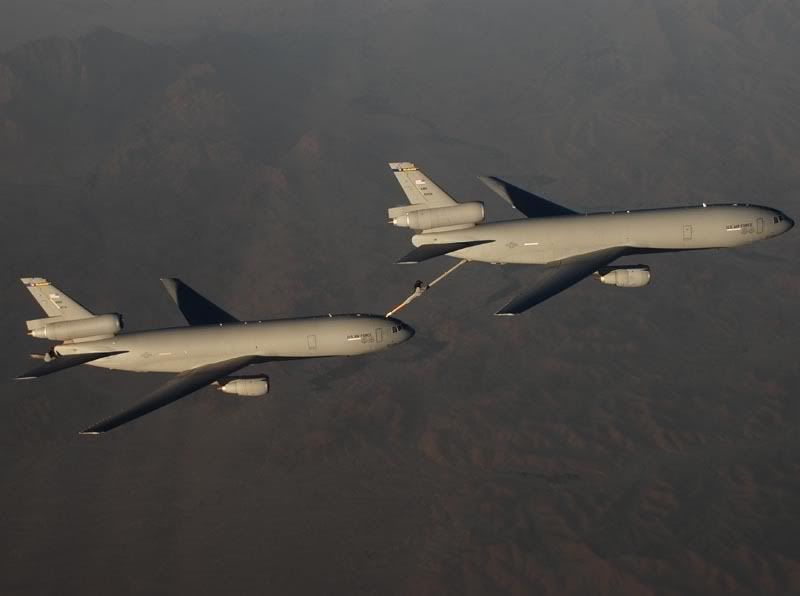
AR in a heavy is not close trail in a T-38.
I would certainly hope that it's easier to maneuver a fighter on the boom than a heavy.
==================================================
Sweet ...
.
 10-28-2012 | 05:33 AM
#58
Organizational Learning
Joined: Nov 2005
Posts: 4,948
Likes: 0
From: Directly behind the combiner
When I went through Castle in the early 80s on my way to a receiver variant of the -135, I had an opportunity to spend one brief session in a facility specifically designed and dedicated to teaching receiver air refueling. The B-52 Air Refueling Part Task Trainer consisted of a dedicated building with a simulator, complete with realistic (for its time) visual, an array of supporting training devices and computer banks, all supported by a dedicated staff of technical support and maintenance, as well as schedulers and instructors. It was there where I got my first glimpse of A/R from the receiver end of the boom.

The ARPTT was built when standard simulators could not replicate the task. Today, the full-motion simulators with life-like visuals are up to the task. The task of air refueling is still taught in the same way, just in a different device.
Ask yourself this. If receiver A/R was so dadgum easy, why did the Air Force invest so much money and resources into a device dedicated to teaching that task, and that task only? If it was so easy, they should have been able to teach the procedures in a classroom, and go practice it in flight on the first sortie.
The answer is that the task is not so dadgum easy in a heavy, and if you put a brand new pilot in the seat with no prior simulator training, he might never get the first contact. Every refueling track has an exit, and they cost a ton of money. That's the same reason you train landings in the sim before you train them in the jet.
I don't know what all the different communities do or have done in the past, or what they do today. I do know that in some airframes, copilots are not allowed to close beyond pre-contact without an Instructor who is specifically certified to instruct air refueling. Where I was, every aircraft commander could supervise copilot refueling. We did an awful lot of refueling -- rarely flying a sortie without it. Other folks had a hard time staying current. I would venture that the pilot flying in that video was on the low experience end of that spectrum. But whether you did it a little and struggled with it, or did it a lot and were very proficient -- it was hard, and dangerous.
CFIC -- Consolidated Flight Instructor Course, for KC-135 and B-52 Instructors. As long as the weather allowed, we all did the whifferdill while in contact. It was a confidence maneuver which demonstrated that the success of the aerial refueling had little to do with the attitude of the two airplanes -- bank, pitch, speed. Successful refueling depends on the smooth, stable platform provided by the tanker and the deliberate, steady inputs made by the receiver. If the receiver concentrated on the tanker, he would be surprised to see the strange horizon relative to the airplanes shown in the pictures.
I'll give you the last word. I'm tired of discussing how difficult normal AR is. My opinion after doing it for 9 years in B-52's is that it is easy. Certainly if it's night, weather, and bad turbulence, it's harder, but day to day....not rocket surgery.
That must make you feel swell to try to put others down.
I am now absolutely convinced of your superiority.
.
 10-28-2012 | 02:09 PM
#60
Gets Weekends Off
Joined: Nov 2008
Posts: 314
Likes: 0
From: UnemploymentJet
Agreed
Of definite value with a Class D simulator, much less so in the B-52 WST (I'm referring to the old visuals). The WST was never sim certed for landings before the visuals were upgraded, and for a good reason IMO. I do not know if they sim certed it for landings with new visuals.

Thread
Thread Starter
Forum
Replies
Last Post


